Executive Summary
Calacatta marble sits at the high end of the natural-stone market because buyers are paying for more than “marble.” They are paying for visual rarity, selection discipline, slab yield, color consistency, export readiness, and the risk premium that comes with fragile, high-value freight. USGS treats dimension stone as a product category whose selection criteria include size, shape, color, grain texture, pattern, finish, durability, strength, and polishability; that framing is exactly why Calacatta is priced the way it is. In public market references, Calacatta pricing is wide rather than neat: premium retail guidance for Calacatta marble shows stone-only figures around $300–$400 per square foot, while other retail guidance quotes installed Calacatta Gold at $50–$180 per square foot and notes that a single slab can exceed $29,000. That spread is not a contradiction; it is the market telling you that origin, grade, thickness, and project scope matter more than a one-line “average.”
The practical takeaway is that buyers should stop asking “What is the price of Calacatta?” and instead ask four questions: Which stone are we buying, in what form, from which supply chain, and for which application? Calacatta Gold typically commands a premium because its bright white or creamy background and bold gold veining are widely associated with luxury sourcing; Calacatta Viola goes even further, because its burgundy-violet veining is both visually distinctive and trend-sensitive, which raises scarcity pricing when demand accelerates. That premium is visible in current market commentary and in live listings, where Calacatta Gold and Calacatta Viola are both presented as high-end, tightly selected inventory rather than commoditized stock.
For procurement teams, the economics are straightforward: landed cost is a stack, not a number. The final cost is shaped by quarry location, block recovery, slab yield, thickness, finish, freight, insurance, duties, packaging, and fabrication waste. Ocean freight is still volatile, and the Freightos Baltic Index is a live benchmark for 40-foot container pricing; the page currently shows $2,857.20 per FEU. Tariff treatment also changes by destination and classification: USGS notes that dimension-stone tariffs ranged from free to 6.5% ad valorem in 2025, depending on preparation and product form, while Canada’s tariff schedule shows free treatment for 2515.12 blocks/slabs under MFN.
1) What Calacatta Marble Really Is?
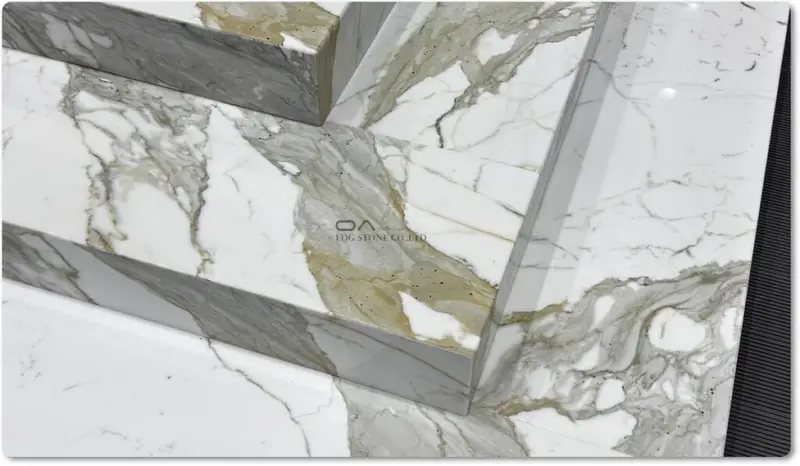
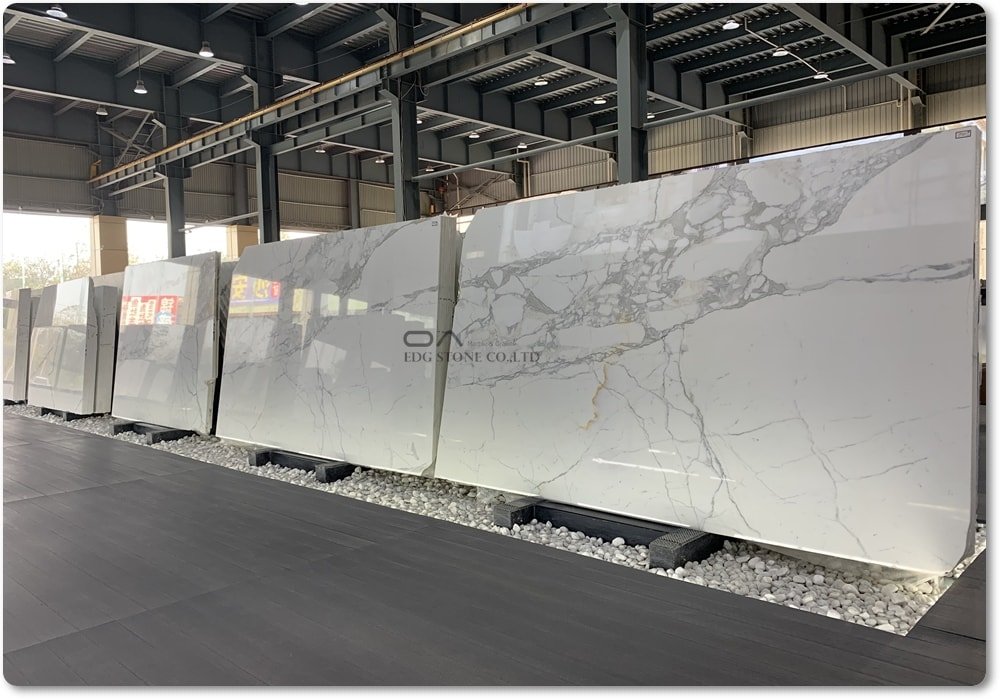
Calacatta is best understood as a commercial stone family, not a single fixed geological species. In the marketplace, it is generally described as an Italian white marble with grey and gold veining, usually positioned above ordinary Carrara in visual intensity and selection grade. Calacatta Gold is commonly described as a brighter white or creamy base with warm gold veining, while Calacatta Viola is described as a white or creamy base with burgundy, violet, and wine-toned movement. Those visual differences are not cosmetic footnotes; they are the core of the value proposition because buyers select Calacatta for statement surfaces, not just for utility.
USGS’s dimension-stone definition is useful here because it explains why some stones are commercial winners even before fabrication begins. Dimension stone is quarried to meet specifications for size and shape, but the market also cares about color, grain texture, pattern, surface finish, durability, strength, and the ability to take a polish. That means a Calacatta block with beautiful veining but poor recoverable yield can still be expensive, because the buyer is paying for visual quality plus the hidden cost of wasted material.
The design side matters as well. The Natural Stone Institute’s design manual is explicit that stone selection involves aesthetics, finish definitions, physical and mechanical properties, samples and mockups, and factors influencing cost. That is the correct framework for a procurement whitepaper because Calacatta is not bought purely by price; it is bought by specification, use case, and risk tolerance.
2) Global Price Benchmarks: Why Public Prices Look So Different?
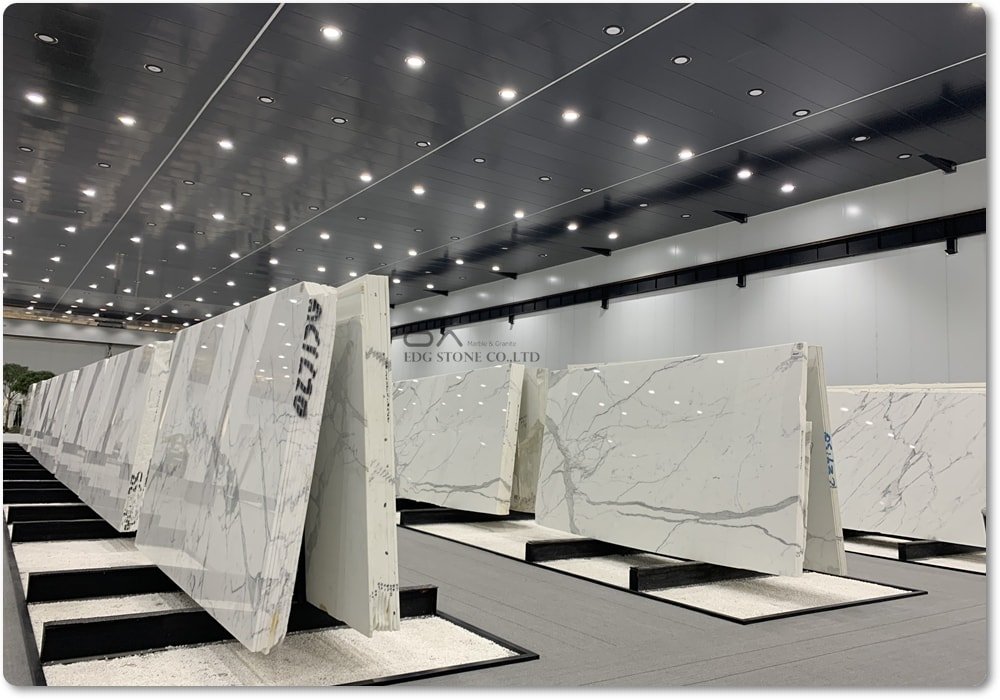
Public pricing for Calacatta is wide because the market quotes different things. Some sources quote stone only, some quote installed cost, and some quote a specific slab or inventory lot. For example, one 2026 retail guide says Calacatta marble stone alone averages about $300–$400 per square foot and notes that a single slab of Calacatta Gold can top $29,000. Another widely visible consumer guide says that installed Calacatta Gold can fall around $50–$180 per square foot, and that a good-quality slab may sit around $80–$100 per square foot. The difference is not a data error; it is the difference between premium retail quoting and broader installed-project quoting.
For slab-level comparison, market listings show that Calacatta Gold can sit in dramatically different lanes depending on source, thickness, and grading. One New Jersey listing from Artistic Tile shows Calacatta Gold at $425 per square foot and describes the stone as a quintessential Italian polished white marble with soft grey and gold veining. Another Canadian slab listing shows a 20 mm polished Calacatta Gold slab with stock-based pricing and quantity discounts, while other suppliers show inventory-only “log in to see price” pages, which is typical for premium stone because the seller wants to control lot selection and trade access.
Calacatta Viola behaves the same way, but with even sharper premiums when the market wants a strong personality. One pricing guide quotes Calacatta Viola at $120–$280 per square foot, with premium-quality slabs above $250 per square foot, while supplier pages describe it as a 20 mm polished slab with beige, bordeaux, cream, ivory, and violet tones, often bookmatched for strong visual symmetry. Live inventory listings also show that Viola slabs are actively traded as a premium, lot-specific material rather than a commodity item.
At the block level, pricing is even harder to standardize because the market buys recovery potential, not finished beauty. USGS notes that dimension stone value is variable by product type, and its selection criteria show why block pricing depends on the recoverable yield of aesthetically acceptable slab faces. In a Calacatta quarry, the same block can produce very different economics depending on veining direction, cracking, color uniformity, and how many exportable slabs can be recovered after sawing. That is why block price discussions are usually reserved for quarry-side buyers, not retail customers.
For countertop pricing, the question is usually not “what is the stone worth?” but “what is the installed surface worth in a project context?” The Sweeten guide and The Spruce both show that marble countertop cost depends heavily on stone type, labor, edges, and size, with marble generally priced lower than some luxury alternatives but still vulnerable to sharp increases when a rare grade is selected. The real lesson for Calacatta is that you should quote by project scope, not by generic countertop averages, because the same stone can move from boutique vanity work to high-end kitchen island territory with radically different yields and waste assumptions.
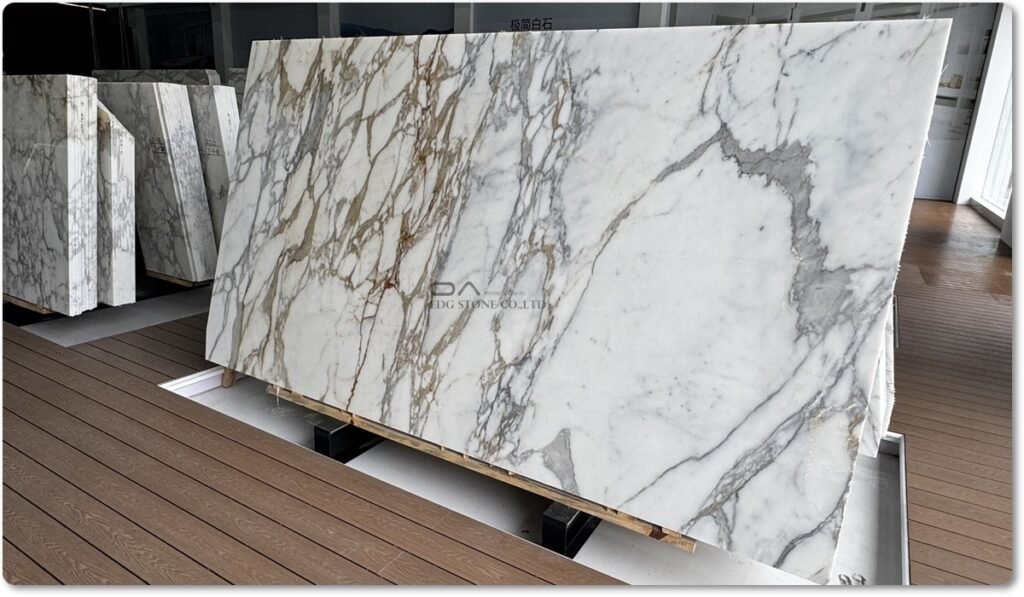
3) What Actually Drives Calacatta Marble Price?
Quarry location and origin risk
Origin matters because not every quarry produces the same visual output, and not every source can deliver the same consistency over time. The Carrara/Apuan Alps region is historically central to Italian marble supply, and public references repeatedly connect Calacatta-family marble to Italian quarrying and Carrara-area sourcing. That matters commercially because buyers are not just paying for the stone; they are paying for traceability, reputation, and the market’s perception of “true Italian” provenance.
Color quality
Color is one of the strongest price drivers in premium marble. USGS notes that color is a normal selection criterion for dimension stone, and Calacatta market descriptions make clear that the most desirable material tends to have a bright white or creamy base rather than a dull grey cast. In practical terms, cleaner backgrounds are harder to find in premium lots, so the price rises as background purity improves.
Veining intensity and character
Veining creates value when it is strong enough to read from a distance but controlled enough to stay elegant. Calacatta Gold is typically described as white marble with bold, warm gold veining, while Calacatta Viola is defined by burgundy-violet veining and high contrast. A slab with elegant, bookmatch-friendly flow will command more than a slab with chaotic, broken, or muddy veining because designers can use it as a focal surface without fighting the pattern.
Slab yield
Yield is one of the least visible but most important pricing variables. A quarry block with beautiful outer faces but fractured interiors produces fewer saleable slabs, and the market price has to absorb that loss. This is why two blocks from the same general source can end up with very different unit economics. USGS’s data sheet notes that rough stone still represents a large share of tonnage and value, which reinforces the point that the industry is always balancing raw block recovery against dressed-stone output.
Thickness
Thickness affects both material usage and fabrication flexibility. Many market listings for Calacatta Gold and Viola show 20 mm or 3 cm options, and thicker material generally means more quarry output, more freight weight, and more fabrication cost. Thicker slabs may also be preferred for luxury islands, waterfall edges, and commercial applications where the visual mass is part of the design.
Finish
Finish matters because polishing, honing, and other surface treatments alter both appearance and labor. USGS and the Natural Stone Institute both identify finish as a standard selection criterion, and supplier pages often separate honed and polished stock. Calacatta Gold is commonly offered in honed and polished variants, while Calacatta Viola listings likewise show polished inventory. The finish itself can change market demand, because polished surfaces accentuate color and veining, while honed surfaces soften reflections and sometimes better suit contemporary interiors.
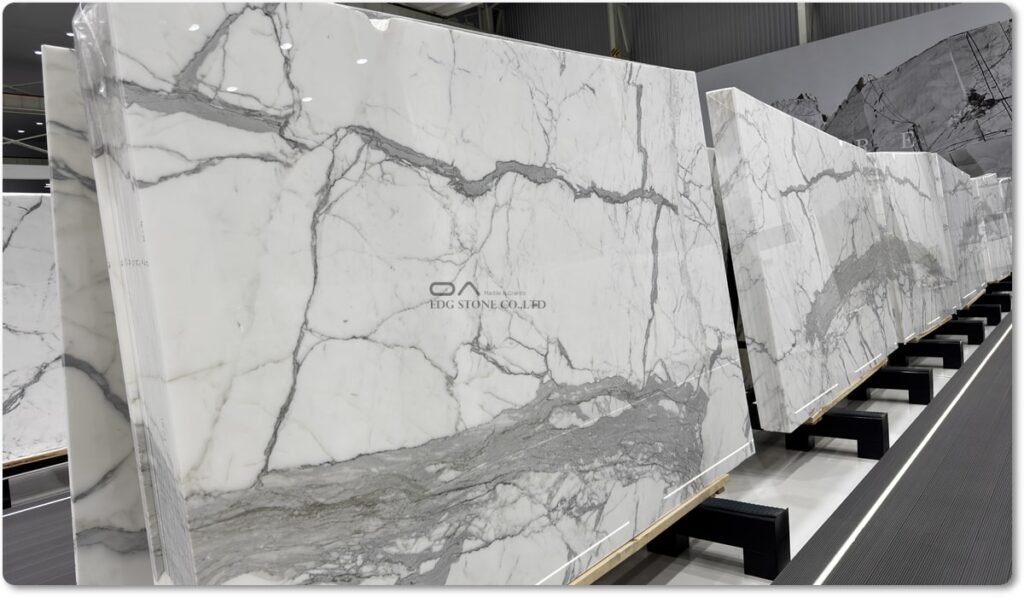
4) Why Calacatta Viola Commands a Premium?
Calacatta Viola is not merely “another Calacatta.” Its violet and burgundy veining make it a statement stone, and statement stones tend to be more sensitive to design cycles. Recent trend coverage shows Viola being highlighted in 2026 luxury kitchen and bathroom design as a bold, characterful material used for islands, splashbacks, and full-height cladding. When a stone becomes a design signal as well as a material, demand rises faster than supply can be normalized, and the price premium expands.
Scarcity compounds the effect. Viola is typically sourced and traded in smaller, lot-specific quantities than mass-market marble colors, and public supplier pages present it as a polished slab with high visual variation and bookmatching potential. That means two buying teams can ask for “Calacatta Viola” and receive materially different product pools unless they define background color, vein density, block range, thickness, and acceptable variation up front.
Demand is also more polarized. In neutral-luxury cycles, gold-veined stones often perform well because they bridge classic and warm modern interiors. But Viola benefits from social-media visibility, hospitality design, and high-end residential projects that want a memorable focal point. That makes its demand less elastic than ordinary white marble and helps explain why premium-grade Viola often trades at a visibly higher level than standard Calacatta variants.
5) Landed Cost Analysis: How the Real Price Is Built?
A good Calacatta procurement model begins with the simple fact that the invoice price is only one line in the budget. The landed cost stack usually includes material, export packing, inland haulage, ocean freight, insurance, customs classification, duties, destination handling, fabrication loss, installation waste, and project-side contingency. USGS’s tariff discussion confirms that dimension-stone tariffs vary by product form and preparation, while official tariff schedules show that marble can fall into different treatment buckets depending on whether it is crude, merely cut, or further worked.
Freight volatility matters because premium stone ships at a high value per container, and even small swings in ocean freight can change the project margin. Freightos’ FBX is a live benchmark for 40-foot container pricing and currently shows $2,857.20 per FEU on its index page. That number is not a quote for marble specifically, but it is a practical benchmark for understanding why shipping terms should be modeled, not guessed.
Insurance is usually a small percentage of the cargo value, but it becomes strategically important for Calacatta because breakage risk is real. Premium marble is brittle, lot-specific, and often selected slab-by-slab, so a single damaged crate can destroy more value than the insurance premium saved by underinsuring. Packaging, therefore,e should be treated as a cost center and a quality-control tool at the same time. Supplier listings that emphasize palletized stock, full pallets, and container availability are signaling exactly this reality.
Duties depend on the destination and the HS code. USGS says dimension-stone tariffs ranged from free to 6.5% ad valorem in 2025, depending on type, degree of preparation, shape, and size. The Canadian tariff schedule shows 2515.12.00 00 for merely cut marble/travertine blocks or slabs at free MFN treatment, while U.S. HTS search snippets show free treatment for 2515.12.10.00 marble in the correct subheading. For buyers, the lesson is simple: classification is part of sourcing strategy, not an afterthought.
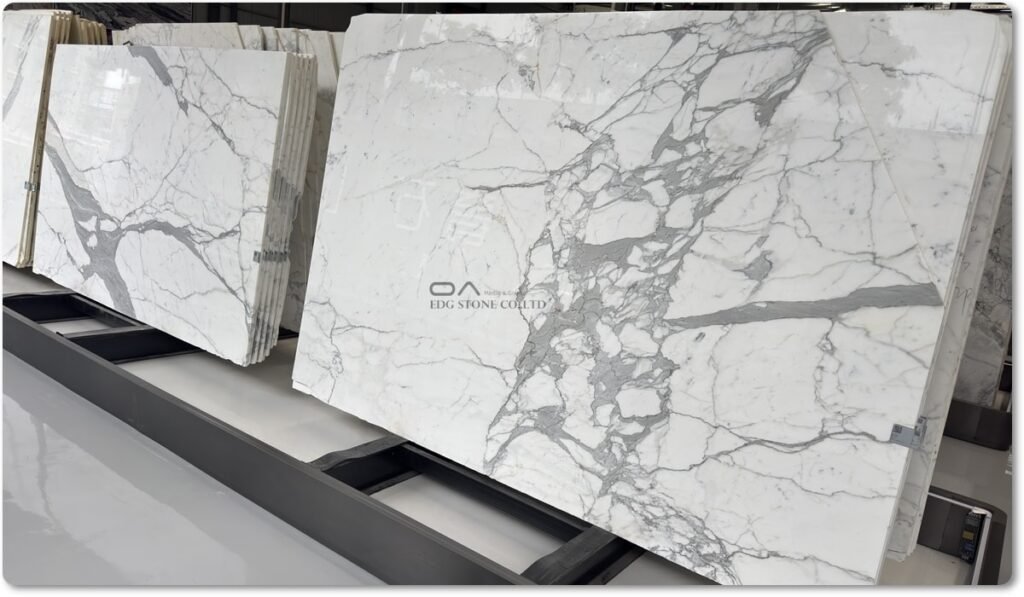
6) Procurement Economics: How Buyers Should Negotiate?
Annual contracts
Annual contracts work best when the buyer has a repeatable design language, stable project flow, or a distributor network. In premium marble, contracts reduce the volatility penalty because the seller can reserve matching lots, plan block recovery, and optimize production sequencing. That matters even more for Calacatta-family stones, where lot continuity is a major part of perceived quality.
Container programs
Container programs are ideal for importers who need predictable landed cost and manageable freight efficiency. Because freight is measured at the container level, slab geometry, crate design, and fill rate all affect the effective cost per square foot. A container program also reduces the hidden costs of fragmented ordering, repeated customs filings, and multiple small shipments. Freightos’ benchmark methodology underscores why container-rate thinking is the right way to manage this category.
Mixed orders
Mixed orders are powerful when the buyer wants to spread risk across Calacatta Gold, Calacatta Viola, and adjacent marble or quartzite families. Mixed containers can improve selection flexibility, but they require tighter documentation, clearer lot control, and more disciplined labeling so that the buyer does not receive mismatched quality levels in one shipment. The Natural Stone Institute’s stone-selection framework supports this approach because it emphasizes samples, mockups, finish definitions, and cost factors.
Negotiation discipline
The best negotiation strategy is not to squeeze the seller on the headline price alone. It is to negotiate yield, thickness tolerance, finish uniformity, packing standard, reserve rights on matching lots, and re-order protection. A stone that appears expensive on a per-square-foot quote can become cheaper in the real project if it produces fewer rejects, easier fabrication, and lower installation risk. That is the economics of premium stone.
7) EDG Stone Factory Cost Optimization Model
Case module: EDG Stone Factory as a global Quartzite Slabs & Countertops Manufacturer and Exporter
EDG Stone Factory’s procurement logic can be positioned as a factory-direct cost optimization model that is equally useful for quartzite and marble buyers. The value is not only in manufacturing; it is in upstream and downstream control: block or slab selection, sorting by visual grade, thickness control, fabrication precision, export packing, container consolidation, and documentation that supports smooth customs clearance. For a buyer, this is how a luxury stone becomes a manageable supply program rather than an unpredictable purchase. This module can be reused across marble, quartzite, granite, and other premium surfacing materials.
In practice, the EDG Stone model should emphasize five controls. First, visual grading before commitment, so Calacatta Gold and Calacatta Viola lots are approved by background color, vein intensity, and pattern flow. Second, yield planning, so the buyer knows how much saleable area comes out of each crate. Third, packaging engineering, so the breakage risk is reduced. Fourth, shipment planning, so annual contracts or mixed-container programs can lower freight waste. Fifth, project-side documentation, so the buyer can match the purchase order, packing list, photos, and final installation lot without confusion.
That model is especially important for Calacatta because premium marble is a specification business. USGS’s dimension-stone criteria and the Natural Stone Institute’s selection guidance both show that color, pattern, finish, durability, and physical properties drive the final choice. EDG Stone Factory should therefore be presented not just as a seller, but as a procurement partner that helps buyers convert a visually rich stone into a predictable landed-cost program.
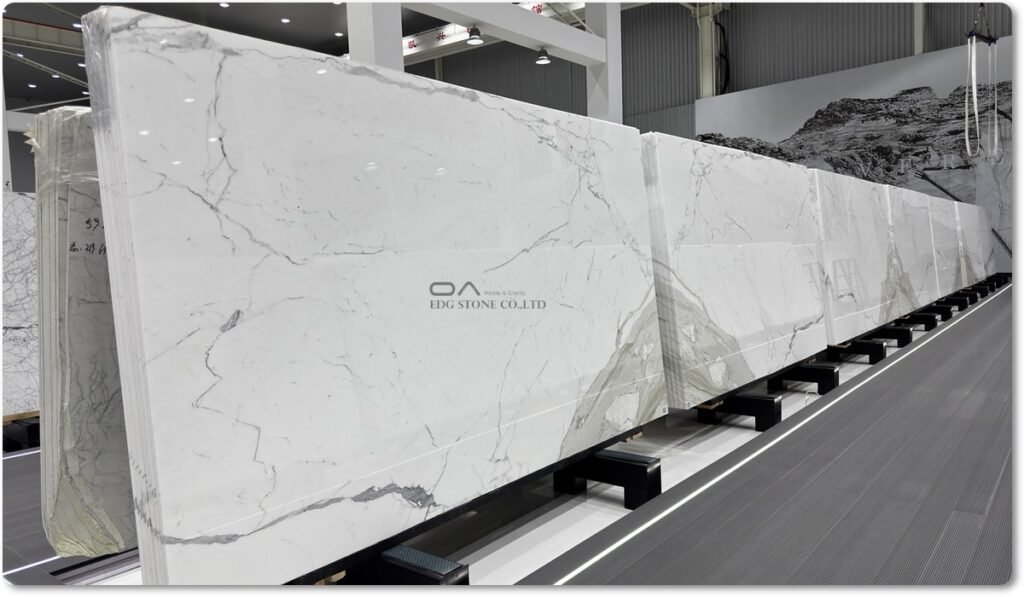
8) Where Calacatta Marble Performs Best?
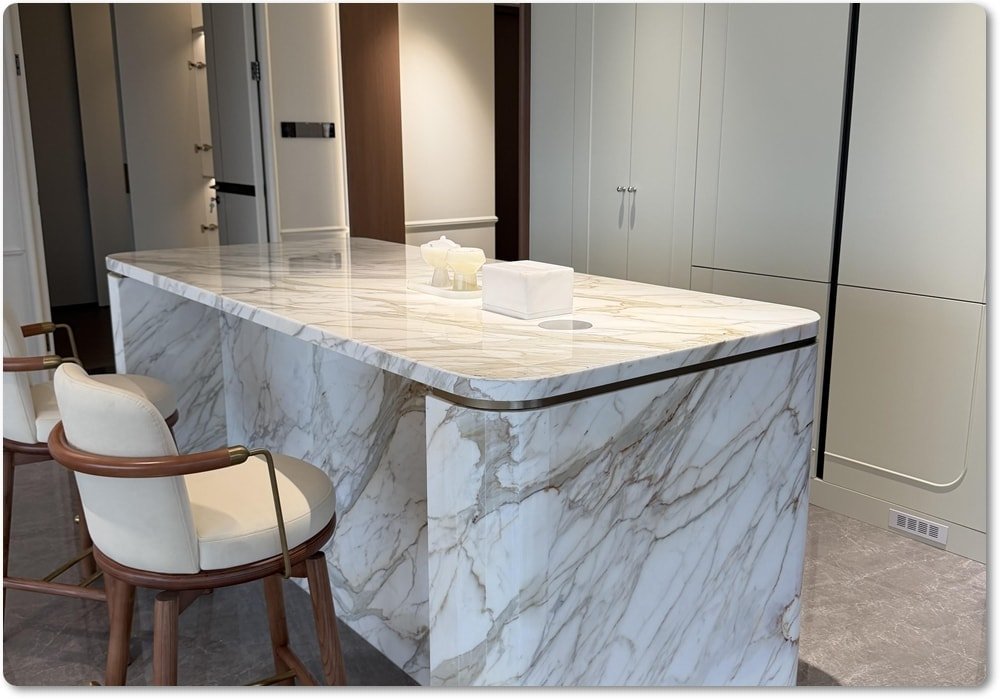
Calacatta marble performs best in spaces where the surface must do more than resist wear. It must signal taste. That is why it is commonly selected for kitchen islands, vanity tops, fireplace surrounds, reception counters, feature walls, and hotel-grade bathrooms. Supplier pages for Calacatta Gold and Calacatta Viola repeatedly frame these stones as suitable for countertops, floors, backsplashes, bathroom walls, and statement interiors.
For kitchens, Calacatta Gold works when the brief is “warm luxury”: white base, gold movement, and a classic but softer tone. For bathrooms, Viola is especially effective when the client wants a dramatic focal point that feels editorial rather than safe. For hospitality, both stones are strongest when the design team wants a memory-making surface with bookmatched symmetry and a premium tactile feel. Those applications align with current trend coverage, showing Calacatta and Viola being used as visual anchors rather than background materials.
Because marble is calcareous, maintenance planning matters. The Natural Stone Institute advises understanding the stone’s geological classification and notes that calcareous stone is sensitive to acidic solutions, so mild, non-acidic cleaners are recommended. It also recommends coasters, trivets, and regular dust mopping, which is exactly why Calacatta should be sold with a maintenance protocol, not only a sales quote.
References
- U.S. Geological Survey, Dimension Stone Statistics and Information. This source defines dimension stone selection criteria and frames the market around size, color, pattern, finish, durability, and polishability.
- U.S. Geological Survey, STONE (DIMENSION), Mineral Commodity Summaries 2026. This provides production, value, import reliance, tariff range, and market trend context for dimension stone.
- U.S. Geological Survey, Mineral Commodity Summaries landing page. This confirms the report’s role as the earliest official nonfuel mineral statistical publication.
- Natural Stone Institute, Dimension Stone Design Manual. This is the stone industry’s technical reference for selection, testing, installation, tolerances, and maintenance.
- Natural Stone Institute, Care & Maintenance of Natural Stone. This supports marble care guidance, especially for calcareous stone.
- Freightos, Freightos Baltic Index (FBX). This is the live global container freight benchmark used in the landed-cost section.
- Government of Canada, Customs Tariff Schedule, Chapter 25. This supports the free-treatment reference for 2515.12 in Canada.
- U.S. International Trade Commission HTS search result for 2515.12.10.00 Marble. This supports the classification discussion and duty-treatment variation.
- Sweeten, A Quick Guide on Calacatta Marble and Its Cost. This supports public price-range examples and the premium nature of Calacatta Gold.