What is Taj Mahal quartzite? (technical & aesthetic profile)
Origin, appearance, and finishes
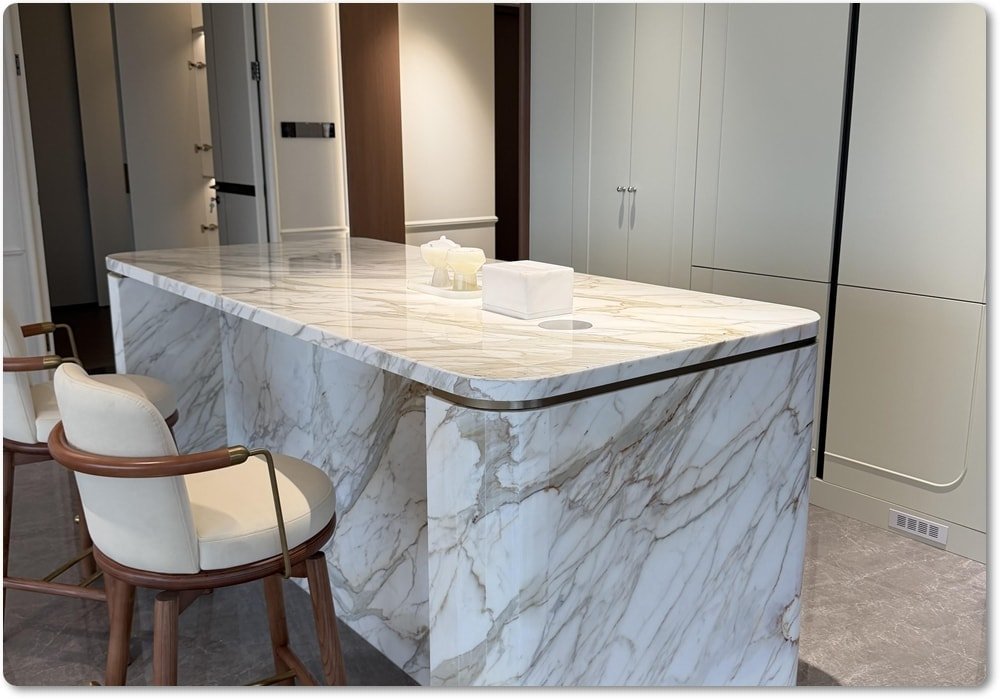
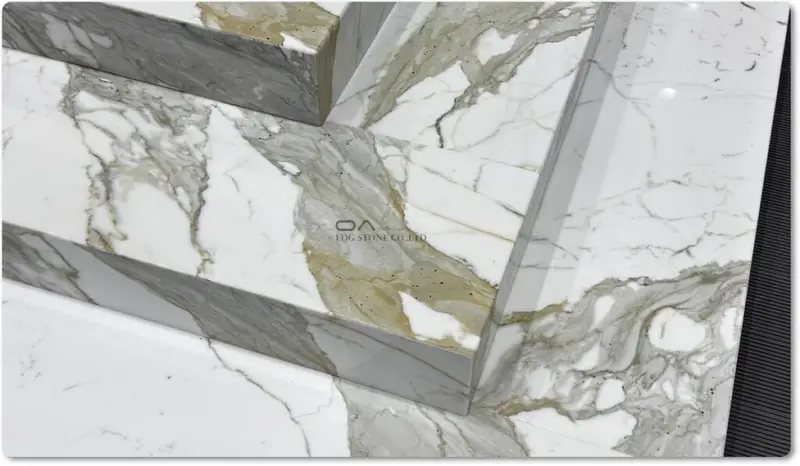
Taj Mahal quartzite is a natural quartzite slab widely distributed by stone importers and fabricators. Visually, it reads like a warm white/ivory marble with soft gold and gray veining. Typical finishes available from suppliers include polished (high gloss), honed (matte/satin), and textured/leathered surfaces; the choice of finish affects soot visibility and cleaning needs.
Key mechanical and thermal properties (practical takeaways)
Hardness & scratch resistance: True quartzite commonly rates around Mohs 7, delivering better scratch resistance than marble and many engineered surfaces — a useful property for high-use applications near hearths.
Thermal behavior & heat tolerance: Quartzite is a naturally silica-rich metamorphic stone that tolerates higher radiant heat than engineered quartz. It is suitable for fireplace surrounds when installed over non-combustible backing and following appliance clearances.
Porosity: Quartzite is generally less porous than some limestones but more porous than dense granites. Many fabricators recommend an impregnating sealer for light-colored slabs to reduce the risk of staining without altering the look.
Why specify Taj Mahal quartzite for fireplace surrounds?
Marble aesthetics with enhanced durability
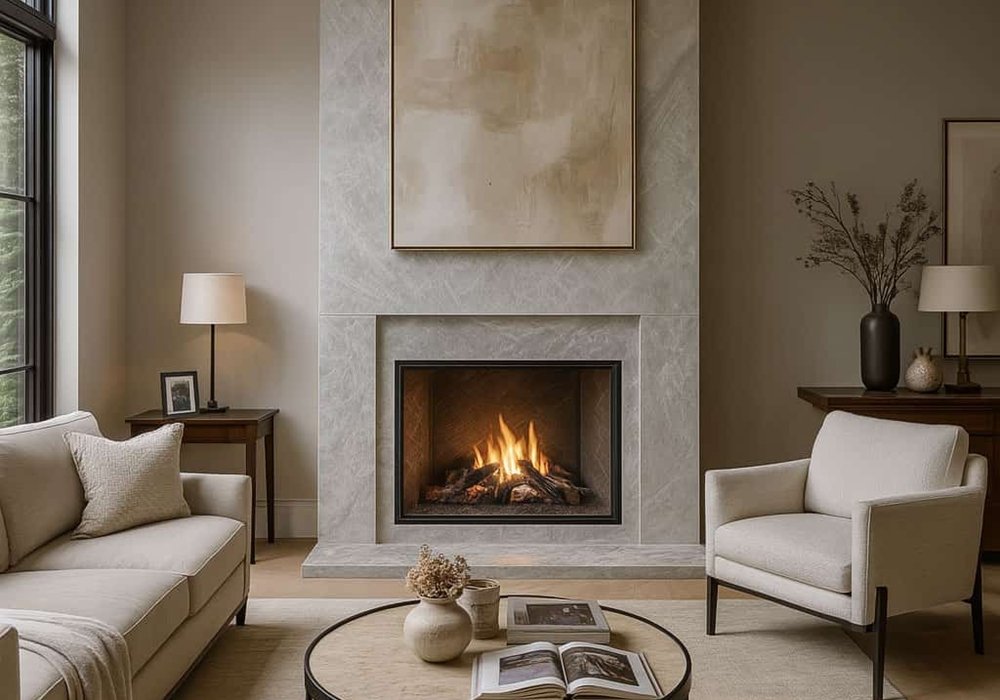
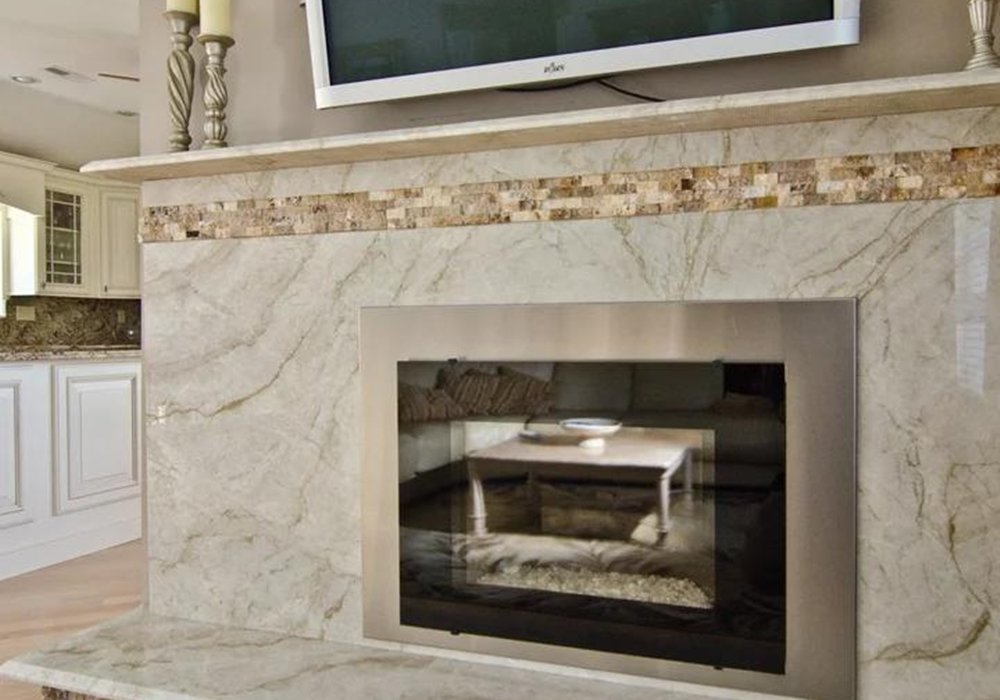
Designers often choose Taj Mahal quartzite for the “marble look” while avoiding the etching and softness of calcitic marbles. It provides elegant veining, warm tonal depth, and a premium feel while resisting routine wear and chipping better than many marbles.
Heat resistance and non-combustibility
Because quartzite is a true natural stone (not a resin blend), it’s classified as a non-combustible finish for architectural use; that makes it suitable for cladding areas immediately adjacent to a fireplace opening, provided the installation follows the hearth and appliance manufacturer’s clearances and code requirements.
Long-term value and lifecycle advantages
Quartzite’s robustness reduces long-term maintenance and replacement costs. For hospitality or high-use residential projects, a durable stone surround lowers lifecycle environmental impact by extending service life versus softer alternatives.
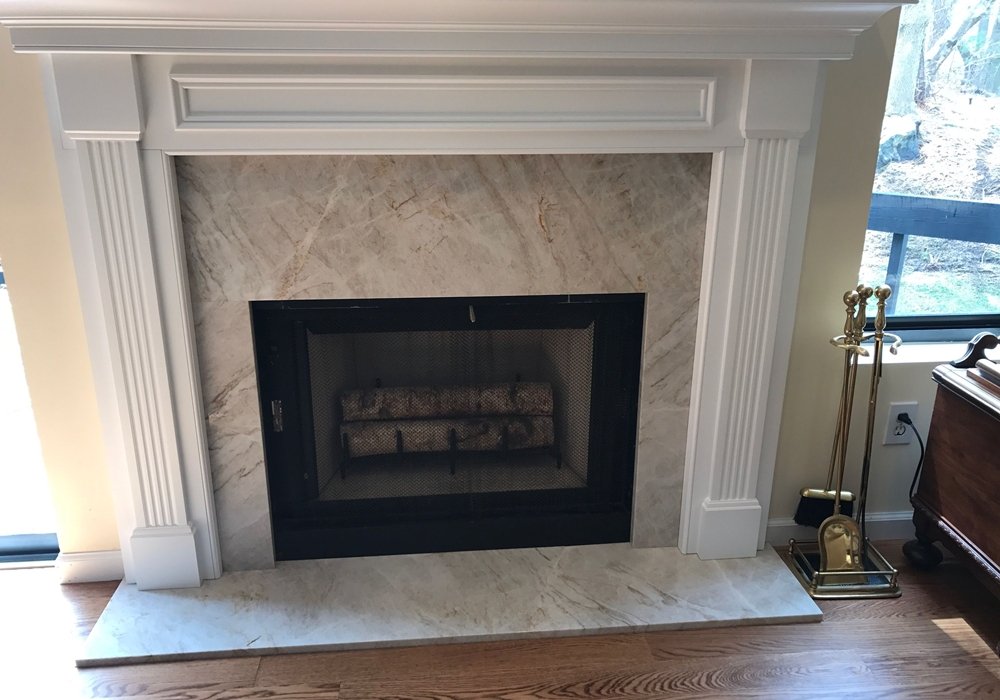
Codes & safety essentials: Rely on appliance listing, IRC, and NFPA
Designing a fireplace surround is not purely aesthetic — safety and code compliance are mandatory. Two core references used in most jurisdictions are the International Residential Code (IRC) and NFPA (National Fire Protection Association) guidance for fireplaces and chimneys. Key compliance points:
Hearth extension: The IRC specifies minimum hearth extension dimensions (for example, common minimums such as 20″ in front and 12″ beyond each side for larger openings) and typically requires that hearths be constructed of non-combustible masonry or concrete.
Clearances to combustibles: Many codes and appliance listings define minimum clearances from the firebox opening to combustible materials and specify how much combustible trim may project near the opening. When non-combustible materials are used for the immediate surround, certain clearances may be reduced — but always follow the appliance manufacturer’s listed clearances and the Authority Having Jurisdiction (AHJ).
Appliance type matters: Gas, electric, and wood-burning units have different tested clearances and hearth requirements. Wood-burning appliances generally require the most conservative dimensions due to higher radiant heat and embers.
Design action: include the fireplace appliance model and manufacturer installation instructions in your submittal and document slab lot numbers and finish — this simplifies permit review and ensures inspectors have the correct data.
Design & detailing best practices for Taj Mahal surrounds
Slab selection and finish considerations
Finish choice: Polished for a luminous statement; honed for low glare and subtlety; leathered (textured) for tactile character — keep in mind textured finishes can trap soot more than polished/honed surfaces.
Book-matching: For feature walls or wide surrounds, visually continuous veining via book-matching produces a high-impact look; request matched slabs early in procurement.
Thickness, backing, and support strategy
Common thicknesses: 2 cm (¾”) and 3 cm (1¼”) are standard. For vertical cladding, 3 cm provides structural simplicity; 2 cm panels require continuous non-combustible backer (cement board, calcium silicate) plus mechanical anchors.
Backing & substrate: Use non-combustible sheathing and proper mechanical anchorage; do not rely solely on thin adhesives where mechanical loads exist.
Movement joints & anchorage
Provide narrow movement joints and flexible high-temperature sealants where stone meets non-stone materials. Stainless mechanical anchors or stone clips combined with rated adhesives minimize stress and prevent cracking.
Mantel & trim integration
If a combustible wooden mantel is desired, follow the listed clearance rules: either place the mantel outside the minimum combustible clearance zone, or provide tested protection methods; alternatively, use a non-combustible stone or metal mantel to eliminate clearance issues.
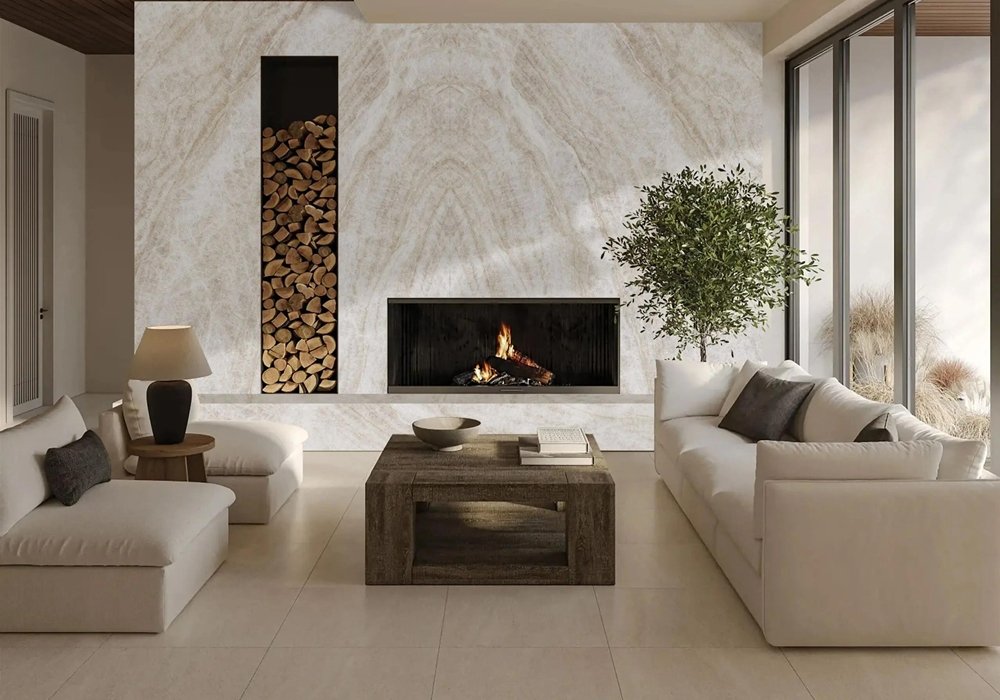
Fabrication, finishes & installation workflow
Fabrication checklist (what to ask your fabricator?)
Confirm slab lot numbers, vein continuity, and any resin stabilization applied during polishing.
Laser/CAD templates for exact cutouts (appliance face, gas log cutouts, surround reveals).
CNC routing for precise edge profiles and mitered corners.
Use of heat-rated adhesives and mechanical anchorsis appropriate to a fireplace environment.
Edge profiles & aesthetics
Eased edges, bevels, mitered waterfall edges, and bullnose profiles are all viable. Mitered corners yield seamless waterfall effects but require tight fabrication tolerances.
Adhesives, mastics & high-temp mortars
Specify adhesives and mastics rated for elevated temperatures near fireplaces. Where local codes require tested systems, follow manufacturer instructions and limit in-field substitutions.
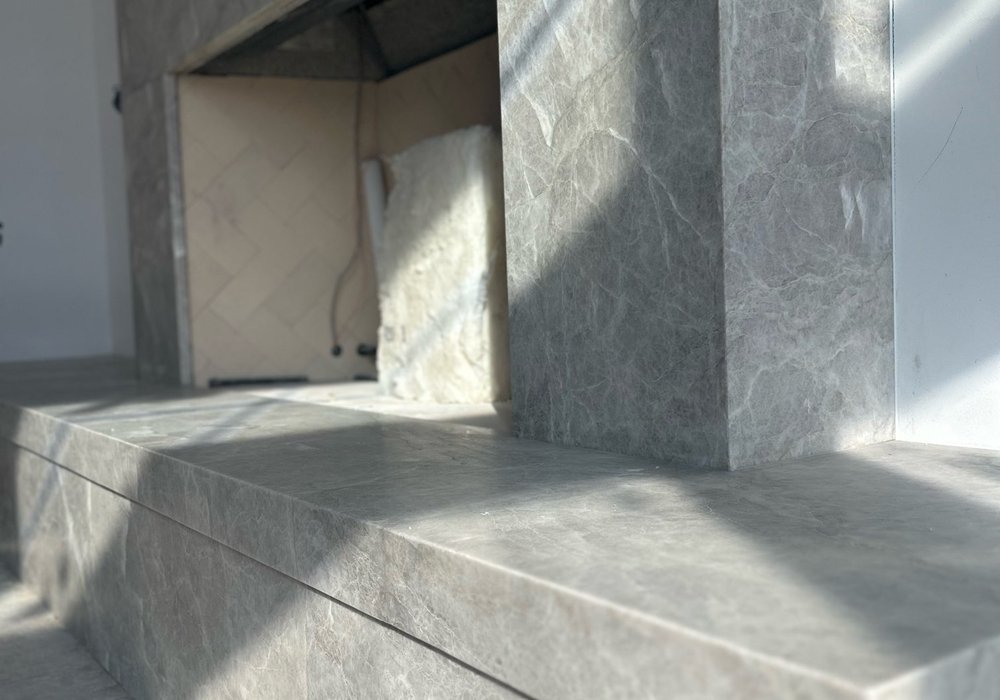
Installation checklist & practical cost guidance
Pre-installation steps
Verify appliance location and manufacturer clearances.
Order matched slabs and confirm lot numbers and finish samples.
Produce a CAD/laser template and mock-fit critical junctions.
Confirm substrate, anchorage plan, and permitted sealant products.
On-site installation sequence
Prepare the non-combustible substrate and anchorage system.
Dry-fit panels, then apply adhesive/anchorage, set stone, and allow manufacturer-recommended cure times.
Fill joints with non-staining flexible sealant or grout as specified.
Clean and protect finished surfaces before handover.
Cost factors and lead time considerations
Costs vary by slab rarity, finish, book-matching complexity, and required fabrication precision. Purchasing directly from a manufacturer or wholesale supplier can control slab unit cost; fabrication complexity and local labor rates primarily influence installation expenses. For feature surrounds with book-matching and integrated hearths, expect a premium due to extra slab consumption and higher fabrication tolerance.
Maintenance, sealing & repair
Routine cleaning
Daily care: dust with a soft cloth and vacuum crevices. For soot, use a mild, pH-neutral stone cleaner and soft microfiber — avoid acidic or abrasive cleaners that dull or etch stone surfaces.
Sealing recommendations
An impregnating (penetrating) sealer is commonly recommended for light-colored quartzite to reduce staining without changing the visual appearance. Initial sealing may be performed at fabrication, and reapplication intervals depend on exposure; many fabricators recommend inspecting annually and re-sealing every 1–3 years as needed.
Repair strategies
Chips and minor cracks can be repaired with color-matched resin fills and professional restoration. Planning for accessible seams and mechanical anchors makes future repairs simpler and less costly.
Sustainability, trends & procurement strategy (manufacturer/factory/wholesale)
Durability as a sustainability advantage
Using a long-life material like quartzite reduces embodied energy per year of service compared with short-lived alternatives. For specifiers focused on lifecycle impacts, durable natural stone can support sustainable building goals.
Market & procurement trends
Large projects (hotels, multi-family, hospitality) increasingly seek factory documentation, lot traceability, and “manufacturer/factory / wholesale” supply chains to ensure consistent aesthetics across many slabs. Include material origin, finish certificate, and thermal suitability in procurement specs.
Documentation to request from suppliers
Ask for: slab lot number, finish type, thickness, whether any resin stabilization was applied, sealing recommendations, and a written statement of recommended uses that explicitly mentions fireplace surrounds where applicable.
FAQ (Google-hot questions answered)
Q1 — Is Taj Mahal quartzite safe to use around a fireplace?
Yes. As a natural quartzite, Taj Mahal is a non-combustible stone with high heat tolerance and is commonly used for fireplace surrounds. Safety depends on installation: the stone must be installed over an appropriate non-combustible backing, with appliance clearances and installation details matching the fireplace manufacturer’s listing and local code requirements.
Q2 — Do fireplace surrounds have to be non-combustible?
The immediate hearth and the area directly adjacent to the firebox are typically required to be non-combustible or to meet tested protection measures as defined by codes such as the IRC and NFPA. Combustible mantels and trim are permitted only when they comply with specified clearance rules; always reference the appliance listing and AHJ guidance.
Q3 — Can Taj Mahal quartzite be used with gas, electric, and wood fireplaces?
Yes — but verify the appliance type. Gas and electric units often have smaller clearance demands than wood stoves; wood-burning fireplaces produce higher radiant heat and ember exposure and usually require more conservative clearances and hearth extensions. Document the appliance model and follow the manufacturer’s installation manual.
Q4 — How should I maintain and clean a Taj Mahal quartzite surround?
Clean with a mild, pH-neutral stone cleaner and soft microfiber cloths. Avoid acidic or abrasive detergents. For light-colored quartzite, consider applying an impregnating sealer after installation and inspect annually; the typical reseal interval is 1–3 years, depending on use and exposure.
Q5 — Where can I buy Taj Mahal quartzite slabs at factory or wholesale prices?
For best pricing and consistent lot quality on large projects, contact slab manufacturers, direct factories, or wholesale distributors that list Taj Mahal quartzite in their product lines. Request lot numbers, finish certificates, and documentation about any resin stabilization and recommended applications (including fireplace suitability).
Semantic closure: How / Why / What / Option / Consideration — Taj Mahal quartzite firewall summary
How: Specify Taj Mahal quartzite slabs (2 cm or 3 cm) mounted over a continuous non-combustible substrate (cement board, masonry), anchored with stainless mechanical clips, and set with high-temperature adhesives or thinset. Use CAD/laser templates for cutouts and book-matching if required.
Why: It combines high Mohs hardness and thermal resistance with marble-like aesthetics, lowering long-term maintenance and replacement cycles while delivering a premium visual focal point.
What this means for specification: Include slab lot numbers, finish type, any resin or stabilizer treatments, and the fireplace appliance’s make/model in the submittal package to your AHJ. For multi-unit projects, specify manufacturer/factory supply and lot consistency clauses.
Options: Polished for dramatic effect; honed for matte elegance; leathered for tactile depth (tradeoff: slightly higher soot capture). Choose 3 cm for simpler vertical assemblies or 2 cm with a robust mechanical anchorage for a thinner modern aesthetic.
Considerations: Always follow appliance clearances and local code, select adhesives and sealants rated for thermal exposure, and contract a fabricator with proven fireplace installation experience. Document everything for inspectors, insurers, and facility managers.
References (author, article/title, source — no links)
International Code Council — Chapter 10: Chimneys and Fireplaces, International Residential Code (IRC) (code publication).
NFPA — NFPA 211: Standard for Chimneys, Fireplaces, Vents, and Solid Fuel-Burning Appliances (standard/guidance document).
Tenax — Sealing Quartzite: Technical guidance and best practices (technical article).
Fine Homebuilding — Code Requirements for Fireplace Clearances (industry article on hearth extension and clearances).
Rumford Fireplaces — Clearances & Mantel Guidelines (industry guidance/reference).