Why a Waterfall Edge? Design theory & impact
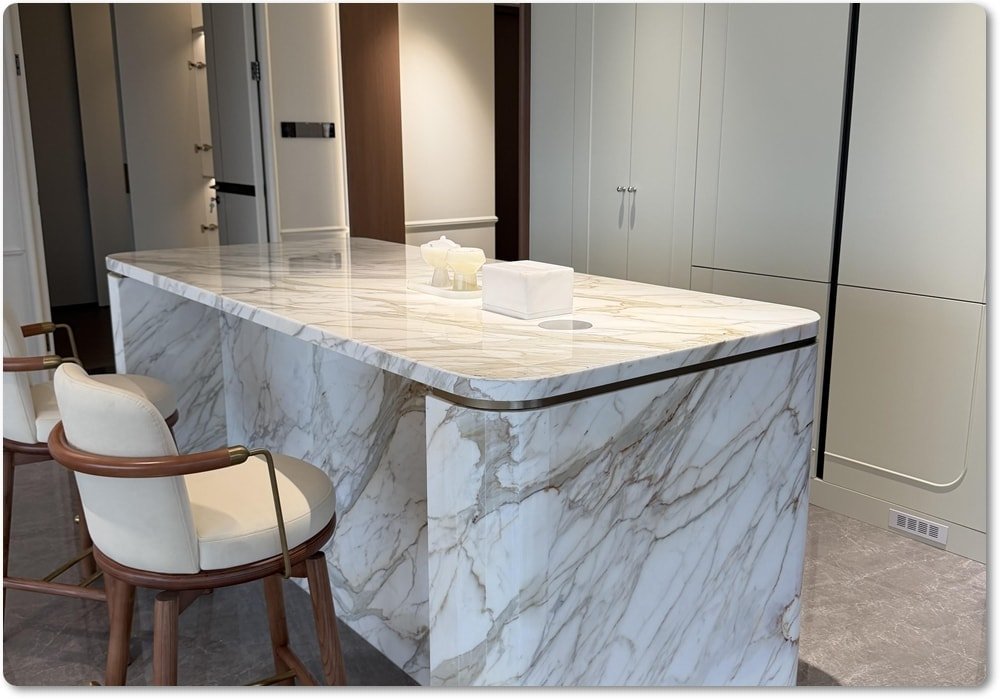
A waterfall edge turns a horizontal surface into vertical architecture. Instead of the countertop merely sitting on cabinetry, a waterfall island reads as a sculptural monolith that visually grounds open-plan kitchens, unifies flooring and cabinetry palettes, and emphasizes materiality in a way that furniture or cabinetry alone cannot.
The architectural gesture
Waterfall islands provide continuous vertical planes that are read from multiple angles. This continuity creates a strong focal axis in spaces where the kitchen is visible from living areas—it frames the room and provides an instant sense of luxury and permanence.
Visual psychology and scale
Large, continuous stone faces increase perceived scale—making islands feel heavier and more intentional. When the material is Taj Mahal quartzite—with its warm cream field and gold/gray veining—the waterfall becomes a warm, layered backdrop for metals and wood.
When to choose a waterfall?
Opt for a waterfall when the island is central to sightlines, when you want to showcase a clean vertical surface (no toe-kick interruptions), or when the island will act as an entertainment or hospitality staging area. Waterfalls work best where the stone pattern is compelling at scale, and the homeowner or client values a strong design signature.
Why Taj Mahal Quartzite for Waterfall Islands?
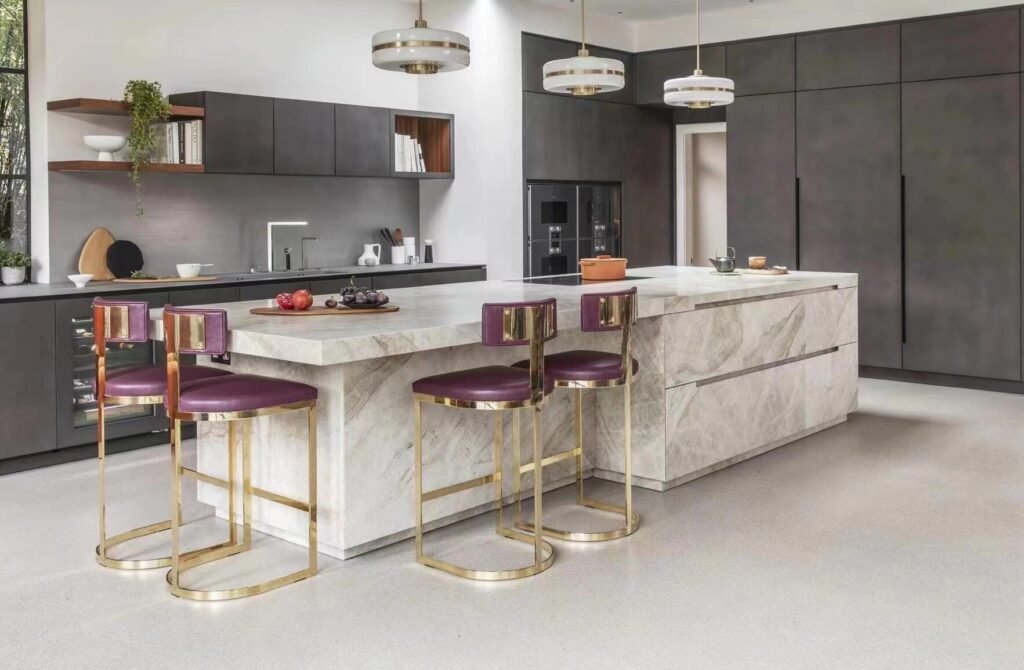
Taj Mahal quartzite brings the right mix of visual nuance and technical durability to waterfall islands.
Visual qualities
Warm, sandy base tones with linear gold-to-gray veins create natural movement that reads beautifully in large vertical runs.
The stone’s relatively calm but defined patterning reduces visual “noise” while delivering an elegant, continuous canvas for pendant lights and brass accents.
Technical qualities
Quartzite is a metamorphosed sandstone; it’s harder and more heat- and scratch-resistant than many marbles and some granites, making it well-suited for heavily used islands.
For a waterfall, stability and slab size are critical—quartzite slabs of sufficient length (and minimal fissures) allow for mitered waterfalls and uninterrupted runs.
Finish choices for waterfall edges
Honed Taj Mahal: satin, muted reflection, reduces glare and fingerprint appearance—excellent for tactile, contemporary settings.
Leathered Taj Mahal: textured finish that adds depth and hides light scratches while preserving veining contrast—ideal for hospitality or high-touch islands.
Polished Taj Mahal: highest reflectivity, deepest color contrast—dramatic, but may show fingerprints and light abrasion on horizontal planes.
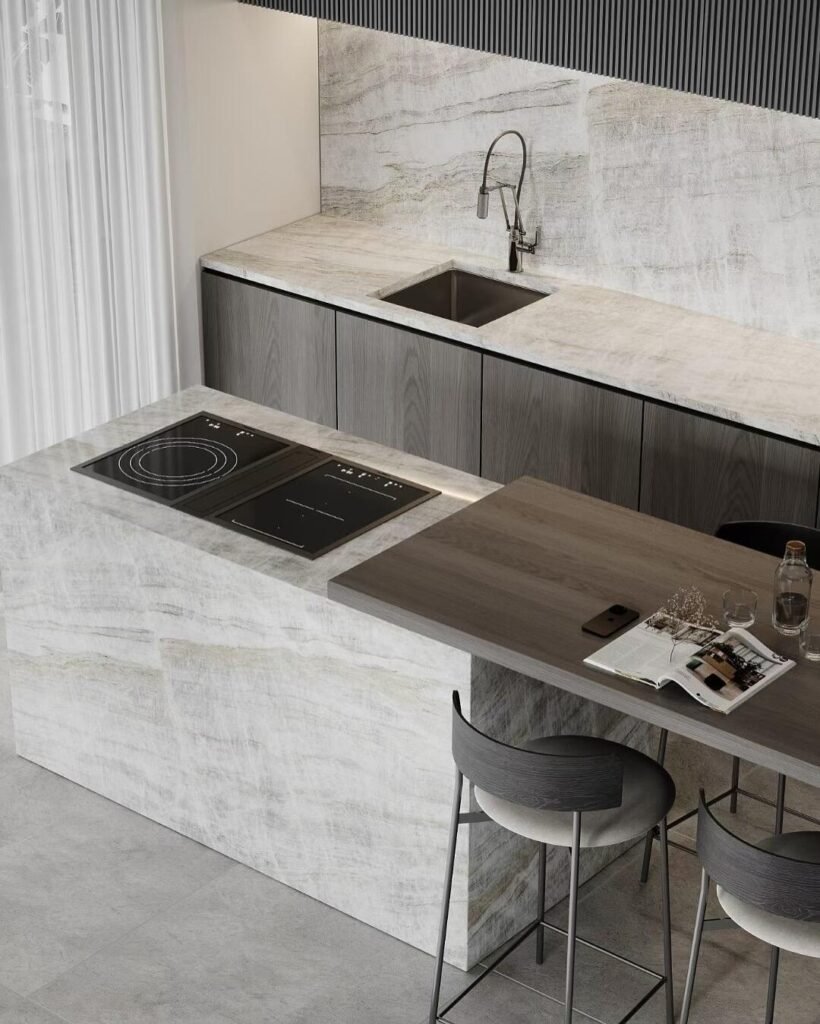
Design Variations & Layout Strategies for Waterfall Islands
Centered hero vein vs offset composition
Centered hero vein: the main vein or motif runs down the center of the island face, creating perfect symmetry and often pairing well with pendant lighting centered over the cook/serving area.
Offset composition: places the strongest veining to one side for a dynamic, directional flow—this can be useful when accommodating sinks, cooktops, or seating.
Mitered waterfall vs butt-joint waterfall
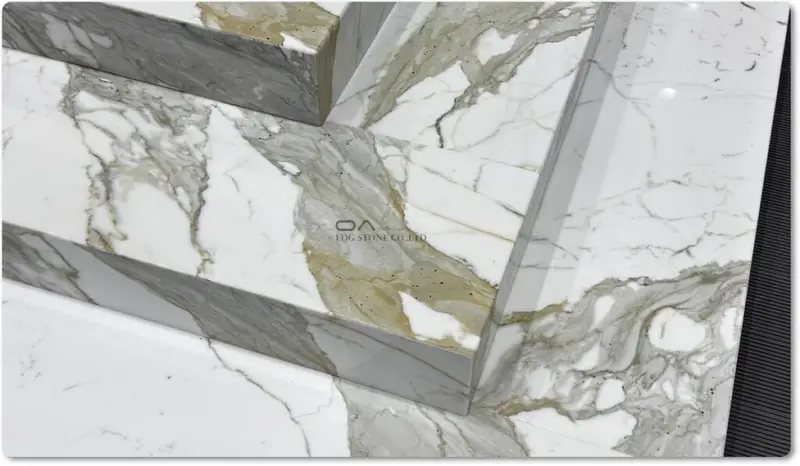
Mitered waterfall: two slabs are mitered at a 45° internal joint to present the visual of a thicker slab with a seamless edge. This is elegant but technically demanding—it requires exact angle cutting and near-perfect seams.
Butt-joint waterfall: the waterfall face is a single piece (or pieces), but the top and vertical faces meet in a flat seam—less expensive, but the seam is more visible. Mitering usually reads as a thicker edge and hides the seam better when done perfectly.
Integrating sinks, appliances, and seating
Plan cutouts and dropped sinks to avoid bisecting major veins. Maintain panel continuity from upper top to waterfall face wherever possible, and reserve cutouts on secondary panels if necessary. For seating overhangs, ensure structural reinforcements (steel brackets, substrate) preserve the waterfall’s visual line without sagging.
Slab Selection, Bookmatching & Sequencing for Waterfall Effects
Reading slabs for vein flow
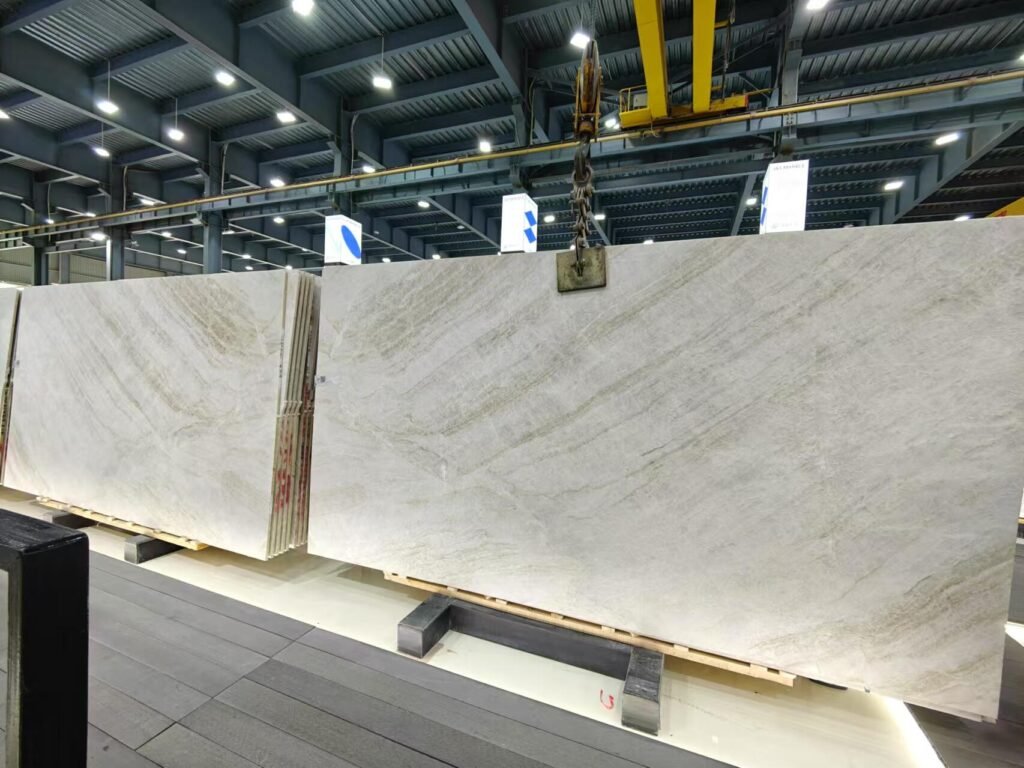
Selecting the right slabs is where design intent meets practical reality. For a waterfall, choose slabs where the vein flow aligns cleanly from the top face to the vertical face. When bookmatching is desired (mirror effect), slabs must be cut sequentially and opened like a book, so veins mirror across the joint.
Minimum slab sizes & yield planning
Large waterfall faces require long, defect-free slabs. Low-yield or heavily veined slabs can increase waste. It’s common to buy an extra slab or two for bookmatched waterfall projects to ensure optimal layout options; this increases material cost but reduces the risk of awkward seams.
Documentation for remote/wholesale purchases
When buying factory or wholesale slabs remotely, require: high-resolution photos of both slab faces, thickness confirmation, measured vein lines, and orientation sketches. For bookmatched waterfall runs, request paired-slab panoramas so the matched effect can be pre-approved.
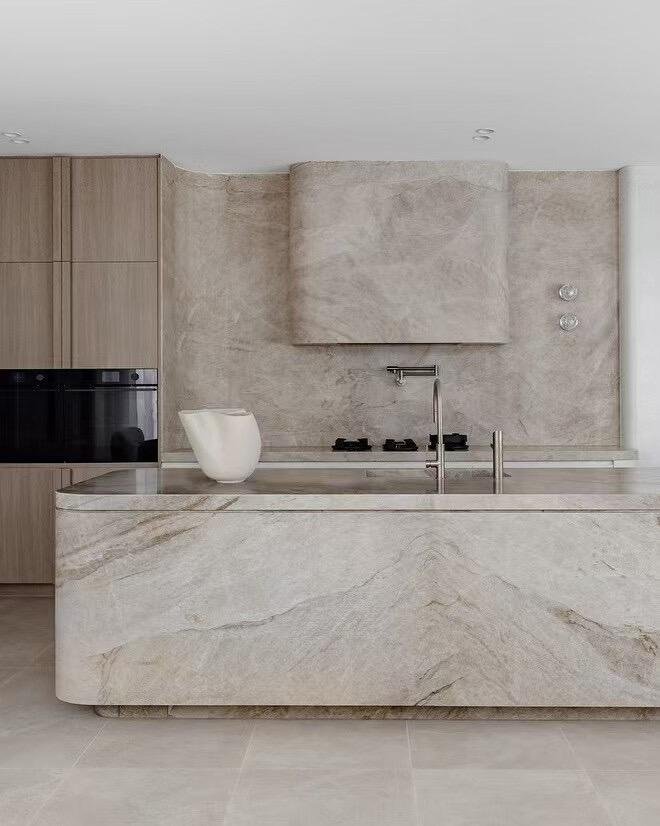
Fabrication & Edge Profiles: Getting the Waterfall Right
Cutting, mitering, and seam strategy
Precision is paramount. Mitered waterfalls call for perfectly square cuts and matched angles; seams must be sanded and filled with close-color epoxy. Micro-tolerances matter—small gaps catch light and break the seamless illusion.
For heavy waterfall faces, mechanical reinforcement (hidden brackets or steel spine) often supports the cantilever and protects the seam from stress.
Adhesives and reinforcement
High-strength epoxies and resins, combined with hidden stainless or carbon-steel reinforcement, are standard on mitered waterfalls. For long overhangs or integrated seating, reinforcement into the cabinetry carcass or a concealed steel frame is advised.
Edge profile choices
Eased/Simple square: contemporary, minimal; shows seam lines less if mitered correctly.
Beveled or rounded: softens the visual weight and can hide minor seam inconsistencies.
Thick-edge illusion (mitered): a mitered edge can create a perceived full-thickness slab when the top and vertical faces are matched; visually desirable but fabrication-intensive.
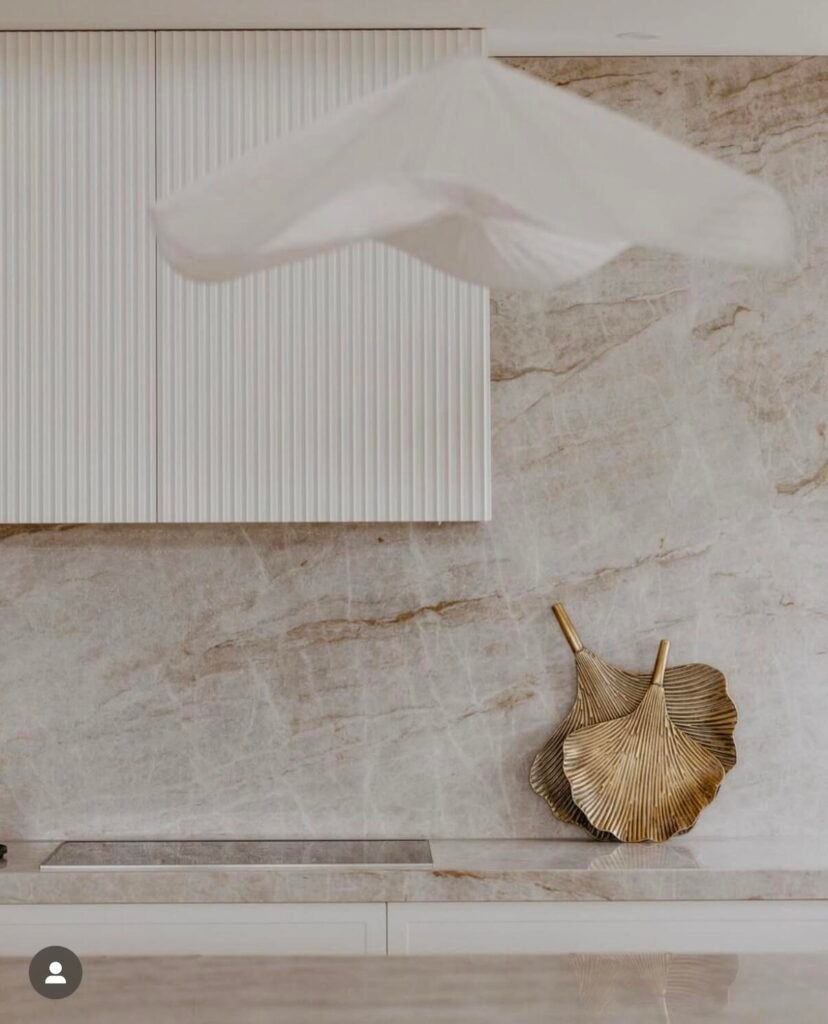
Installation Best Practices & On-site Considerations
Templating and dry-fitting
Always dry-fit pieces at the site before adhesive application. Confirm seam alignment, miter accuracy, and stone orientation with the client. Photograph and log the final layout for warranty and future maintenance records.
Transport and protection
Stone slabs are heavy and brittle in their dimensions—pack with edge protectors, and use A-frame transportation. For long shipments from manufacturers or factories, secure the slabs vertically and cushion between slabs to avoid chipping.
Installing mitered waterfalls
Use jigs and clamps to hold mitered faces in alignment while the adhesive cures. Reinforce from within cabinetry where possible, and ensure that any substrate or mechanical support is non-compressible. After cure, seams should be sanded flush and finished to the agreed surface (honed, leathered, polished).
Maintenance, Care & Longevity (Honed/Leathered-specific tips)
Daily cleaning and sealing
Use pH-neutral cleaners and soft microfiber cloths. Avoid acidic cleaners that can etch some stone species. Penetrating sealers are recommended, especially on honed and leathered finishes; sealing frequency depends on use, but many installers recommend checking annually.
How do honed and leathered surfaces age?
Honed surfaces develop a soft patina and may show oil absorption more readily than polished surfaces—this can become part of the stone’s lived-in character. Leathered finishes camouflage light scratches and fingerprints while emphasizing texture.
Repair strategies
Small chips and seam issues can often be repaired with color-matched epoxy. For wear or more serious damage, a professional stone restorer can re-hone or re-texture a damaged area to blend with the surrounding finish.
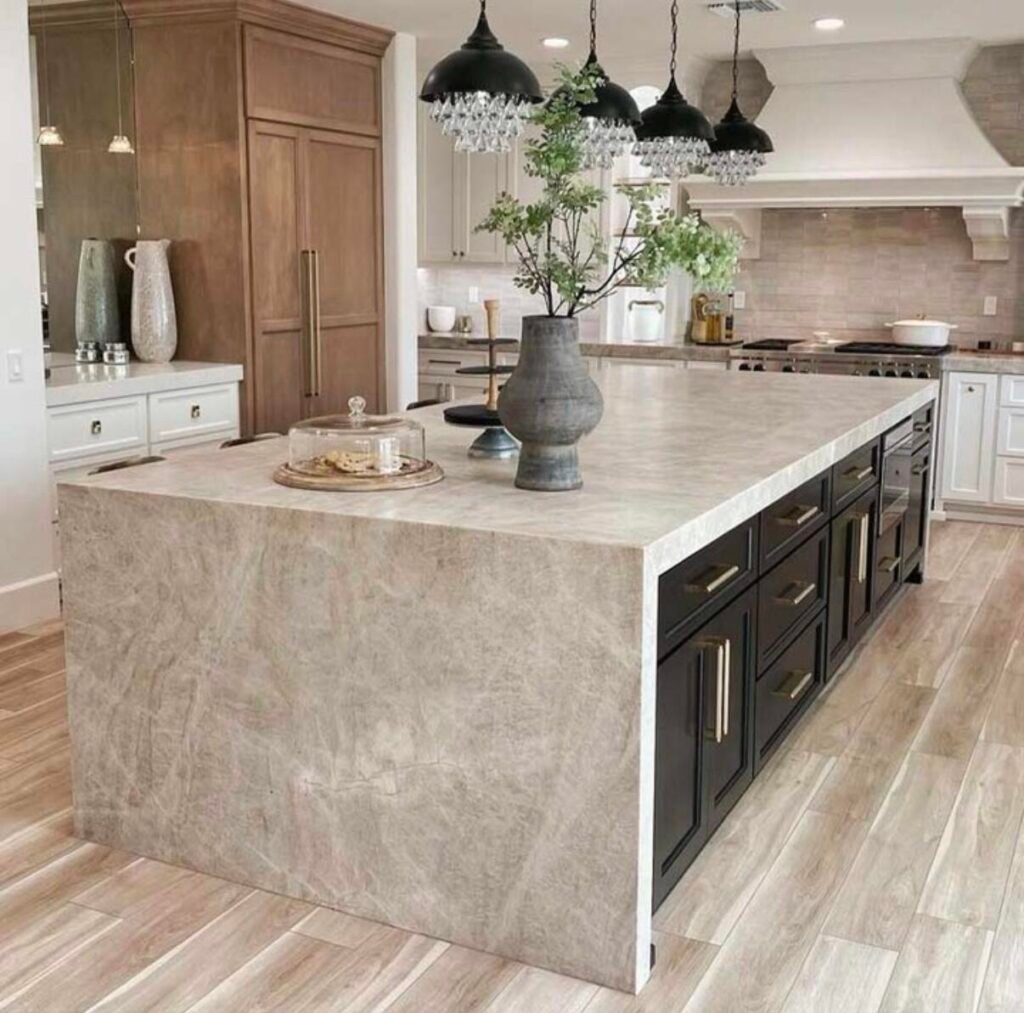
Cost Drivers & Sourcing Options (Manufacturer / Factory / Wholesale)
Typical cost drivers
Material: slab quality, thickness, and rarity (Taj Mahal with strong vein definition commands a premium).
Bookmatching/waterfall premium: increased slab usage and precision labor.
Fabrication complexity: mitered edges, cutouts, reinforcement, and edge profiles.
Shipping & handling: long slab shipments from factories add logistics cost.
Installation: experienced installers charge premium rates for precision waterfall installs.
Price ranges & market signals
Market pricing varies widely by region and slab grade, but contemporary indicators show Taj Mahal quartzite installed prices frequently range from approximately $60 to $200+ per square foot, depending on slab grade, finish, and regional labor rates. Premium bookmatching and waterfall fabrication can push the upper end of project budgets. (See references for representative pricing guides.)
Sourcing routes
Local fabricator: lower logistical risk, in-person slab selection, easier warranty, and coordination.
Factory/Manufacturer direct: potential slab cost savings, better access to slab inventory, and paired bookmatch sets—but requires robust QC and shipping arrangements.
Wholesale: bulk or repeat buyers may access slab lots at lower per-slab prices; good for developers or multi-unit projects.
Regulatory & Sustainability Landscape (Safety, Silica & EPDs)
Worker safety & respirable crystalline silica
Cutting and polishing stone generates respirable crystalline silica. Regulatory bodies have set limits and required controls: in U.S. regulation, permissible exposure limits for respirable crystalline silica are enforced, with an OSHA PEL at 50 micrograms per cubic meter (µg/m³) as an 8-hour time-weighted average. NIOSH recommends a REL of 0.05 mg/m³ (50 µg/m³) for respirable crystalline silica. These requirements drive fabricator investments in wet cutting, local exhaust ventilation, HEPA vacuums, and respiratory protection programs.
Sustainability transparency: EPDs and reporting
Natural stone industry groups and certifying bodies now publish Environmental Product Declarations (EPDs) to quantify lifecycle impacts. Buyers and specifiers increasingly request EPDs and chain-of-custody documentation when selecting materials for projects that target green-building certifications or corporate sustainability goals. Suppliers that provide EPDs and health/product declarations often win commercial and institutional projects.
Practical implications for buyers
Demand EPDs or product transparency statements from manufacturers and ask fabricators about silica control measures. These verifications increase project certainty and can be decisive for commercial contracts.
Visual Inspiration & Case Studies
Residential modern island (case example)
A modern open-plan residence used a bookmatched, honed Taj Mahal slab for a 10-foot waterfall island. The design centered the primary vein and positioned pendant lighting to emphasize vein symmetry. A mitered waterfall was chosen to present a thick-edge appearance, with concealed steel reinforcement behind the waterfall face. The result: the island read as a sculptural bench-like mass that anchored the living space.
Hospitality statement island
A boutique hotel bar used leathered Taj Mahal countertops for a dramatic tactile experience. The slightly textured surface minimized fingerprints and enhanced the bar’s warm ambiance under low light. Because of the project scale, the hotel procured slabs through a wholesale manufacturer and coordinated local fabrication for final templating and installation.
Photography and portfolio tips
For marketing, photograph both slab faces, a wide panorama of the finished island, and close-ups of seams and edge profiles. Include a scale object (e.g., dish or pendant) to help viewers understand slab scale and vein proportion.
Buyer’s Checklist & Quick Decision Matrix
10-point pre-order checklist
Request high-resolution images of both slab faces and both slab edges.
Verify slab thickness and finish (honed, leathered, polished).
Ask for paired-slab bookmatch panoramas if waterfall or bookmatching is required.
Confirm reinforcement strategy for mitered waterfalls.
Request EPD or sustainability documentation if the project requires it.
Verify fabricator silica control measures (wet cutting, HEPA, PPE).
Confirm transport insurance and protective packaging for long shipments.
Approve a centered layout and client sign-off mockup before cutting.
Schedule installation with experienced stone installers and allow time for curing.
Arrange for initial sealing and register warranty with the fabricator.
Quick decision matrix
Factory direct / wholesale: choose if you need specific slab pairs, lower per-slab pricing, and can manage logistics.
Local fabricator: choose if you want in-person slab selection, shorter lead times, and simplified warranty/coordination.
Long-tail Keyword Bank & Content Cluster Suggestions
Buy Taj Mahal quartzite slab wholesale factory,
Taj Mahal quartzite waterfall island manufacturer price,
Taj Mahal leathered quartzite kitchen island supplier,
Taj Mahal quartzite kitchen countertops bookmatched,
Taj Mahal quartzite countertop with backsplash factory direct,
Semantic Closure: How / Why / What / Options / Considerations
Why: Waterfall edges convert countertops into architectural objects; Taj Mahal’s warm tone and sweeping veins produce an elegant, high-ROI focal point, particularly effective in open-plan and hospitality spaces.
What: Anticipate higher material usage and a fabrication premium: bookmatching and mitering increase slab waste and labor. Expect extended lead times for paired-slab sourcing or factory-direct imports.
Options: Choose honed or leathered finishes for tactile, low-glare surfaces; choose polished for high-contrast drama. Source locally for control or factory/wholesale to access paired slabs—combine both for optimal control and cost savings.
Considerations: Verify silica control measures (wet cutting, HEPA, respirators) and request EPD/product transparency if green credentials matter. Approve a mockup layout and slab photos before cutting to avoid irreversible mistakes and to ensure the waterfall reads exactly as envisioned.