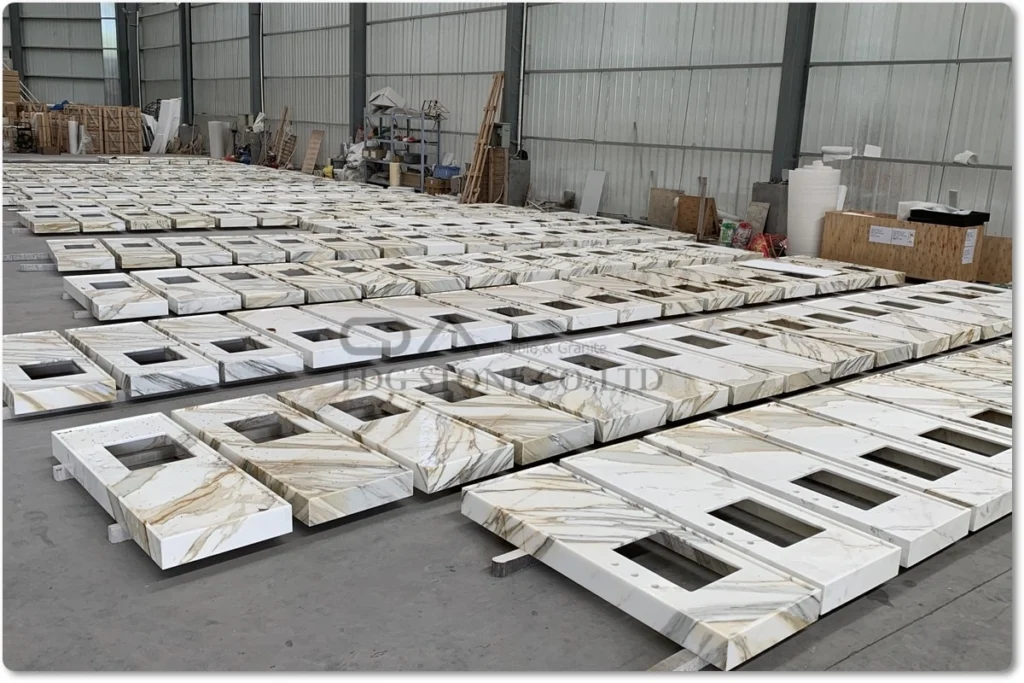
Marble Countertops Quality Inspection: Quick Summary
Marble countertop quality inspection is a documented process for verifying natural stone identity, visual acceptability, dimensions, fabrication accuracy, surface finish, functional cutouts, packaging, and compliance with agreed purchase specifications. ASTM C503/C503M-23 provides a reference for evaluating marble dimension stone, including relevant material properties. Material testing and finished-countertop inspection serve different purposes and should not replace one another. Buyers should establish written acceptance criteria before production, approve representative samples, verify critical dimensions against approved drawings, document permitted natural variations, and inspect finished products before shipment. No single tolerance or sampling percentage should be assumed to apply to every marble countertop project.

1. Executive Summary: How to Control Marble Countertop Quality?
Natural marble countertops are manufactured from a geological material whose appearance, mineral composition, and physical properties can vary from one block or slab to another. Unlike products made from a fully uniform industrial material, marble countertops require two complementary forms of quality control: material evaluation and finished-product inspection.
Material evaluation examines the suitability and characteristics of the stone itself. Finished-product inspection determines whether the fabricated countertop matches the approved drawings, sample, finish, workmanship requirements, and contractual acceptance criteria.
A countertop can pass a visual inspection while still having unsuitable physical properties for its intended application. Conversely, a marble slab can satisfy the specified material requirements while a fabricated countertop fails because of inaccurate dimensions, chipped edges, misplaced sink cutouts, or damage during packaging.
For commercial buyers, effective quality control therefore requires more than checking whether a countertop looks attractive.
A professional inspection program should establish five essential controls:
- Material identification: Confirm the agreed marble type, source information where available, material selection, and traceability records.
- Visual acceptance: Define acceptable natural veining, color variation, filled fissures, repairs, and prohibited defects.
- Fabrication verification: Compare actual dimensions, edge profiles, cutouts, thickness, and finish with approved drawings and specifications.
- Material performance: Obtain relevant laboratory test results when required by the application, contract, or project specification.
- Shipment release: Record final inspection results, nonconformities, corrective actions, and packaging condition before dispatch.
The governing principle is straightforward: quality must be measured against agreed requirements, not against an undefined expectation of perfection.
For example, natural gray veining in white marble may be an acceptable geological characteristic. An unapproved through-crack crossing a narrow countertop section may be a structural concern. A properly disclosed and accepted resin-filled fissure is not automatically equivalent to an undisclosed repair that compromises the appearance or integrity of the product.
Buyers should make these distinctions explicit before placing an order.
Who should use this guide?
This white paper is intended for:
- Importers purchasing natural marble countertops in bulk.
- Marble countertop manufacturers and fabrication workshops.
- Wholesale suppliers and distributors serving construction markets.
- Hotel and hospitality procurement teams.
- Residential and multifamily developers.
- Quality assurance personnel responsible for incoming or pre-shipment inspections.
- Contractors and project managers coordinating fabrication and installation.
For an international procurement project, the inspection specification should identify the contractual requirements, applicable standards, approved drawings, inspection stages, sampling method, and acceptance procedure before production begins.

2. Scope and Definitions: What Does Marble Countertop Quality Mean?
2.1 What are natural marble countertops?
Natural marble countertops are fabricated stone surfaces used in kitchens, bathrooms, hotel vanities, reception areas, commercial interiors, and other architectural applications.
Depending on the project, the finished product may include:
- A single-piece countertop.
- A countertop assembled from multiple sections.
- A kitchen island.
- A bathroom vanity top.
- A hotel vanity countertop.
- A countertop with a sink cutout.
- A backsplash integrated with the countertop.
- An edge profile formed through machining and polishing.
- A countertop with visible seams, joints, or mitered edges.
- A countertop supplied with brackets, supports, or other specified components.
The product specification should identify the material and finished assembly clearly. Marble countertops made from natural stone should not be confused with engineered quartz surfaces, porcelain slabs, or artificial stone products, which have different compositions and may require different specifications.
2.2 What is a marble countertop quality inspection?
A marble countertop quality inspection is a structured verification process that determines whether the supplied material and fabricated product meet the requirements established in the purchase contract.
The inspection normally covers several distinct categories.
| Inspection category | Primary objective | Typical evidence |
|---|---|---|
| Material identity | Confirm the agreed material | Material declaration, photographs, traceability records |
| Visual quality | Verify appearance against the approved reference | Inspection photographs, defect records, approved sample |
| Dimensional accuracy | Confirm compliance with drawings | Measurement records |
| Fabrication quality | Check edges, cutouts, joints, and machining | Inspection checklist and detailed photographs |
| Surface finish | Confirm the specified finish and workmanship | Visual inspection and agreed assessment method |
| Material performance | Evaluate relevant physical properties | Laboratory test reports |
| Packaging | Reduce transportation damage risk | Packing photographs, crate records, loading inspection |
| Documentation | Maintain traceability and accountability | Inspection report, corrective-action records, release approval |
These categories should be assessed independently. Passing one category does not automatically establish compliance with the others.
2.3 Quality control versus quality assurance
Quality assurance (QA) focuses on preventing problems through defined procedures, responsibilities, specifications, and records.
Quality control (QC) focuses on verifying whether the actual material and products meet those requirements.
For a marble countertop manufacturer, QA may include drawing approval procedures, material identification rules, inspection instructions, and nonconformity management.
QC may include measuring a countertop, checking its polished surface, examining a sink cutout, or recording a chipped corner.
A supplier can perform QC without having a formally certified quality management system. Buyers should not assume that an inspection checklist, a factory audit, or a laboratory report automatically establishes ISO certification or another independent certification.
2.4 Why written acceptance criteria matter
Descriptions such as premium quality, first-class marble, perfect polish, and export quality are insufficient on their own.
They do not establish measurable acceptance requirements.
A procurement specification should instead identify:
- The agreed stone and visual reference.
- Permitted color and veining variation.
- The treatment of natural fissures and filled areas.
- The dimensions and measurement method.
- The permitted dimensional deviations.
- The required edge profile.
- Sink and faucet cutout locations.
- Surface finish expectations.
- The applicable material testing requirements.
- The inspection sampling plan.
- The procedure for handling rejected or disputed products.
The exact requirements must be appropriate to the product, the intended use, and the contract. There is no single universal tolerance that should be applied to every countertop regardless of size, thickness, fabrication method, or installation conditions.

3. Technical Evaluation: Material Standards, Visual Inspection and Fabrication
3.1 Material Identification and Traceability
Correct material identification is the first step in marble countertop quality control.
A material that resembles the approved sample may not necessarily be the same commercial stone, quarry variety, or geological material specified in the purchase order.
Natural marble varies according to mineral composition, geological formation, quarry location, and the specific block from which the slab is cut. Trade names can also vary between suppliers.
For this reason, a material description should be sufficiently detailed to connect the purchase order, approved sample, production batch, and finished countertop.
3.1.1 What information should buyers verify?
A material identification record should include, where applicable:
- Commercial marble name.
- Geological or petrographic identification, if required.
- Quarry or source information, where documented and contractually relevant.
- Supplier’s material reference.
- Slab or block identification.
- Batch or production lot number.
- Thickness specification.
- Surface finish.
- Material selection or grading requirements.
- Approved sample reference.
- Photographs of selected slabs.
- Applicable laboratory test reports.
Not every supplier can provide every form of geological traceability. Buyers should distinguish between information that is available, information that can reasonably be documented, and information that is contractually required.
For a high-value hotel project, identifying which slabs are allocated to which vanity tops may be important for color coordination and replacement planning.
For a wholesale order, batch identification may be sufficient if the contract does not require individual slab traceability.
3.1.2 How should buyers handle material substitutions?
Material substitutions should require written approval before production.
A supplier should not replace the agreed marble with a visually similar stone simply because the alternative is more readily available.
A substitution request should identify:
- The originally specified material.
- The proposed alternative.
- The reason for the change.
- The differences in appearance and material properties.
- Any implications for cost, lead time, maintenance, or suitability.
- The revised sample or material documentation.
- The buyer’s written approval.
Procurement rule: A change in material identity is a specification change, not merely a production adjustment.
3.2 Visual Inspection: Cracks, Veins, Repairs and Color Variation
Visual inspection is often the most commercially sensitive part of natural marble countertop acceptance.
The difficulty is that marble naturally contains geological features that may be desirable, neutral, or unacceptable depending on their location, appearance, continuity, and relationship to the approved sample.
Inspectors must distinguish natural characteristics from workmanship problems and defects that affect suitability.
3.2.1 Natural veining
Veins are a defining feature of marble.
Their color, direction, width, continuity, and density can vary within the same slab and between slabs from the same source.
A natural vein should not automatically be classified as a crack or defect simply because it is visible.
The inspector should assess:
- Whether the feature is consistent with the approved material.
- Whether the vein is open, filled, or apparently closed.
- Whether it creates a visible discontinuity on the finished surface.
- Whether it crosses a narrow section, cutout, or edge.
- Whether the contract restricts its location or appearance.
- Whether its condition raises a concern about the intended application.
Aesthetic acceptance and structural suitability are separate questions. A visually prominent vein might be acceptable in one design but unacceptable in another, while a less visible feature may require technical investigation if it affects the stone’s integrity.
3.2.2 Natural color variation
Color differences can result from mineral distribution, geological formation, slab orientation, lighting, and the way a surface reflects light.
White marble, for example, may contain gray veining, subtle cream tones, or localized mineral markings.
The acceptance criteria should explain whether the buyer expects:
- A close visual match to a reference sample.
- A range of acceptable colors.
- Coordinated slabs for a single installation.
- Sequential vein matching.
- Bookmatched patterns.
- A commercially graded selection.
- Separate approval of each slab before fabrication.
A small hand sample cannot represent every feature of a large slab. For premium projects, buyers should consider approving photographs of the actual slabs under reasonably consistent lighting before fabrication begins.
Photographs should supplement, rather than automatically replace, an agreed physical sample or documented visual selection procedure.
3.2.3 Resin-filled fissures and repairs
Natural stone may be treated with resin, filler, mesh backing, or other materials to support fabrication or improve appearance.
The presence of a repair does not automatically mean that a countertop is unacceptable. Its acceptability depends on the agreed specification, the type and location of the treatment, the quality of execution, and the intended application.
Inspectors should examine:
- The location and visibility of the repair.
- Whether the treatment was disclosed where disclosure was required.
- Whether the repair is consistent with the approved sample.
- Whether there are visible gaps, poorly matched filler, or excessive discoloration.
- Whether the treatment is stable under the specified use conditions.
- Whether the repair creates an unresolved structural concern.
A surface repair should not be assumed to restore the original mechanical properties of the stone.
Likewise, a filled fissure should not automatically be treated as equivalent to an open crack. Its condition and suitability must be assessed individually.
3.2.4 Structural cracks and open seams
Potentially significant defects include:
- Open cracks.
- Unstable seams.
- Cracks extending through the stone thickness.
- Cracking around sink cutouts.
- Edge fractures.
- Broken corners.
- Defects that compromise a narrow bridge between cutouts.
- Damage that affects installation or support.
The inspector should document the location, length, apparent depth, and relationship of the feature to the finished geometry.
Where a feature may affect structural performance, visual inspection alone may not be sufficient. Technical assessment, additional testing, or rejection may be appropriate depending on the contract and application.
3.2.5 Pits, chips, scratches and stains
These issues should be classified according to their nature and the agreed finish requirements.
| Condition | Inspection approach | Acceptance principle |
|---|---|---|
| Natural mineral markings | Compare with approved material | Accept or reject according to the agreed visual range |
| Natural veining | Examine appearance and physical condition | Do not automatically classify veins as defects |
| Resin-filled fissure | Check disclosure, appearance, and suitability | Apply agreed repair criteria |
| Open crack | Examine location and potential integrity impact | Escalate if structural suitability is uncertain |
| Edge chip | Measure and record location | Apply contractual edge-damage criteria |
| Surface scratch | Inspect under agreed lighting and viewing conditions | Compare with the specified finish standard |
| Localized stain | Determine visibility and whether it can be removed | Apply the agreed appearance criteria |
| Poorly blended repair | Record color, texture, and finish mismatch | Assess against the approved sample and repair specification |
Key principle: The purpose of visual inspection is not to eliminate the natural character of marble. It is to ensure that the supplied stone matches the agreed aesthetic requirements and remains suitable for its intended use.
3.3 Dimensional Tolerances and Drawing Verification
Dimensional accuracy is essential because marble countertops must fit cabinets, wall conditions, appliances, sinks, and adjacent stone components.
Even a visually attractive countertop can become unusable if the sink cutout is misplaced or the finished length exceeds the available installation space.
3.3.1 What dimensions should be inspected?
Depending on the product, the dimensional checklist may include:
- Overall length.
- Overall width or depth.
- Nominal and actual thickness.
- Diagonal measurements where relevant.
- Squareness and corner geometry.
- Flatness or warpage, where specified.
- Edge straightness.
- Cutout dimensions.
- Cutout center positions.
- Distances from cutouts to finished edges.
- Backsplash height and thickness.
- Miter dimensions.
- Seam positions.
- Faucet-hole diameter and location.
- Finished dimensions of individual countertop sections.
The inspection drawing should identify the relevant datum points and measurement method.
For example, the distance from the front edge to a sink cutout should be measured from the specified finished edge, not from an unfinished reference surface unless the drawing explicitly requires otherwise.
3.3.2 How should dimensional tolerances be established?
Dimensional tolerances should be specified before production.
They should account for:
- The size and geometry of the component.
- The fabrication process.
- The installation interface.
- The stone’s thickness and condition.
- The required edge profile.
- The sink or appliance manufacturer’s requirements.
- Site measurement conditions.
- Whether the countertop is supplied in one piece or several sections.
Do not assume that every marble countertop has the same acceptable dimensional deviation.
A tolerance suitable for a large commercial vanity may not be appropriate for a precision-fitted countertop with tight joints or a complex mitered edge.
The buyer and manufacturer should agree on the applicable tolerance for each critical dimension.
3.3.3 Drawing revision control
A common source of quality disputes is fabrication against an outdated drawing.
The approved production drawing should include:
- Drawing number.
- Revision identifier.
- Issue date.
- Overall dimensions.
- Critical cutout positions.
- Edge-profile details.
- Surface finish.
- Material and thickness.
- Special fabrication notes.
- Approval status.
Changes after approval should be recorded and reapproved where they affect product conformity.
For complex hotel or multifamily projects, each countertop should be traceable to the relevant room, unit, or installation location.
This allows the project team to identify a mismatch before products are packed or installed.

3.4 Edge Profiles, Sink Cutouts and Surface Finish
Fabrication quality determines how successfully the raw slab becomes a functional countertop.
These checks should be included in the finished-product inspection rather than assumed to be covered by the material certificate.
3.4.1 Edge profiles
Typical edge profiles include:
- Eased edge.
- Straight polished edge.
- Beveled edge.
- Bullnose.
- Half-bullnose.
- Ogee.
- Mitered edge.
The drawing should identify the required profile and, where necessary, its dimensions.
Inspectors should check for:
- Correct profile geometry.
- Consistent edge dimensions.
- Smooth transitions.
- Visible chips or fractures.
- Unpolished sections.
- Excessive grinding marks.
- Uneven joints between mitered components.
- Repair areas that differ noticeably from the surrounding finish.
A named edge profile may be interpreted differently by different workshops. For custom projects, a cross-sectional drawing or approved physical sample can reduce ambiguity.
3.4.2 Sink cutouts and faucet holes
Sink cutouts are critical because they affect both fit and the remaining stone section.
Inspection should verify:
- Cutout length and width.
- Corner radii, where specified.
- Cutout position relative to the approved drawing.
- Remaining material around the cutout.
- Surface finish and edge quality.
- The absence of unacceptable chips or cracks.
- Faucet-hole positions and diameters.
- Compatibility with the specified sink model.
Undermount sinks, top-mounted sinks, and integrated stone basins may require different fabrication details.
The relevant sink manufacturer’s installation dimensions should be used where applicable.
A cutout should not be approved solely because the sink appears to fit. The inspector should also consider the specified edge treatment and any requirements for support or installation.
3.4.3 Surface finish
Common finishes include polished, honed, brushed, and other specified textures.
A finish inspection should consider:
- Uniformity of the intended surface appearance.
- Visible scratches.
- Grinding marks.
- Dull patches.
- Excessive gloss variation where consistency is required.
- Residual adhesive or contamination.
- Poorly blended repair areas.
- Localized discoloration.
- Surface irregularities that exceed the agreed criteria.
Inspection conditions matter. Light direction, viewing distance, surface cleanliness, and moisture can influence how the stone appears.
The purchase specification should therefore identify a practical inspection method, including the lighting and viewing conditions used for acceptance when appearance is commercially critical.
3.5 Material Testing vs. Finished-Product Inspection
One of the most important distinctions in marble countertop procurement is the difference between testing the stone material and inspecting the finished product.
Laboratory testing evaluates selected material properties under defined test conditions. Finished-product inspection evaluates whether the actual countertop complies with the purchase requirements.
Neither activity replaces the other.
3.5.1 ASTM C503/C503M: Marble dimension stone
ASTM C503/C503M-23, Standard Specification for Marble Dimension Stone, is a relevant reference for assessing marble intended for general building and structural purposes.
The standard addresses material characteristics, physical requirements, and sampling. Its scope includes marble that has been cut or otherwise formed into dimension-stone products, while excluding certain artificial and cast products. The specification also references relevant dimension-stone test methods. ASTM Store
However, a countertop buyer should not interpret ASTM C503/C503M as a complete fabrication inspection checklist.
It does not eliminate the need to specify countertop dimensions, sink cutouts, edge profiles, surface appearance, or packaging requirements.
The applicable material requirements should be confirmed against the actual contract, the intended application, and the relevant standard edition.
3.5.2 Relevant ASTM material test methods
Depending on the stone, project requirements, and specified standard, relevant test methods may include:
| Standard | General purpose | Procurement relevance |
|---|---|---|
| ASTM C97/C97M | Water absorption and bulk specific gravity of dimension stone | Helps characterize selected physical properties |
| ASTM C99/C99M | Modulus of rupture of dimension stone | Evaluates a specified aspect of stone strength |
| ASTM C170/C170M | Compressive strength of dimension stone | Measures compressive strength under the prescribed method |
| ASTM C880/C880M | Flexural strength of dimension stone | Evaluates flexural performance under the specified method |
| ASTM C503/C503M | Specification for marble dimension stone | Provides material requirements and related sampling provisions |
ASTM and the Natural Stone Institute identify these and other standards within the dimension-stone testing and specification framework. The exact edition applicable to a project must be checked before testing is commissioned. ASTM Store
The current edition of a test method should not be assumed to be identical to the edition cited in an older project specification.
For example, ASTM’s standards catalogue identifies ASTM C97/C97M-26 as an active edition as of October 2026, while ASTM C503/C503M-23 remains listed as active in the available catalogue. Buyers should verify the current status and contractual edition directly before issuing test instructions. Intertek Inform
3.5.3 How should buyers choose material tests?
The selection of tests should be driven by the material and its intended use.
A procurement team should ask:
- Is the material intended for interior or exterior use?
- Will it be exposed to water, weather, heat, or chemicals?
- Is the countertop subject to unusual loading or unsupported spans?
- Does the specification identify minimum or maximum property values?
- Is the test required for initial qualification, production verification, or dispute resolution?
- Does the laboratory report identify the actual material tested?
- Is the sample representative of the supplied batch?
- Are the test method and edition clearly stated?
A report for one marble variety should not automatically be applied to another variety.
Likewise, a report from an earlier shipment may not establish the properties of a new batch unless the buyer’s qualification procedure permits that use and material consistency can be adequately demonstrated.
3.5.4 What material testing cannot prove
A laboratory report does not, by itself, prove that a finished countertop:
- Has the correct dimensions.
- Has the correct sink cutout.
- Matches the approved color range.
- Has no unacceptable chips.
- Has a consistent polished finish.
- Is correctly labeled.
- Is packed safely for transportation.
- Will fit the actual installation site.
These are separate inspection questions.
Recommended approach: Use laboratory tests to establish relevant material properties and use documented product inspections to establish finished-product conformity.
3.6 Sampling Plans and Batch Acceptance
Sampling is necessary when a purchase contains many countertops, particularly for hotels, residential developments, multifamily housing, and wholesale orders.
Inspecting every item may be practical for some critical dimensions or high-value products, while a statistically designed sample may be more suitable for certain repetitive checks.
The correct approach depends on the project risk and contract.
3.6.1 Define the inspection lot
Before sampling, establish what constitutes a batch or inspection lot.
A lot might be defined by:
- A specific production order.
- A group of countertops made from an identified material batch.
- A hotel room type.
- A production period.
- A particular drawing revision.
- A shipment or container.
- A defined quantity of visually coordinated slabs.
A single shipment may contain multiple lots if different materials, specifications, or production conditions apply.
The lot definition should be agreed before inspection rather than changed after a problem is discovered.
3.6.2 Choose the sampling method
Three common approaches are:
100% inspection: Every item is checked for the specified characteristics. This may be appropriate for critical dimensions, product identification, or high-risk features when resources permit.
Random sampling: Items are selected using a defined random method. This can support assessment of repetitive production characteristics.
Risk-based inspection: Inspection intensity is increased for characteristics with higher consequences of failure, such as cutout geometry, fragile sections, or products with a history of nonconformities.
These approaches can be combined.
For example, a project might require every countertop to undergo an identity and visual check while selected dimensions are also independently measured according to a documented sampling plan.
3.6.3 Do not invent a universal inspection percentage
A sampling percentage should not be selected merely because it is commonly used elsewhere.
The plan should specify:
- Lot size.
- Sample size or sample-selection method.
- Critical characteristics.
- Major and minor nonconformity categories.
- Acceptance and rejection criteria.
- Whether a failed sample triggers expanded inspection.
- Whether the affected lot can be reworked and reinspected.
- Who has authority to release the lot.
Where a formal statistical sampling standard is used, the contract should identify the standard and edition, inspection level, acceptance criteria, and relevant parameters.
A sampling plan is not meaningful unless the acceptance rules are also defined.
3.6.4 Sample approval versus batch acceptance
An approved sample establishes a reference for material appearance, workmanship, or both.
It does not automatically establish that every item in a production batch complies.
The sample may also fail to represent the full natural variation of a material.
For that reason, commercial buyers should establish two distinct approval points:
- Sample approval: Confirmation of the acceptable material and workmanship reference.
- Batch acceptance: Verification that production items meet the approved specifications and agreed variation limits.
For visually sensitive projects, approval of the actual slabs or slab photographs before fabrication can provide an additional control.
3.7 Pre-Shipment Inspection Procedures
Pre-shipment inspection is the final opportunity to identify problems before products leave the factory.
For a marble countertops manufacturer, this stage should focus on finished-product conformity, documentation, identification, and shipping readiness.
A practical inspection sequence includes the following steps.
Step 1: Review the purchase order and approved drawings
Confirm the current drawing revision, quantity, material, thickness, finish, edge profile, and special requirements.
Step 2: Verify material identification
Check that the inspected products correspond to the agreed material and production lot.
Review available material labels, batch records, or slab allocation records.
Step 3: Conduct a visual inspection
Inspect the specified surfaces, edges, corners, seams, repairs, and cutouts.
Record any condition that falls outside the agreed acceptance criteria.
Step 4: Measure critical dimensions
Use appropriate measuring equipment to check the dimensions identified in the inspection plan.
Record actual measurements rather than simply writing “pass” when the contract requires dimensional evidence.
Step 5: Inspect fabrication details
Verify the edge profile, cutout geometry, finish, and other product-specific features.
Step 6: Review nonconformities
Confirm that identified problems have been corrected, formally accepted through an authorized deviation, or otherwise resolved under the contract.
Step 7: Inspect packaging
Check whether the packaging arrangement protects the stone against foreseeable handling and transportation risks.
The inspection may cover corner protection, separation between stone surfaces, internal bracing, moisture considerations, lifting arrangements, crate condition, and product identification, as applicable.
Step 8: Verify shipping records
Review the required packing list, product labels, crate numbers, inspection report, and other contractual documentation.
Step 9: Record the release decision
The responsible party should document whether the inspected goods are accepted, rejected, or subject to corrective action before shipment.
Important: A pre-shipment inspection report is evidence of the checks performed. It should not be interpreted as a guarantee against every possible defect or transportation incident.
3.8 Nonconformity Records and Corrective Actions
A nonconformity is a failure to meet a specified requirement.
It should be recorded in a way that makes the problem identifiable, reproducible, and actionable.
A useful nonconformity report includes:
- Unique report number.
- Purchase order and production batch.
- Product identification.
- Drawing number and revision.
- Description of the requirement.
- Actual condition or measurement.
- Photographs.
- Inspection date.
- Severity or classification.
- Immediate containment action.
- Proposed corrective action.
- Responsible party.
- Reinspection result.
- Final disposition.
Possible dispositions include:
- Rework and reinspect.
- Replace the affected product.
- Repair under an approved procedure.
- Accept through a documented concession.
- Reject the affected item or lot.
The appropriate decision depends on the type of defect and the contractual requirements.
A visible chip might be repairable under an approved procedure, while an incorrectly positioned sink cutout may require remanufacturing.
A potential structural crack should not be accepted solely because a repair would make it less visible.
Corrective action versus cosmetic repair
A cosmetic repair addresses the immediate appearance of a problem.
A corrective action addresses the cause of the nonconformity and aims to prevent recurrence.
For example, if multiple countertops have misplaced sink cutouts, repairing individual pieces does not necessarily resolve the underlying issue. The production team may also need to investigate drawing revision control, machine setup, measurement procedures, or operator verification.
Buyers should request evidence proportionate to the seriousness and recurrence of the problem.

4. Procurement Checklist: How Buyers Can Verify Marble Countertop Quality?
A reliable inspection program should translate the purchase specification into checks that can be completed and documented.
The following checklist can be adapted for marble countertop imports, wholesale orders, hospitality projects, and residential developments.
4.1 Before placing the purchase order
The buyer should confirm that the following information is available:
- Exact commercial marble name and material description.
- Approved physical sample or documented visual reference.
- Required thickness and surface finish.
- Acceptable color and veining range.
- Written criteria for cracks, filled fissures, and repairs.
- Approved fabrication drawings.
- Edge profiles and cutout details.
- Dimensional tolerances for critical measurements.
- Applicable material standards and test requirements.
- Sampling and acceptance procedure.
- Packaging and shipping requirements.
- Procedures for nonconformities and corrective actions.
Why this matters: Many quality disputes originate from incomplete specifications rather than from a disagreement about the physical condition of the stone.
4.2 During material selection
The buyer or authorized representative should:
- Confirm that the proposed material corresponds to the purchase order.
- Review representative slabs or photographs of the actual slabs.
- Assess whether the natural color and veining range is acceptable.
- Identify any commercially significant fissures, repairs, or unusual markings.
- Record slab or batch identification where available.
- Obtain approval before material substitution.
- Determine whether additional laboratory testing is required.
For projects requiring coordinated appearances, the buyer should specify how slabs will be selected and matched.
For example, a hotel vanity project may require consistent visual character across rooms, whereas a residential project may intentionally use contrasting veining to emphasize individual designs.
4.3 During fabrication
The inspection plan should identify the production stages at which checks are required.
| Production stage | Recommended verification | Evidence to retain |
|---|---|---|
| Drawing approval | Confirm dimensions, cutouts, and edge details | Approved drawing revision |
| Material allocation | Confirm material and visual selection | Slab photographs and identification records |
| First-piece approval | Verify workmanship and critical geometry | First-piece inspection record |
| Cutting | Check dimensions and cutout locations | Measurement record |
| Edge processing | Check profile and visible workmanship | Inspection checklist |
| Surface finishing | Check finish consistency and repairs | Photographs and inspection results |
| Final inspection | Confirm product conformity | Final inspection report |
| Packaging | Verify protection and identification | Packing and loading photographs |
A first-piece inspection is particularly useful for repetitive orders. It provides an opportunity to identify drawing interpretation or machine setup problems before they affect the remaining production.
However, first-piece approval does not replace batch inspection.
4.4 Before shipment
Use the following release checklist:
- Correct product quantity.
- Correct material identification.
- Correct drawing revision.
- Critical dimensions checked.
- Cutouts and edge profiles verified.
- Surface finish inspected.
- Visible damage documented.
- Repairs assessed against the agreed criteria.
- Nonconformities resolved or formally dispositioned.
- Packaging and protection checked.
- Product labels and crate identification verified.
- Packing list and inspection records completed.
- Shipment release decision documented.
For high-value orders, buyers may choose to appoint an independent inspection company.
The inspection scope should be agreed in advance so that the inspector knows which characteristics must be measured, how samples should be selected, and what constitutes acceptance or rejection.

5. Cost and Risk Factors: What Determines the Cost of Quality Inspection?
Quality inspection creates a cost, but inadequate inspection can expose buyers to additional expenses after delivery.
For marble countertops, the commercial consequences of a quality failure may extend beyond the replacement cost of the stone.
They can include freight, customs handling, installation delays, additional labor, site remeasurement, contractor rescheduling, and disruption to hotel or residential project handover.
5.1 The main components of inspection cost
Inspection expenditure may include:
1. Internal factory QC
This includes production checks, measuring equipment, inspection labor, documentation, and the handling of nonconforming products.
2. Laboratory testing
Testing costs depend on the requested properties, specimen preparation, laboratory requirements, applicable test methods, and whether the testing is performed for initial material qualification or subsequent verification.
3. Third-party inspection
Independent inspection fees may depend on the location, inspection duration, product quantity, technical complexity, reporting requirements, and travel arrangements.
4. Sample production
Custom samples may require material selection, cutting, edge processing, polishing, shipping, and approval time.
5. Corrective work
Reworking or replacing nonconforming countertops may require additional stone, fabrication, inspection, packaging, and transportation.
6. Packaging verification
Additional packaging checks may be necessary for large-format components, delicate edge profiles, or products with complex geometries.
The appropriate inspection budget should be based on project risk rather than an assumed universal percentage of the purchase value.
5.2 Why should inspection focus on critical risks?
Not every inspection characteristic carries the same commercial consequence.
A minor visual difference within the approved natural range may have little impact on installation.
An incorrect sink cutout, by contrast, can make an otherwise attractive countertop unusable.
A useful risk assessment considers:
- Probability of the problem occurring.
- Consequence if it occurs.
- Likelihood that the problem will be detected before shipment.
- Cost and difficulty of correction after delivery.
- Whether the problem affects safety, structural suitability, or installation.
This approach helps buyers allocate inspection resources where they provide the greatest value.
5.3 The hidden cost of unclear specifications
Consider a hypothetical order for marble vanity tops for a hotel.
The buyer approves a small sample but does not define the acceptable range of veining or how filled fissures will be assessed.
After fabrication, some tops contain more visible gray veins than the buyer expected. The factory considers the products consistent with the approved material, while the buyer considers the variation unacceptable.
Neither party has a clear contractual basis for resolving the disagreement.
The resulting dispute may require additional photographs, independent assessment, rework, or replacement.
The underlying issue is not necessarily poor workmanship. It is the absence of a sufficiently detailed visual acceptance specification.
A written material-selection procedure and approval of representative slabs could reduce this risk substantially.
5.4 Natural variation versus manufacturing defects
The distinction should be addressed before production.
| Condition | Potential interpretation | Recommended contractual treatment |
|---|---|---|
| Natural veining | Expected characteristic of marble | Define acceptable visual range |
| Mineral color variation | May be inherent to the material | Establish reference sample and selection rules |
| Approved resin repair | May be acceptable depending on specification | Define disclosure and appearance requirements |
| Unapproved material substitution | Specification deviation | Require written approval |
| Incorrect cutout position | Fabrication nonconformity | Specify dimensions and tolerances |
| Unacceptable edge chip | Workmanship nonconformity | Define inspection and repair criteria |
| Surface finish inconsistent with the order | Fabrication nonconformity | Specify finish and inspection conditions |
| Damage caused by inadequate packaging | Packaging or handling failure | Define packaging and shipment responsibilities |
The classification of a condition depends on the evidence and the agreement. This table is a practical framework, not a substitute for project-specific acceptance criteria.
5.5 How should buyers balance quality and price?
A lower purchase price may be commercially attractive, but the buyer should compare the total cost of obtaining an acceptable, installable product.
A more useful comparison includes:
- Material consistency.
- Fabrication accuracy.
- Inspection documentation.
- Packaging quality.
- Lead-time reliability.
- Replacement and rework procedures.
- Communication during production.
- Ability to meet the approved drawings.
- Responsibility for nonconforming products.
For a one-off decorative countertop, the evaluation may emphasize appearance and custom workmanship.
For a multifamily development with repetitive vanity tops, dimensional repeatability, batch identification, and production controls may be more important.
For a luxury hotel, visual coordination, replacement traceability, and reliable project documentation may justify additional inspection effort.
6. Supplier Evaluation: How to Select a Reliable Marble Countertops Manufacturer
Choosing a marble countertops manufacturer or supplier requires evaluating the evidence behind its quality claims.
A supplier’s website, product photographs, or general statement that it follows strict quality control procedures should not be treated as proof that a particular order will meet the buyer’s requirements.
Instead, procurement teams should request evidence appropriate to the order.
6.1 Documents to request from a marble countertop supplier
The following table provides a practical supplier evaluation framework.
| Document or record | What it helps verify | Important limitation |
|---|---|---|
| Material specification | Agreed stone and product description | Does not prove every finished item conforms |
| Approved sample record | Accepted visual or workmanship reference | Does not represent every possible natural variation |
| Production drawings | Required dimensions and geometry | Must be revision-controlled |
| Material test report | Tested properties of identified specimens | Does not establish finished-product dimensions or appearance |
| Slab selection photographs | Visual characteristics of selected material | Photographs can differ from in-person viewing conditions |
| First-piece inspection record | Initial production conformity | Does not replace subsequent inspection |
| Dimensional inspection report | Actual measurements of inspected items | Coverage depends on the inspection plan |
| Final inspection report | Results of specified final checks | Only supports the characteristics actually inspected |
| Nonconformity records | Evidence of defect management | Does not guarantee that every issue has been detected |
| Packaging photographs | Visible packaging and loading arrangements | Do not guarantee that transportation damage cannot occur |
The buyer should review the actual content of the records rather than judging a supplier solely by the number of documents supplied.
6.2 Questions to ask before placing an order
Ask the supplier:
- How will the specified marble be identified and allocated to the order?
- Can the buyer approve the material before fabrication?
- How will natural color and veining variation be managed?
- How are cracks, fissures, and resin repairs classified?
- Which drawing revision will govern production?
- Which dimensions will be measured and recorded?
- How will the first finished piece be approved?
- What material tests are available or required?
- How are nonconforming products recorded and resolved?
- What packaging method will be used for international transportation?
- Which inspection records will be supplied before shipment?
- What happens if an inspection identifies a nonconformity?
These questions help establish whether the supplier understands the buyer’s technical requirements and can provide appropriate evidence.
6.3 Factory inspection versus third-party inspection
Factory inspection and third-party inspection serve different purposes.
Factory internal inspection allows the manufacturer to monitor production continuously, identify problems early, and correct errors before shipment.
Third-party inspection provides an independent assessment within the agreed inspection scope.
A third-party inspector may verify dimensions, appearance, packaging, documentation, or other specified characteristics. The inspector’s findings depend on the sampling plan, available access, test methods, and inspection conditions.
Neither approach is automatically sufficient on its own.
For a large order, the buyer may use the following combination:
- Factory QC during material selection and fabrication.
- Buyer approval of the first finished piece.
- Independent pre-shipment inspection for selected critical characteristics.
- Final review of the inspection report and shipping documents.
The appropriate arrangement depends on project value, technical complexity, delivery risk, and the parties’ contractual responsibilities.
6.4 What should buyers know about EDG Stone?
EDG Stone’s commercial focus includes natural stone countertops, marble products, and custom stone fabrication for export markets.
When evaluating EDG Stone for a particular marble countertop order, buyers should confirm the specific material, dimensions, fabrication details, inspection requirements, packaging arrangement, and delivery terms with the sales and production teams.
For project-specific procurement, buyers can request clarification on:
- Material availability and selection.
- Custom countertop dimensions.
- Edge profiles and cutout requirements.
- Drawing review and approval.
- Required material documentation.
- Inspection records available for the order.
- Packaging specifications.
- Production and delivery arrangements.
Important qualification: The inspection stages described in this article are recommended procurement practices. They should not be interpreted as a claim that EDG Stone maintains a particular certification or has completed every listed inspection procedure for every order. Any statement about an established factory system, testing capability, or documented inspection record should be supported by the relevant evidence.
7. Practical RFQ Template: Marble Countertops Quality Requirements
A well-prepared Request for Quotation (RFQ) should communicate both the commercial requirements and the quality standards expected from a marble countertops manufacturer.
The following template can be copied into an email, spreadsheet, or procurement document and sent to potential suppliers.
7.1 Marble Countertops RFQ Specification
| RFQ field | Information required from buyer |
|---|---|
| Project name | [Project name] |
| Buyer / company | [Company name] |
| Destination country | [Country] |
| Delivery address or port | [Destination] |
| Product type | Kitchen countertop / Vanity top / Hotel countertop / Other |
| Marble name | [Commercial material name] |
| Material origin | [Required origin, if applicable] |
| Material identification | [Supplier reference or agreed identification method] |
| Color and veining | [Reference sample / Approved range / Slab selection] |
| Thickness | [Specified thickness and tolerance] |
| Surface finish | [Polished / Honed / Other] |
| Edge profile | [Profile and drawing reference] |
| Overall dimensions | [Length × width × thickness] |
| Sink cutout | [Type, dimensions, and position] |
| Faucet holes | [Quantity, diameter, and position] |
| Backsplash | [Dimensions and finish, if applicable] |
| Drawing revision | [Drawing number and revision] |
| Quantity | [Number of pieces] |
| Packaging | [Required packaging and protection] |
| Applicable standards | [Specified standards and editions] |
| Material testing | [Required tests and acceptance values] |
| Visual acceptance | [Approved sample and variation criteria] |
| Dimensional acceptance | [Specified tolerances] |
| Sampling plan | [Inspection method and acceptance rules] |
| First-piece approval | [Required / Not required] |
| Third-party inspection | [Required / Not required] |
| Required documentation | [Test reports, inspection records, packing list, etc.] |
| Delivery terms | [Agreed Incoterms rule and named place or port] |
| Requested delivery date | [Date] |
| Warranty / claims procedure | [Contractual requirements] |
The RFQ should distinguish mandatory requirements from preferences. This helps suppliers identify potential technical or commercial conflicts before production begins.
7.2 Recommended Acceptance Criteria Matrix
The following matrix can be included in a purchase specification.
The acceptance rules must be completed by the buyer and supplier before production. The examples below identify what should be controlled without inventing universal numerical tolerances.
| Characteristic | Inspection method | Acceptance criterion to define |
|---|---|---|
| Material identity | Document and label verification | Agreed material and identification requirements |
| Color variation | Visual comparison | Approved sample or documented color range |
| Natural veining | Visual inspection | Agreed veining characteristics and selection rules |
| Fissures and repairs | Visual examination and documentation review | Permitted locations, appearance, disclosure, and technical suitability |
| Cracks | Visual inspection and technical assessment where needed | Contractual defect criteria and application-specific requirements |
| Overall dimensions | Calibrated or suitable measuring equipment | Drawing dimensions and agreed tolerances |
| Thickness | Suitable thickness measurement | Nominal thickness and agreed tolerance |
| Cutout geometry | Measurement against approved drawing | Specified dimensions and positions |
| Edge profile | Visual and dimensional verification | Approved profile and workmanship requirements |
| Surface finish | Inspection under agreed conditions | Specified finish and appearance criteria |
| Packaging | Visual and documentation check | Agreed protection, identification, and handling requirements |
| Documentation | Record review | Required reports and traceability information |
7.3 Nonconformity Reporting Form
Use the following fields when a problem is identified.
MARBLE COUNTERTOPS NONCONFORMITY REPORT
Report Number:
Purchase Order:
Project:
Supplier:
Production Batch:
Product / Piece ID:
Drawing Number and Revision:
Inspection Date:
1. Requirement
Describe the contractual requirement or approved specification.
2. Actual Condition
Describe the observed defect or measured deviation.
3. Classification
[ ] Material identification
[ ] Visual appearance
[ ] Dimensional accuracy
[ ] Fabrication workmanship
[ ] Surface finish
[ ] Packaging
[ ] Documentation
[ ] Other
4. Evidence
Photograph references:
Actual measurements:
Applicable test report:
Inspector’s comments:
5. Proposed Disposition
[ ] Rework
[ ] Replacement
[ ] Approved repair
[ ] Expanded inspection
[ ] Conditional acceptance
[ ] Rejection
[ ] Further technical evaluation
6. Corrective Action
Describe the proposed action and responsible party.
7. Reinspection
Date:
Results:
Supporting records:
8. Final Decision
[ ] Accepted
[ ] Rejected
[ ] Accepted under documented concession
[ ] Pending further action
Authorized Representative:
Date:
This form supports consistent communication between the buyer, manufacturer, and inspector. For large projects, a shared nonconformity register can also help track repeated problems across production batches.
7.4 Example: How to Write a Clear Inspection Requirement
Weak requirement:
The marble countertops must be perfect, with no defects and excellent workmanship.
This requirement is difficult to enforce because it does not define perfection, distinguish natural features from defects, or specify an inspection method.
Improved requirement:
The finished marble countertops shall comply with the approved production drawings, material specification, and agreed visual acceptance criteria. Natural veining and color variation shall be assessed against the approved sample and documented material-selection requirements. Cracks, chips, repairs, surface irregularities, and dimensional deviations shall be evaluated according to the written acceptance matrix. Critical dimensions, including overall size and sink cutout position, shall be measured and recorded in accordance with the agreed inspection plan. Products that do not meet the specified requirements shall be documented and dispositioned before shipment.
This version is more useful because it establishes identifiable requirements and a process for resolving nonconformities.
For a real purchase order, the buyer should add the actual numerical tolerances, applicable standard editions, sampling rules, and any project-specific acceptance limits.
8. Frequently Asked Questions: Marble Countertops Quality Inspection
FAQ 1: What standards are used to inspect natural marble countertops?
ASTM C503/C503M-23 is a relevant specification for marble dimension stone. Depending on the project, material evaluation may also use applicable ASTM test methods for water absorption, density, compressive strength, modulus of rupture, or flexural strength.
However, material standards do not replace finished-countertop inspection. Buyers should separately specify dimensional tolerances, surface finish, edge profiles, cutouts, packaging, and visual acceptance criteria. The applicable standard editions and contractual requirements should be confirmed before inspection.
FAQ 2: How do you distinguish natural marble veins from structural cracks?
Natural veins are geological features and are not automatically defects. Their acceptability depends on the approved visual reference, the nature of the feature, its location, and the intended application.
An open crack, unstable seam, or discontinuity that may compromise the countertop requires a different assessment. Where structural suitability is uncertain, visual inspection alone may be insufficient, and additional technical evaluation may be necessary.
FAQ 3: What dimensional tolerance is acceptable for marble countertops?
There is no single tolerance that should be assumed to apply to every marble countertop project.
Acceptable deviations depend on the approved drawings, component dimensions, fabrication method, installation requirements, and contract. Buyers should specify tolerances for overall dimensions, thickness, cutouts, edge geometry, and other critical features before production begins.
FAQ 4: Should marble countertops undergo laboratory testing before shipment?
Laboratory testing is appropriate when required by the contract, material specification, intended application, or project risk assessment.
Tests may be needed to establish relevant physical properties or qualify a material for a particular use. For routine production, a previously approved test report may be acceptable if the contractual procedure permits it and the tested material is demonstrably representative.
Laboratory testing does not replace final inspection of dimensions, workmanship, appearance, and packaging.
FAQ 5: How can importers reduce marble countertop quality problems?
Importers can reduce risk by establishing written specifications before production, approving representative samples, controlling drawing revisions, defining acceptable natural variation, checking critical dimensions, and documenting nonconformities.
For larger orders, buyers should also consider first-piece approval, batch identification, risk-based sampling, independent pre-shipment inspection, and photographic packaging records. These controls help identify problems before the goods are shipped internationally.
9. References: Standards and Technical Resources
The following sources provide a technical foundation for developing a marble countertop quality inspection specification.
The distinction between material specifications, laboratory test methods, and finished-product acceptance remains essential when applying these references to a commercial order.
9.1 ASTM International
1. ASTM C503/C503M-23 — Standard Specification for Marble Dimension Stone
A principal reference for marble dimension stone. It addresses material characteristics, physical requirements, and sampling, and references relevant test methods and dimension-stone selection guidance.
Official source: ASTM C503/C503M-23
2. ASTM C97/C97M — Standard Test Methods for Absorption and Bulk Specific Gravity of Dimension Stone
Relevant to the measurement of water absorption and bulk specific gravity under the prescribed test procedures. Confirm the edition specified by the project and the current edition applicable to the order.
Official source: ASTM C97/C97M standards catalogue
3. ASTM C99/C99M — Standard Test Method for Modulus of Rupture of Dimension Stone
A reference for assessing modulus of rupture under the applicable test method. Use it where the project specification requires this property.
4. ASTM C170/C170M — Standard Test Method for Compressive Strength of Dimension Stone
A reference for determining the compressive strength of dimension stone using the specified procedure.
5. ASTM C880/C880M — Standard Test Method for Flexural Strength of Dimension Stone
A reference for determining flexural strength under the prescribed testing conditions.
The Natural Stone Institute’s standards reference provides an overview of relevant dimension-stone specifications and test methods, including C503, C97, C99, C170, and C880. Natural Stone Institute
For standards 3–5, buyers should verify the exact edition and scope in the official ASTM catalogue before incorporating them into a contract.
9.2 Natural Stone Institute
6. ASTM International Standards Reference
The Natural Stone Institute provides a reference list of ASTM specifications and test methods relevant to dimension stone.
Resource: Natural Stone Institute — ASTM Standards
7. Quality Assurance Specification Language: Stone Countertops
This resource provides example specification language relating to stone fabrication and project quality assurance. It can help procurement teams develop more detailed supplier qualification and inspection requirements.
Resource: Natural Stone Institute — Quality Assurance Specification Language
9.3 How to apply these references
Before issuing a purchase order, the buyer should:
- Identify the applicable material specification.
- Confirm the current or contractually required edition.
- Identify any required laboratory test methods.
- Define the relevant acceptance values.
- Establish the finished-product inspection criteria.
- Specify the sampling and reporting procedure.
- Document any project-specific deviations or additional requirements.
A cited standard should support a defined procurement requirement, not merely appear in the contract as a general statement of quality.
Standards note: The references above are technical resources, not a declaration that every listed test is mandatory for every marble countertop. The applicable requirements depend on the material, intended use, contractual specification, and project conditions.
10. EDG Stone CTA: Request a Marble Countertops Quality Checklist
Quality Starts with a Clear Specification
Choosing a marble countertops manufacturer is only one part of a successful procurement process. Buyers also need a clear method for approving materials, verifying fabrication, evaluating natural variation, and documenting finished-product conformity.
For importers, distributors, contractors, and project developers, a structured inspection specification can help reduce misunderstandings between the buyer, manufacturer, and third-party inspector.
EDG Stone supplies natural stone products and offers custom stone fabrication for different commercial and residential requirements. Buyers evaluating a marble countertop order can discuss their material selection, dimensions, fabrication drawings, surface finish, cutouts, packaging, and documentation needs with the EDG Stone team.
What to Prepare Before Requesting a Quote
To support a more accurate technical and commercial assessment, prepare the following information where available:
- Material: Marble name, preferred color, and reference photographs.
- Dimensions: Overall sizes, thickness, and quantity.
- Fabrication: Edge profiles, sink cutouts, faucet holes, and backsplash requirements.
- Quality requirements: Applicable standards, dimensional tolerances, and visual acceptance criteria.
- Inspection: Required material tests, sampling procedures, and pre-shipment checks.
- Packaging: Export packaging and handling requirements.
- Destination: Delivery country, destination port or location, and requested delivery schedule.
Providing this information early helps the supplier identify technical questions before production and quotation are finalized.
Request a Marble Countertops Quality Checklist
Need a practical checklist for your next marble countertop purchase?
Request a project-specific checklist covering material identification, natural variation, dimensional inspection, fabrication quality, pre-shipment inspection, and packaging verification.
Suggested CTA buttons:
- Request a Marble Countertops Quality Checklist
- Get a Marble Countertops Quote
- Explore Custom Stone Fabrication
Recommended internal links for EDG Stone:
| Link destination | Suggested anchor text | Purpose |
|---|---|---|
/stone-countertops-manufacturer/ | Marble Countertops Manufacturer | Connect quality research to the commercial supplier page |
/marble-countertops-cost/ | Marble Countertops Cost and Pricing | Support buyers comparing cost and quality |
/custom-stone-fabrication/ | Custom Stone Fabrication | Connect inspection requirements to fabrication capabilities |
/white-marble/ | White Marble | Support buyers researching white marble selections |
/stone-furniture-procurement-rfq/ | Stone Procurement and RFQ Guide | Provide a related procurement resource |
Before publishing, verify that each destination exists and that its content matches the proposed anchor text. Replace any unavailable destination with the appropriate live EDG Stone page.
11. Semantic Content Block: A Structured Guide to Marble Countertops Quality
The following section is designed as a standalone HTML content block near the end of the article.
Unlike a conventional FAQ section, it combines explanation, decision criteria, procurement considerations, and application guidance. It can help readers understand how the inspection process fits into the wider process of buying natural marble countertops.
The block uses ordinary HTML headings and paragraphs so that its content remains readable and accessible without JavaScript.
Understanding Marble Countertops Quality:
From Material Selection to Shipment Acceptance
What Determines the Quality of Natural Marble Countertops?
Natural marble countertop quality depends on several independent factors: material suitability, natural appearance, fabrication accuracy, surface finish, dimensional conformity, and packaging. A product may perform well in one category and still fail in another. Effective procurement therefore requires a documented specification that separates material properties from finished-product workmanship.
How Should Buyers Evaluate Marble Countertop Quality?
Buyers should begin with the intended application and approved material reference. They should then define acceptable natural color and veining variation, identify critical dimensions, specify edge profiles and cutouts, and determine whether laboratory testing is required. During production, first-piece approval and documented inspection can help identify inconsistencies before the order is completed.
Why Are Natural Marble Characteristics Different from Defects?
Marble is a geological material. Veins, mineral markings, and color variations may be inherent to the selected stone. Their presence alone does not establish a defect. Open cracks, unacceptable chips, incorrect dimensions, and poorly executed repairs require separate evaluation against the purchase specification. Filled fissures should be assessed according to their condition, appearance, disclosure requirements, and suitability for the intended application.
Material Testing and Product Inspection: Two Different Controls
ASTM C503/C503M-23 is a reference for marble dimension stone, while applicable ASTM test methods can be used to evaluate selected physical properties. Finished-countertop inspection addresses different questions, including dimensions, cutout positions, edge workmanship, surface finish, and packaging. A material test report does not establish that every finished countertop conforms to its approved drawing.
Which Inspection Approach Is Appropriate for Different Projects?
For a one-off residential countertop, the buyer may prioritize actual material selection, critical measurements, and final appearance. For a hotel or multifamily project, repeatability, drawing revision control, batch identification, first-piece approval, and a documented sampling plan may become more important. Wholesale orders may also require traceability, repeat-order consistency, and standardized inspection records.
What Should Buyers Consider Before Accepting a Shipment?
Before shipment, buyers should verify product identity, inspect agreed visual characteristics, measure critical dimensions, review fabrication details, resolve nonconformities, and check packaging. The inspection report should identify the products inspected, the methods used, the applicable acceptance criteria, and any outstanding deviations.
How Do Quality Requirements Affect Procurement Cost?
Inspection requirements can affect material selection, sample preparation, laboratory testing, fabrication planning, rework, and shipment schedules. The appropriate level of inspection depends on project value, technical complexity, installation risk, and the consequences of nonconformity. Buyers should compare suppliers using total procurement risk rather than purchase price alone.
What Evidence Should a Marble Countertops Manufacturer Provide?
Depending on the purchase requirements, useful evidence may include material specifications, approved drawings, slab selection photographs, laboratory test reports, dimensional inspection records, nonconformity reports, and packaging photographs. The buyer should verify the scope and relevance of each document rather than assuming that a document’s existence proves complete product conformity.
Procurement Insight: Quality Is an Agreed and Verifiable Outcome
Reliable marble countertop procurement depends on translating expectations into requirements that can be inspected and documented. An approved sample establishes a visual reference; a drawing defines the required geometry; applicable material standards support material evaluation; and final inspection establishes whether the supplied products meet the contract. These controls work together but serve different purposes.
For buyers working with EDG Stone, the recommended next step is to prepare the project drawings, material preferences, quantities, destination, and inspection requirements before requesting a quotation. This provides a practical starting point for discussing fabrication scope, material selection, packaging, and quality documentation.
Procurement recommendation:
Request a Marble Countertops Quality Checklist and establish written acceptance criteria before production begins.