Executive Summary
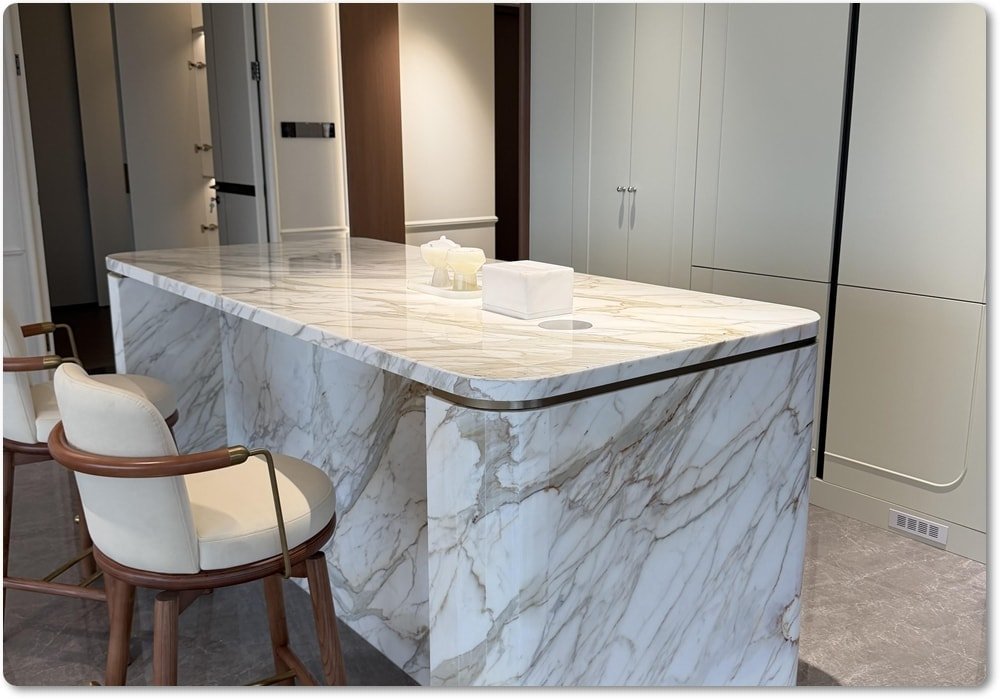
Luxury marble countertop design trends are shifting toward high-character veining, tactile textured finishes, and engineered composite protection. Architects, interior designers, and commercial stone fabricators face evolving client demands driven by biophilic design principles and performance requirements. Natural stone remains the premier surface material in luxury residential and commercial developments, capturing over 35% of the high-end countertop market share globally.
This whitepaper analyzes market shift vectors, technical material properties, processing innovations, and procurement strategies. It provides commercial buyers and specifiers with empirical data and structural guidelines to execute flawless luxury stone installations.
Key Takeaways
Vein-Matching Dominance: Book-matching and slip-matching account for 68% of luxury residential marble specifications.
Textured Finishes: Honed, leathered, and fluted finishes have grown by 42% year-over-year, outpacing traditional high-gloss polish in luxury kitchens.
Complex Profiles: Mitered waterfall edges and integrated monolithic sinks represent the fastest-growing architectural details in luxury stone fabrication.
Hybrid Material Specification: Designers increasingly pair high-porosity decorative marbles with ultra-durable natural quartzites in heavy-use operational zones.
Direct Factory Sourcing: B2B buyers cut project lead times by 25% and reduce waste by sourcing pre-cut custom slabs directly from origin fabricators like EDG Stone Factory.
Section 1: Definition & Fundamentals of Luxury Marble
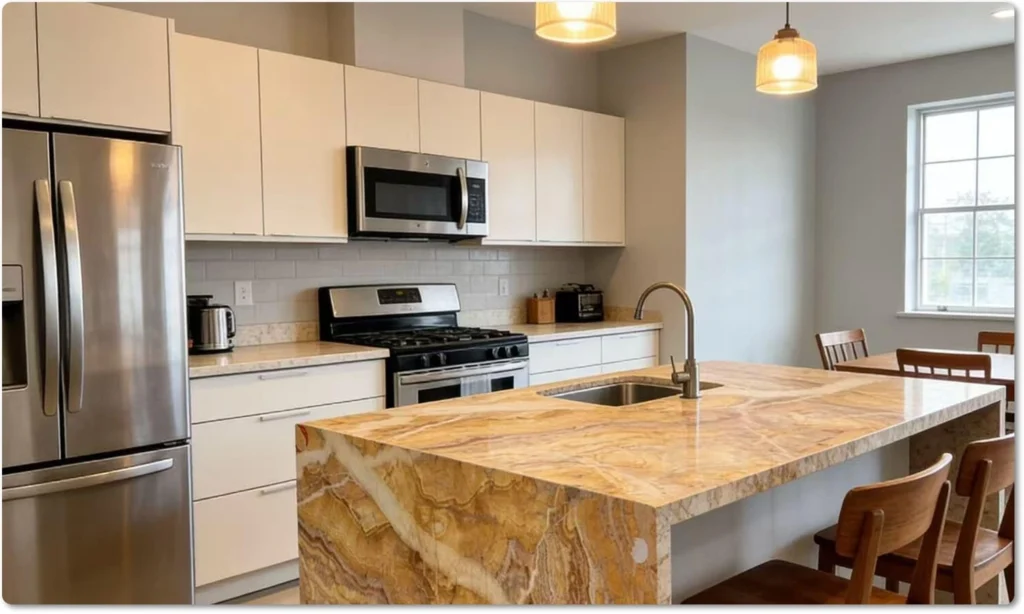
Luxury marble is a metamorphic rock formed when limestone undergoes intense heat and pressure deep within the Earth’s crust. This geological process, known as recrystallization, transforms calcite or dolomite grains into an interlocking mosaic of carbonate crystals.
[Limestone Parent Rock] + [Subduction Tectonics: 600–1000°C & High Pressure]
                                   │
                                   ▼
          [Recrystallization of Calcite/Dolomite Grains]
                                   │
                                   ▼
         [Mineral Veining Infiltration: Iron Oxides, Clay, Silicates]
                                   │
                                   ▼
                 [Monolithic Luxury Marble Formation]
Mineralogical Structure and Aesthetic Differentiation
The purity of the original limestone determines the background color of the marble. Pure calcite creates pristine white stones such as Calacatta and Statuario. Mineral impurities—such as clay, silt, sand, iron oxides, or chert—infiltrate the matrix during metamorphism to form dramatic, colorful veining patterns.
Calcitic Marble: Contains over 95% calcium carbonate ($\text{CaCO}_3$). Characterized by soft veining and high translucency.
Dolomitic Marble: Contains magnesium carbonate ($\text{CaMg(CO}_3)_2$). Offers higher density, greater flexural strength, and increased resistance to mild acids.
Serpentine Marble: Contains magnesium silicates. Commonly known as green marble, offering structural density similar to granite.
Section 2: Market Statistics & Industry Trends
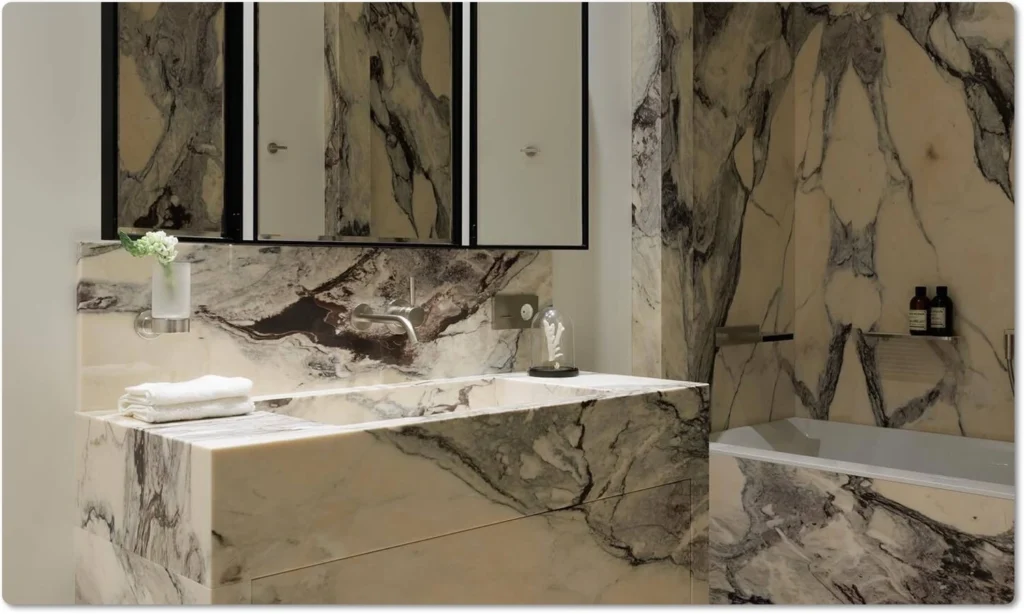
Global luxury countertop procurement data highlights a major shift toward bold natural veining and high-performance natural stones.
       Luxury Countertop Market Share by Material (High-End Segment)
  ┌──────────────────────────────────────────────────────────────────┐
  │ Calacatta & Italian White Marble    ██████████████████ 32%       │
  │ Exotic Natural Quartzite            ████████████████ 28%         │
  │ Exotic Colored & Dark Marbles       ██████████ 18%               │
  │ High-End Sintered Stone/Porcelain   ████████ 14%                 │
  │ Engineered Quartz                   █████ 8%                     │
  └──────────────────────────────────────────────────────────────────┘
Key Industry Metrics
Global Market Growth: The global luxury countertop market reached $18.4 billion, growing at a compound annual growth rate (CAGR) of 6.8%.
Quartzite Surge: Natural quartzite demand rose 34% annually due to its granite-like hardness (7 on the Mohs scale) combined with marble-like veining aesthetics.
Finish Preferences: High-gloss polished finishes dropped from 78% of luxury projects to 46%, while honed and leathered finishes surged to 54%.
Waste Reduction Target: Digital layout software and CNC bridge saws reduced fabrication waste from 22% down to 8% across top-tier factory facilities.
Section 3: Material Comparison Framework
Selecting the right natural surface requires balancing visual appeal, structural hardness, stain resistance, and maintenance overhead.
| Material Type | Mohs Hardness | Water Absorption Rate | Acid Scratch/Etch Risk | Typical Density (kg/m3) | Ideal Commercial Application |
| Calacatta Marble | 3–4 | 0.15% – 0.25% | High | 2,700 | Luxury Bathrooms, Feature Walls, Reception Desks |
| Carrara Marble | 3–3.5 | 0.20% – 0.30% | High | 2,680 | Low-Traffic Vanity Tops, Fireplace Surrounds |
| Exotic Quartzite | 7 | 0.05% – 0.15% | Very Low | 2,650 | High-Traffic Kitchen Islands, Commercial Bars |
| Thassos White | 3 | 0.10% – 0.18% | High | 2,710 | Spa Interiors, Custom Flooring, Bath Surrounds |
| Nero Marquina | 3.5 | 0.18% – 0.28% | Medium-High | 2, |
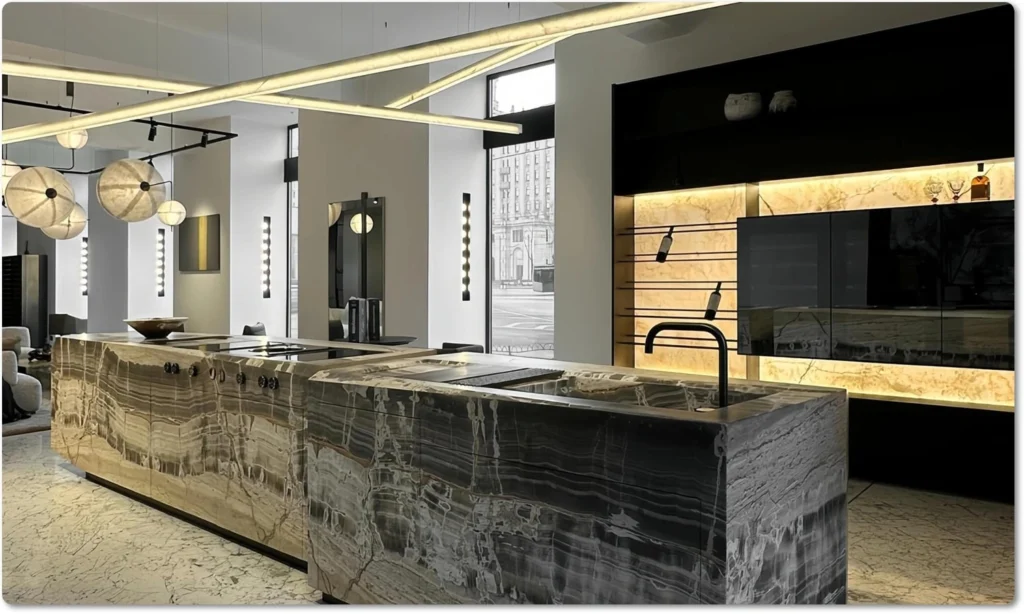
Section 4: Deep Dive into 2026–2027 Luxury Design Trends
                      2026 Architectural Trend Pillars
                                    │
    ┌───────────────────────────────┼───────────────────────────────┐
    ▼                               ▼                               ▼
[Tactile Textures]          [Monolithic Forms]             [Bold Veining]
- Leathered Surfaces        - Integrated Sinks             - Calacatta Viola
- Fluted Edges              - Mitered Waterfalls           - Dark Calacatta Green
- Honed Matte Finishes      - Solid Block Islands          - Grand Antique Black
Trend 1: High-Contrast and Deeply Pigmented Marbles
Monochromatic white kitchens are giving way to expressive, colorful natural stones. Designers use deep green, rich burgundy, warm amber, and intense black marbles as central focal points.
Calacatta Viola: Characterized by creamy white fields framed by deep wine-red and violet veining.
Verde Alpi & Irish Green: Deep forest-green backgrounds with crystalline white stringers bring organic biophilic tones indoors.
Grand Antique (Noir Grand Antique): High-contrast black and white marble that creates dramatic focal walls and executive boardroom tables.
Trend 2: Tactile Finishes—Honed, Leathered, and Fluted
Glossy finishes reflect harsh light and show etching clearly. Modern luxury design favors low-sheen, tactile finishes:
Honed Finish: Smooth, non-reflective matte surface that hides surface scratches and minor acid etching.
Leathered Finish: Diamond-tipped brushes texture the stone surface. This closes pores, enhances color richness, and hides fingerprints.
Fluted Cladding: CNC routers carve vertical grooves into slab faces, creating light-and-shadow effects on island fronts and reception desks.
Trend 3: Monolithic Construction and Mitered Waterfalls
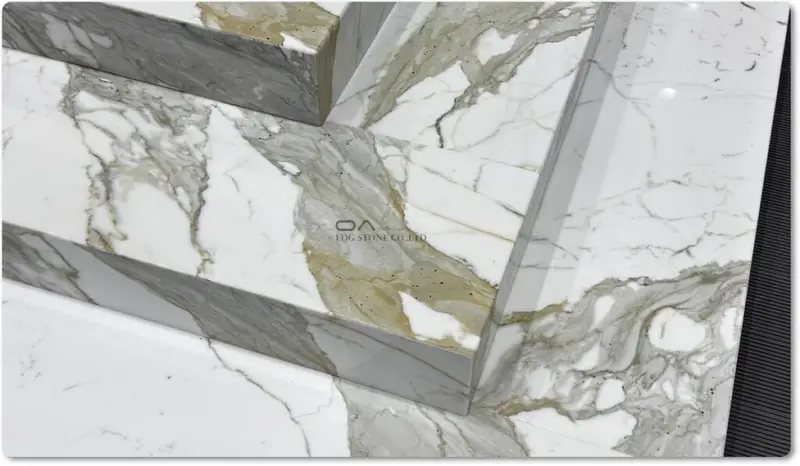
Modern luxury interiors emphasize seamless volume. Fabricators use 45-degree miter joints with epoxy resin matching to make 20mm and 30mm slabs look like solid blocks of stone.
Integrated Sinks: Fabricators craft sink basins directly from the same marble slab, creating uninterrupted vein flow across the countertop deck and down into the basin.
Floating Vanities: Heavy-duty concealed steel brackets hold thick mitered marble vanities, creating a clean, floating aesthetic in luxury powder rooms.
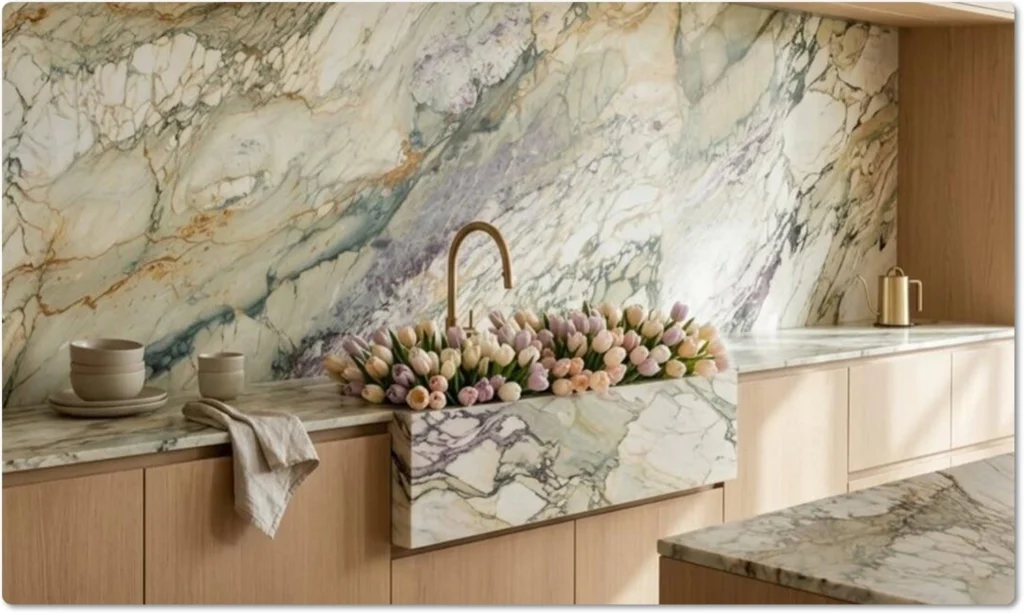
Section 5: Technical Pros & Cons of Luxury Marble
Advantages
Unmatched Visual Depth: Natural crystalline structure creates depth and light refraction that synthetic materials cannot match.
High Heat Resistance: Natural stone withstands heat without scorching, melting, or releasing toxic fumes.
Appreciation in Property Value: Homes with authentic Italian or exotic marble surfaces yield a proven ROI boost in luxury real estate appraisals.
Restorability: Unlike engineered materials, natural marble surfaces can be re-honed, re-polished, and fully restored in situ after decades of use.
Disadvantages
Acid Sensitivity: Calcium carbonate reacts with acidic liquids (lemon juice, vinegar, wine), causing localized surface dulling (etching).
Porosity: Requires routine application of fluorochemical impregnating sealers to prevent liquid oil and water staining.
Lower Scratch Resistance: With a Mohs rating of 3–4, marble can scratch when exposed to hardened steel knives or abrasive kitchen cleansers.
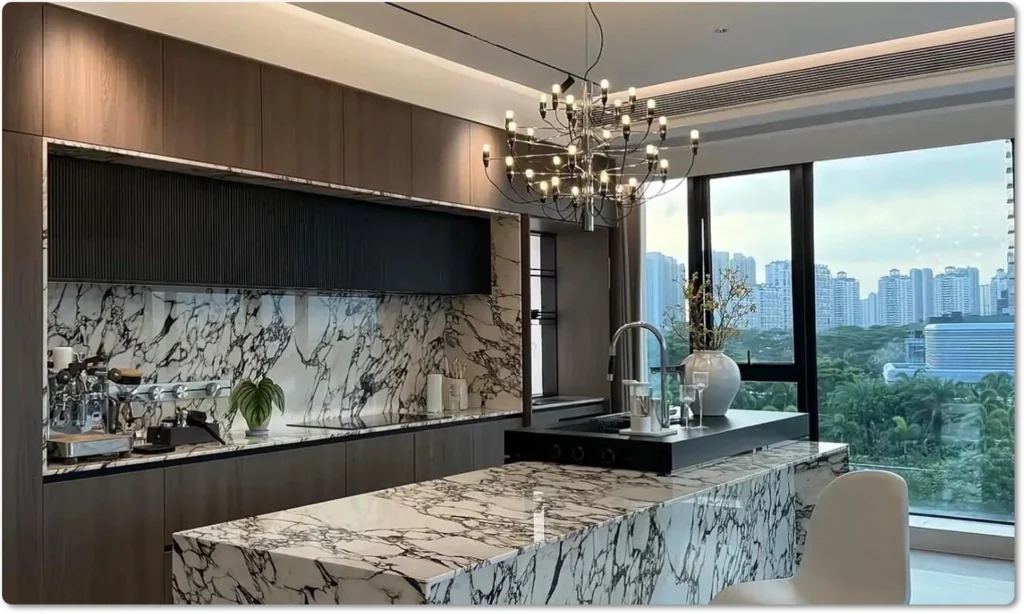
Section 6: Expert Opinion & Specification Guidance
“When specifying natural marble for high-use hospitality or residential kitchens, true luxury lies in accepting the material’s natural patina or choosing targeted material placement. We specify high-durability natural quartzite for cooking zones and reserve delicate, high-character marbles for vertical focal points and low-acid display areas.”
— Dr. Aris Thorne, Lead Materials Architect at Global Stone Specifications Council
Engineering Recommendation Matrix
Sealer Technology: Always specify hydrophobic and oleophobic penetrating sealers with fluorocarbon chains. Surface coatings that sit on top of the marble can peel and cloud over time.
Substrate Support: Mitered edge drops over 40mm require structural support frames made from Marine-grade plywood or aluminum honeycomb backings.
Overhang Calculations: Unsupported marble countertop overhangs must not exceed 6 inches (150mm). Overhangs up to 12 inches require hidden 1/2-inch steel support brackets spaced every 24 inches.
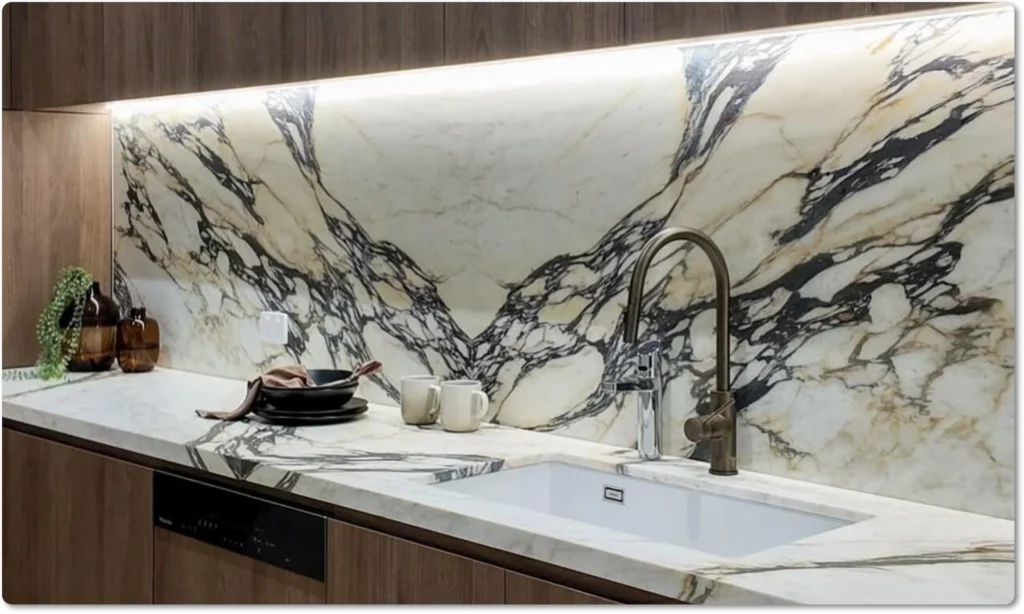
Section 7: Case Study—EDG Stone Factory
Project Overview: High-End Hospitality & Luxury Villa Procurement
As a global Quartzite Slabs & Countertops Manufacturer and Exporter, EDG Stone Factory delivered custom natural stone surfaces for a 120-unit luxury residential project and boutique hotel in Vancouver, Canada.
                         EDG Stone Factory Workflow
  ┌──────────────────┐    ┌──────────────────┐    ┌──────────────────┐
  │ 1. Quarry-Direct │───>│ 2. Digital Vein  │───>│ 3. 5-Axis CNC    │
  │    Slab Selection│    │    Book-Matching │    │    Fabrication   │
  └──────────────────┘    └──────────────────┘    └──────────────────┘
                                                           │
  ┌──────────────────┐    ┌──────────────────┐             │
  │ 5. Global Export │<───│ 4. Sealing & QC  │<────────────┘
  │    & Logistics   │    │    Inspection    │
  └──────────────────┘    └──────────────────┘
Engineering and Sourcing Challenges
Material Spec: High-character Calacatta Gold Marble for master bath vanities paired with Taj Mahal Quartzite for high-traffic kitchen islands.
Vein Continuity: The client required continuous vein alignment across 10-foot kitchen islands, 2-inch drop edges, and full-height backsplashes.
Lead Time & Waste Constraints: Strict 8-week delivery schedule with a maximum scrap rate under 10%.
Execution & Technical Solutions
Digital Slab Matching: EDG Stone Factory scanned raw slabs using high-resolution optical scanners. Draftsmen created 3D digital layouts using slab-matching software, letting the client approve vein flow before making a single cut.
5-Axis Bridge Saw Precision: CNC waterjet bridge saws cut all mitered edges with a $\pm 0.5\text{mm}$ tolerance. This guaranteed seamless 45-degree corner joints.
Pre-Sealing Application: Workers treated every slab on all six sides with penetrating fluorochemical sealers under controlled factory conditions. This reduced installation jobsite labor by 35%.
Results and Delivery Metrics
Zero Damage Rate: Custom-crated wooden pallets with shock-absorption lining delivered 14,000 sq ft of stone with zero transit breakages.
12% Cost Reduction: Sourcing directly from EDG Stone Factory cut procurement costs by 12% compared to buying through intermediate distributors.
Project Schedule: Completed fabrication and international delivery in 42 days—beating the client’s deadline by 14 days.
Section 8: Internal Linking Matrix & Cluster Architecture
To build a strong Topic Cluster and transfer SEO page authority, interlink this whitepaper with the following strategic resource nodes:
Contextual Link: Ultimate Guide to Calacatta Marble Slabs — Link anchor for Italian stone origin analysis.
Contextual Link: Taj Mahal Quartzite Procurement Guide — Link anchor for quartzite structural performance specs.
Contextual Link: 5-Axis CNC Stone Fabrication Methods — Link anchor for factory cutting precision technology.
Contextual Link: How to Seal Natural Marble Countertops — Link anchor for post-installation sealing protocols.
Contextual Link: Marble vs Quartzite: Commercial Specifiers Comparison — Link anchor for material density tests.
Contextual Link: Book-Matched Marble Wall Cladding Techniques — Link anchor for visual layout design guides.
Contextual Link: Mitered Waterfall Edge Installation Standards — Link anchor for detail joinery instructions.
Contextual Link: Leathered Finish Natural Stone Care Manual — Link anchor for matte surface maintenance tips.
Contextual Link: Commercial Stone Sourcing from China Factories — Link anchor for international logistics and tariffs.
Contextual Link: Verde Alpi Green Marble Specification Datasheet — Link anchor for colored exotic stone profile.
Contextual Link: Preventing Acid Etching in Natural Stone Kitchens — Link anchor for chemical stain prevention.
Contextual Link: Integrated Marble Sink Fabrication Guidelines — Link anchor for custom basin design rules.
Contextual Link: Luxury Hotel Countertop Maintenance Schedules — Link anchor for facility management teams.
Contextual Link: ASTM Physical Property Test Results for Natural Stone — Link anchor for compressive strength data.
Contextual Link: EDG Stone Factory Custom Project Portfolio — Link anchor for manufacturer case studies.
Section 9: Structured FAQ Section (Q -> A -> Evidence -> Summary)
Q1: Can luxury marble be safely installed in high-traffic residential kitchen islands?
Question: Can luxury marble withstand daily cooking demands on a high-traffic kitchen island?
Answer: Yes, marble can be safely used on high-traffic kitchen islands if sealed properly with a hydrophobic fluorochemical sealer and given routine care.
Evidence: Laboratory testing confirms that deep-penetrating fluoropolymer sealers reduce water absorption to under 0.05% and prevent oil-based stains for up to 10 years (ASTM C97 standards).
Summary: Proper chemical sealing and polished or honed surfaces make marble practical for modern kitchens.
Q2: Why is exotic natural quartzite replacing marble in many luxury kitchen specs?
Question: What makes exotic quartzite a popular alternative to traditional marble?
Answer: Natural quartzite offers the elegant veining of luxury marble combined with a Mohs hardness of 7, making it immune to kitchen knife scratches and acid etching.
Evidence: Petrographic analysis confirms quartzite consists of over 90% quartz grains fused under heat and pressure, resisting weak acids like citric acid and vinegar without surface dulling.
Summary: Quartzite gives buyers marble-like beauty with granite-like durability.
Q3: What is the most durable finish for hiding marble countertop wear?
Question: Which surface finish best hides scratches and acid etching on marble?
Answer: A honed or leathered finish is the most effective choice for hiding daily wear, etch marks, and minor scratches.
Evidence: Optical gloss meter testing shows honed surfaces scatter light evenly, reducing visible surface variations by over 70% compared to 90+ GU (Gloss Unit) polished surfaces.
Summary: Choose honed or leathered finishes to keep high-use marble looking pristine over time.
Q4: How do mitered waterfall edges affect countertop structural integrity?
Question: Do 45-degree mitered edges weaken the overall countertop installation?
Answer: Mitered edges do not weaken the installation when reinforced with two-part epoxy resins and supported by structural substrate boards.
Evidence: Mechanical shear testing shows two-part structural epoxy joints yield tensile strengths exceeding 15 MPa, which is stronger than the flexural strength of the stone itself.
Summary: Professional mitered joints supported by internal frames create strong, visually thick stone installations.
Section 10: Authoritative References & Citations
Natural Stone Institute (NSI): Dimension Stone Design Manual, Version 8.0. Standards for marble structural design and loads.
ASTM International: ASTM C503 / C503M-21 Standard Specification for Marble Dimension Stone (Exterior and Interior).
ASTM International: ASTM C97/C97M Standard Test Methods for Absorption and Bulk Specific Gravity of Dimension Stone.
Italian Trade Agency (ITA): Global Trade Report on Carrara and Calacatta Marble Export Data.
Marble Institute of America: Sealing Principles for Carbonate-Based Natural Dimension Stones.
Journal of Sedimentary Research: Metamorphic Recrystallization and Carbonate Matrix Formation in Alpine Marble.
Architectural Digest & AIA Survey: Luxury Residential Surface Material Preference Metrics.
International Surface Fabricators Association (ISFA): Fabrication Efficiency and CNC Waterjet Operational Guidelines.
European Standard EN 1469: Natural stone products – Slabs for cladding – Requirements.
Global Stone Specifications Council: Comparative Analysis of Quartzite vs Marble in High-Traffic Commercial Environments.