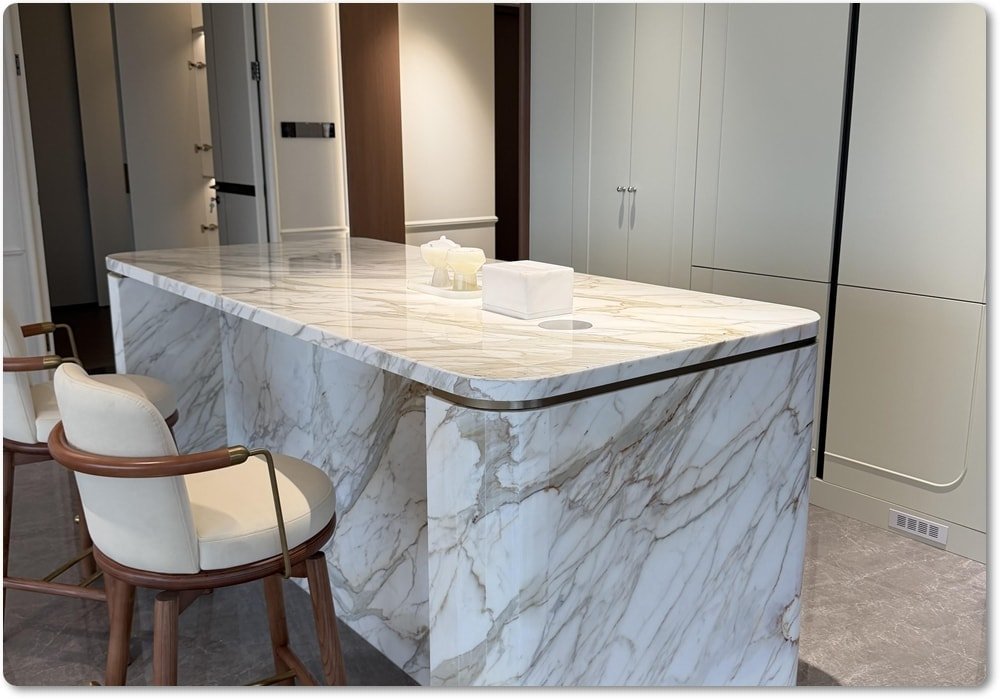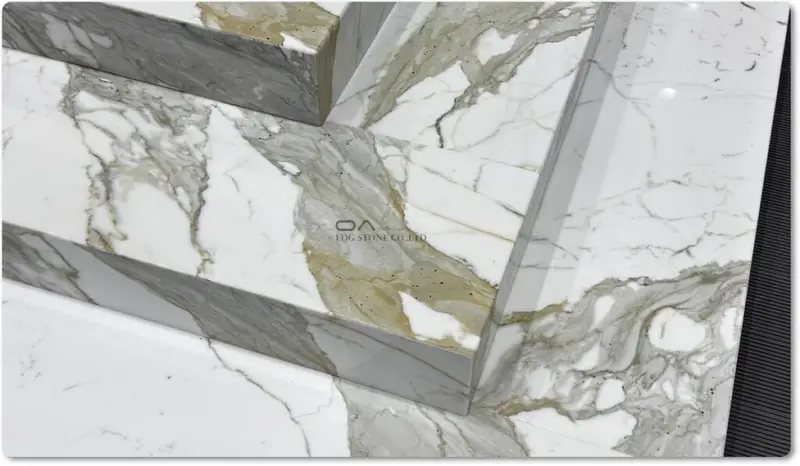
Choosing the right format of natural stone determines the success of high-end interior projects. Interior designers, real estate developers, and stone procurement managers frequently face a critical choice: should they invest in large-scale marble slabs or opt for versatile white marble tiles?
Both formats deliver the timeless, sophisticated aesthetic of natural stone. However, they differ significantly in raw material cost, structural performance, labor demands, and architectural application.
This comprehensive technical guide breaks down the core distinctions between white marble formats. We analyze material properties, installation realities, application suitability across residential and commercial sectors, and direct procurement strategies.
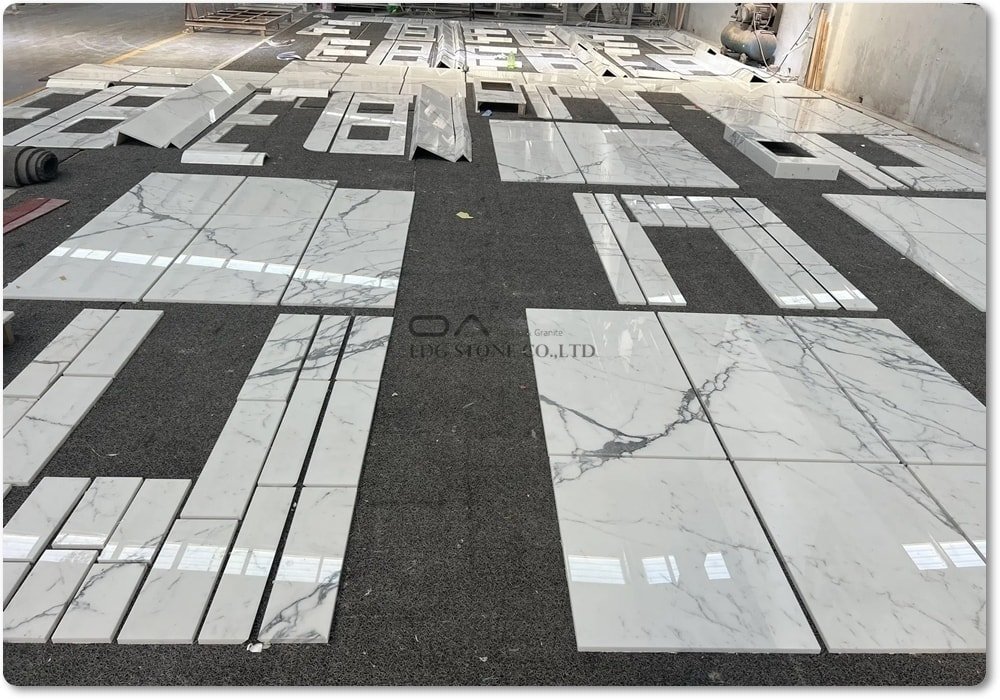
1. Material Architecture: Defining Slabs and Tiles
Understanding the distinction between a slab and a tile requires looking at how quarries extract and process natural stone. The physical dimensions, thickness variations, and finishing methods dictate how these materials perform under structural loads.
Technical Characteristics of Marble Slabs
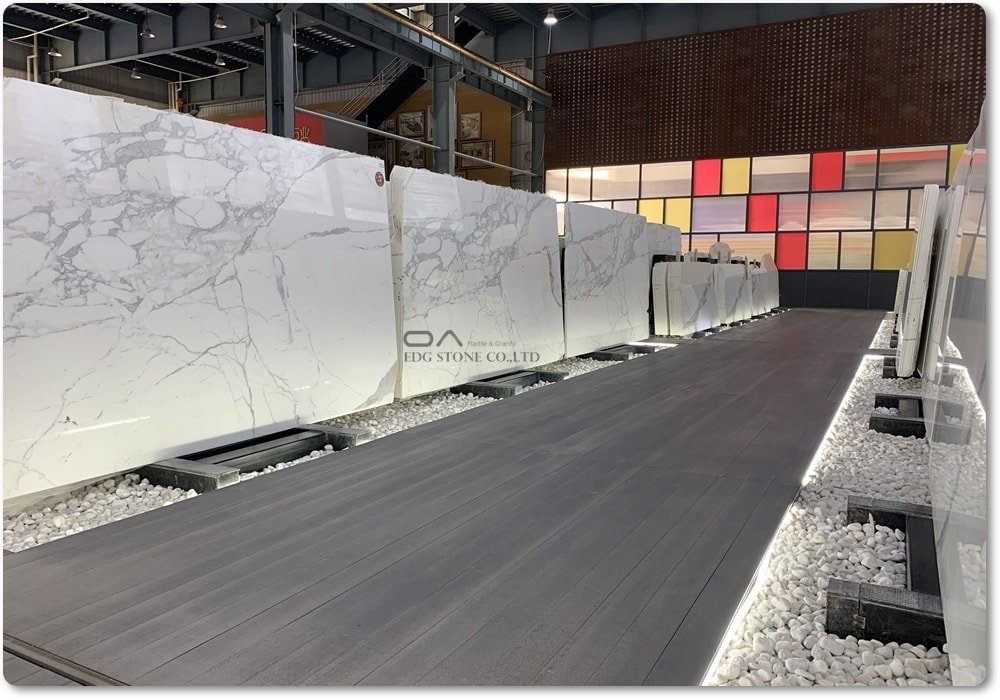
A marble slab is a large, continuous sheet of natural stone sliced directly from a quarried block. Slabs serve as raw material for custom fabrication rather than for off-the-shelf installation.
Average Physical Dimensions: Slabs generally range from 105 inches to 130 inches in length and 60 inches to 80 inches in height ($2700 \text{ mm} \times 1600 \text{ mm}$ to $3300 \text{ mm} \times 2000 \text{ mm}$).
Standard Thickness Profiles: The global stone industry standardizes slabs at $20 \text{ mm}$ ($3/4 \text{ inch}$) and $30 \text{ mm}$ ($1 \text{ } 1/4 \text{ inches}$). Custom architectural specifications may require $40 \text{ mm}$ or $50 \text{ mm}$ profiles for structural load-bearing elements.
Surface Finishes: Fabricators process the surface to specific requirements. Common options include high-gloss polished, matte honed, textured leathered, or anti-slip acid-washed.
The Bookmatch Phenomenon: True bookmatching involves polishing consecutive slabs from the same block on opposite sides. When placed side-by-side, the natural veining opens up like a mirror image, creating a symmetrical pattern. This premium technique requires precise slab sequence tracking during extraction and processing.
Technical Characteristics of White Marble Tiles
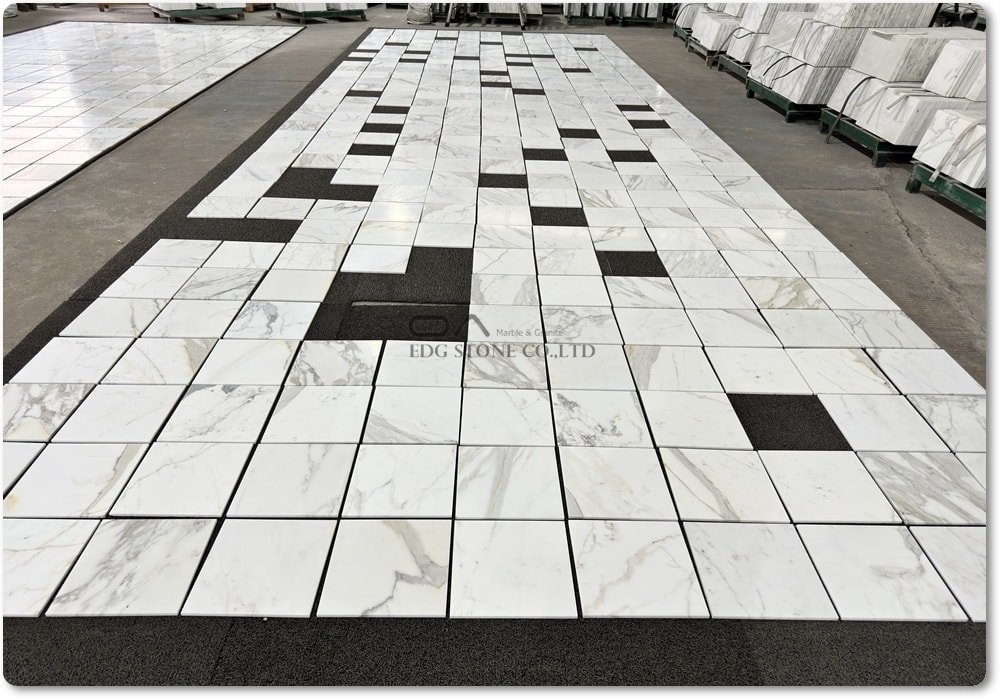
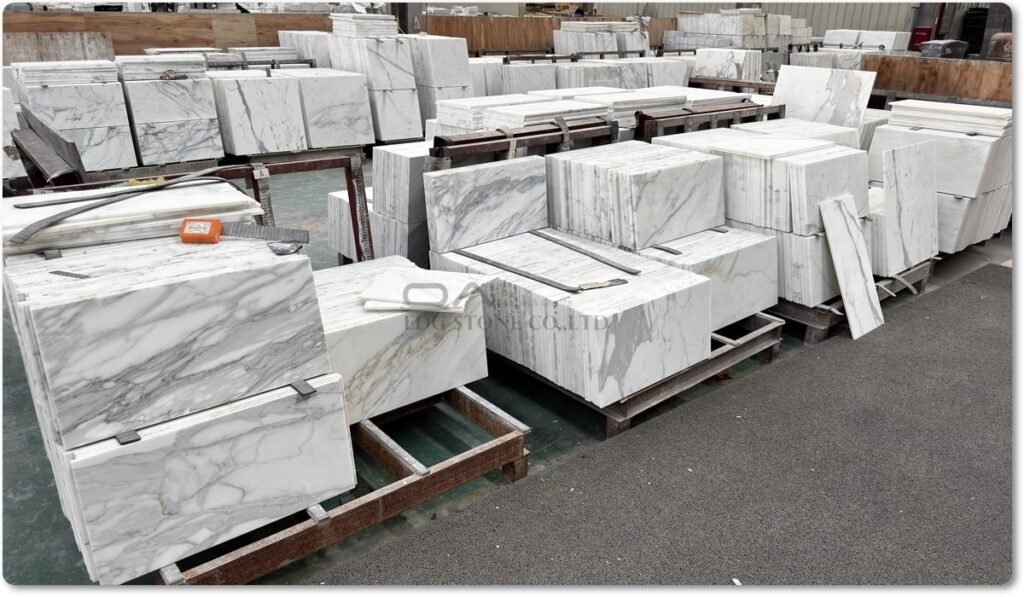
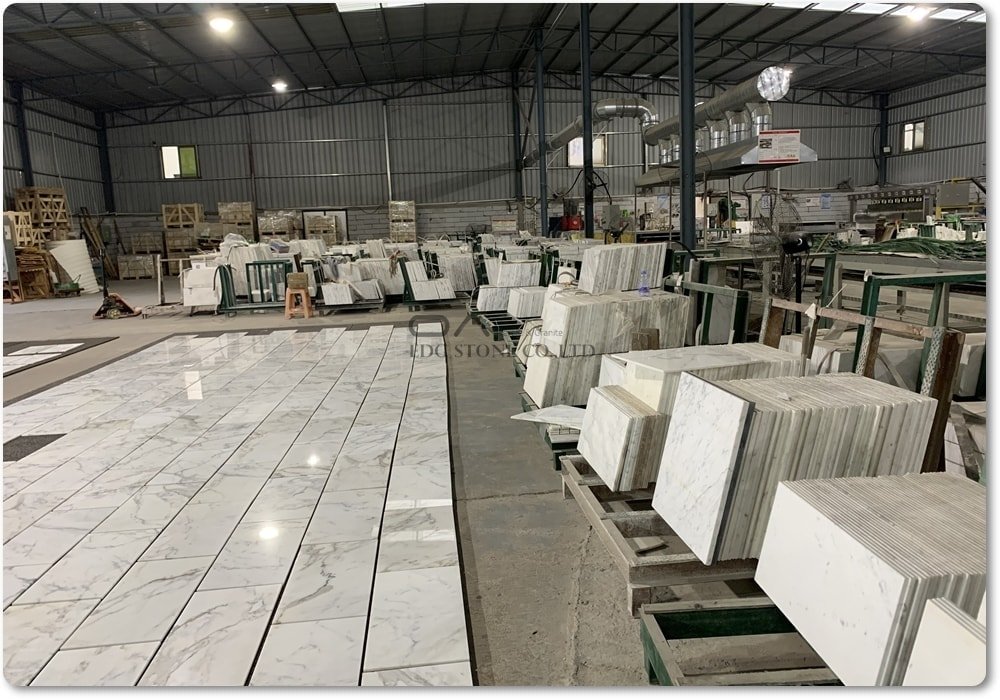
White marble tiles are standardized geometric units manufactured from smaller blocks or block remnants. Factories pre-cut and pre-finish these elements for direct installation.
Standard Geometric Formats: Common industry sizes include $12 \times 12 \text{ inches}$, $12 \times 24 \text{ inches}$, $24 \times 24 \text{ inches}$, and modern large-format tiles measuring $36 \times 36 \text{ inches}$. The white marble tile in a 12×24 format remains the commercial standard due to its balanced aspect ratio and ease of handling.
Standard Thickness Profiles: Tiles feature much thinner cross-sections than slabs to reduce structural weight. Standard thickness ranges from $10 \text{ mm}$ ($3/8 \text{ inch}$) to $12 \text{ mm}$ ($1/2 \text{ inch}$). Large-format options may go up to $15 \text{ mm}$.
Edge Calibration: High-quality tiles undergo mechanical rectification. This process grinds the tile edges to a perfect 90-degree angle with tight tolerances ($\pm 0.5 \text{ mm}$). Rectified edges allow installers to use minimal grout lines ($1.5 \text{ mm}$), creating a cleaner visual plane.
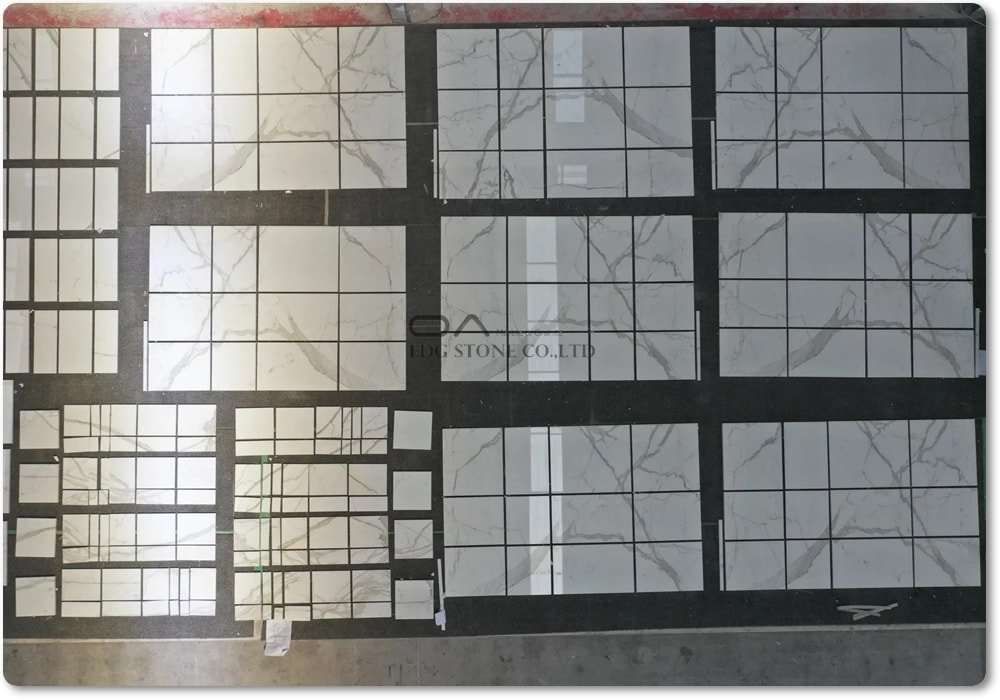
2. Comparative Matrix: Engineering & Financial Performance
Selecting between slabs and tiles requires balancing aesthetics against physical realities and budget boundaries. The following engineering matrix provides a side-by-side technical comparison based on industry testing standards.
Structural and Economic Comparison
| Engineering Metric | White Marble Slabs | White Marble Tiles |
| Grout Joint Density | Zero internal joints; monolithic surface | High density ($1.5 \text{ mm} – 3.0 \text{ mm}$ spacing intervals) |
| Average Material Cost | $60 – $250+ per sq. ft. (FOB Quarry) | $8 – $30 per sq. ft. (Wholesale Distribution) |
| Average Installation Cost | $40 – $120 per sq. ft. (Requires heavy rigging) | $10 – $35 per sq. ft. (Standard thin-set methods) |
| Structural Mass (Weight) | ~14.5 lbs/sq. ft. ($20 \text{ mm}$ thickness) | ~7.2 lbs/sq. ft. ($10 \text{ mm}$ thickness) |
| Flexural Strength Index | Lower tolerance for subfloor deflection | Higher tolerance due to independent joint movement |
| Material Yield Waste Rate | 15% – 35% (Due to custom perimeter cutting) | 5% – 10% (Standardized layout allocation) |
3. Structural Application Analysis by Scenario
Material dimensions and physical thickness dictate where slabs and tiles perform best. Using the wrong format can cause structural failure, telegraphing cracks from the subfloor, or water intrusion.
Floor Systems: High-Traffic and Residential Loadings
Floor designs must account for structural deflection and impact resistance.
White Marble Floor Tiles: Tiles excel in expansive floor areas. The network of grout joints acts as a built-in expansion pathway, absorbing minor shifts in the subfloor. This flexibility minimizes the risk of hairline fractures across the natural stone.
Slabs for Flooring: Specifying full-scale slabs for flooring requires an engineered, deflection-free concrete slab substrate. Installers use a thick mortar bed method. This layout offers a premium look but increases the overall weight load on the building’s structure.
Wall Systems: Vertical Anchoring and Aesthetics
Vertical installations must manage gravity loads and require secure mechanical anchoring.
The Seamless Wall Feature: Slabs provide an unbroken visual field. They work well for bookmatched feature walls in luxury lobbies or high-end residential spaces. Installers anchor these heavy vertical panels using stainless steel clips and epoxy, bypassing thin-set adhesives.
Standard Wall Tiling: Pre-cut tiles are lighter and easier to install on vertical surfaces. Installers can secure them directly to cement backer boards using standard polymer-modified thin-set mortars. This approach is highly efficient for standard commercial fit-outs and standard residential walls.
Wet Environments: Bathroom and Kitchen Systems
Moisture management and chemical resistance are critical in kitchens and bathrooms.
Bathroom Systems: Splashing water and high humidity can damage natural stone. Using large slabs in showers eliminates grout lines, which removes the primary weak point where mold and moisture collect. Conversely, small tiles work best for shower floors. The frequent grout joints provide the necessary traction to prevent slipping.
Kitchen Systems: Kitchen countertops experience high mechanical stress, impact, and acid exposure. Slabs are the standard choice here; their $20 \text{ mm}$ or $30 \text{ mm}$ thickness provides the structural strength needed for cutouts like under-mount sinks. Tiles on countertops create regular grout lines that can harbor food particles and staining agents.
4. Case Study: Global Sourcing and Alternatives
EDG Stone Factory Case Analysis
While white marble remains an industry favorite for luxury spaces, commercial projects often face budget constraints, strict timelines, and demanding durability requirements. In these situations, engineering procurement managers frequently look to alternative materials like high-performance quartzites or engineered surfaces.
EDG Stone Factory is a prominent global Quartzite Slabs & Countertops Manufacturer and Exporter. Their international project workflows highlight a shifting trend in commercial stone procurement.
[Raw Material Selection] ---> [Multi-Axis CNC Shaping] ---> [Resin Vacuum Infusion] ---> [Export Quality QC Check]
Procurement Optimization Data
Analysis of large-scale commercial hospitality projects shows that substituting or mixing white marble with hard quartzites improves long-term performance:
Scratch Resistance: Quartzite registers a 7 on the Mohs Hardness Scale, outperforming classic white marble, which ranks at 3 to 4.
Acid Resistance: Engineered quartzites resist etching from mild acidic commercial cleaners, which helps lower long-term maintenance costs.
Logistical Efficiency: Sourcing pre-fabricated components directly from integrated manufacturers like EDG Stone reduces raw material waste from 25% to less than 4%.
5. Technical Decision-Making Framework
To select the correct material format, project managers can use this structured decision framework based on the project’s core parameters.
Is the application a Countertop/Feature Wall?
 ├── YES: Select WHITE MARBLE SLABS (Or Quartzite Slabs for high-wear areas)
 └── NO:  Evaluate Area Size & Budget Constraints
           ├── High Budget / Seamless Design Req. -> Select LARGE FORMAT SLABS
           └── Commercial / High Floor Area --------> Select WHITE MARBLE TILES (12x24 or 24x24)
Technical Evaluation Protocol
Verify the Load-Bearing Capacity: Ensure the floor assembly meets or exceeds standard deflection limits ($L/720$) before specifying thick marble slabs.
Calculate Traffic and Slip Risks: For wet public spaces, specify honed or textured tiles rather than high-gloss polished slabs to ensure public safety.
Review the Total Lifecycle Budget: Factor in regular maintenance costs. Slabs require periodic professional polishing, while tile installations require deep grout cleaning and resealing.
6. Technical Entity Knowledge Base (FAQ)
Question
Why do white marble slabs cost more per square foot than pre-cut white marble tiles?
Answer
Slabs require premium, crack-free stone blocks during extraction. The processing steps involve specialized multi-blade gang saws or diamond wire saws that generate significant material waste. Additionally, moving, storing, and shipping full-size slabs require specialized heavy machinery and heavy A-frame shipping containers, which drive up logistics and handling fees.
Evidence
Data from the Natural Stone Institute (NSI) shows that processing large slabs requires stone blocks without internal fissures. Only about 15% to 20% of quarried marble blocks meet the structural requirements for full-size slab production. The remaining stone is cut down into smaller blocks to manufacture standardized tiles.
Question
Can I install 12×24 white marble floor tiles over an existing wood subfloor?
Answer
You cannot install marble tiles directly over a standard plywood subfloor. Wood expands and contracts with changes in humidity, which creates movement that can crack brittle natural stone tiles or pop grout joints. Installers must first stiffen the subfloor with an approved cement backer board or apply a specialized uncoupling membrane using polymer-modified thin-set mortar.
Evidence
The Tile Council of North America (TCNA) Handbook, Method F141, requires all natural stone floor installations to rest on a rigid substrate with a maximum deflection index of $L/720$ under full load conditions.
Question
How often should you seal white marble surfaces in commercial applications?
Answer
High-traffic commercial installations require sealing with a deep-penetrating fluoropolymer sealer every 6 to 12 months. Food service areas like countertops or kitchen backsplashes may need more frequent sealing depending on usage.
Evidence
ASTM C97 testing shows that natural marble maintains an average water absorption rate of 0.1% to 0.15%. Applying a penetrating sealer fills these microscopic pores without altering the stone’s appearance, blocking water and oil-based staining agents from altering the matrix.