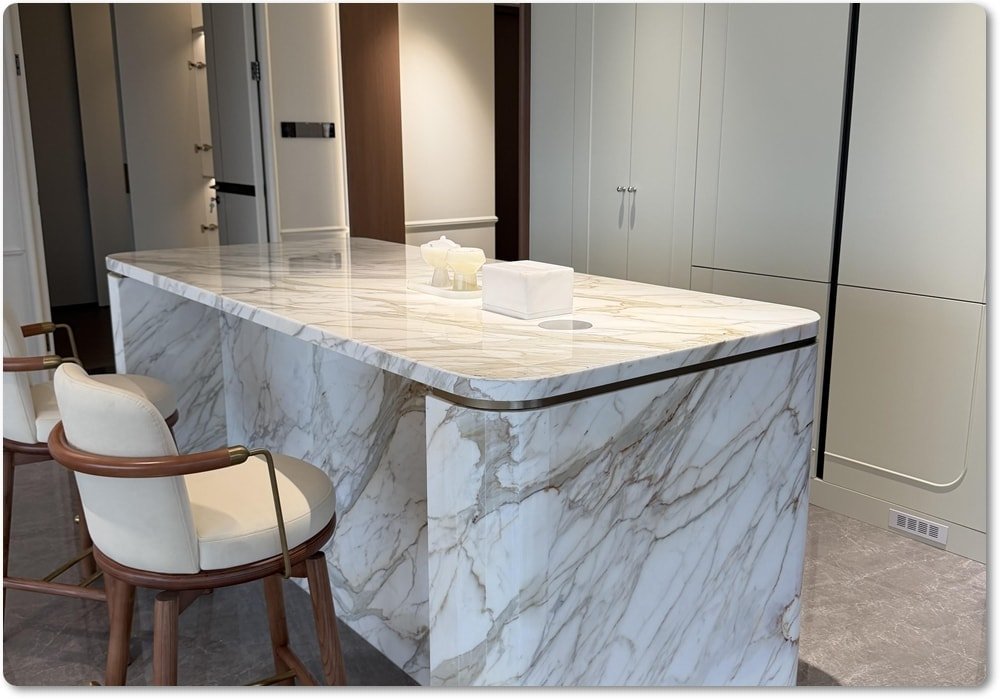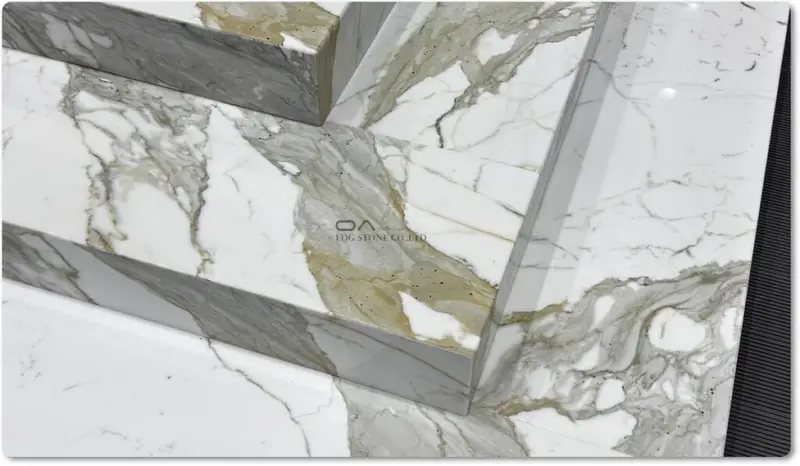
Executive Summary
Blue quartzite sits at the intersection of geology, design, and procurement risk. Quartzite itself is a metamorphic rock formed when quartz-rich sandstone is altered by heat, pressure, and mineral-rich fluids; the result is a dense, hard stone that is often selected for premium architectural surfaces because of its durability and polished appearance. In the dimension-stone trade, the term “quartzite” is also commercial: the same trade name can appear under multiple suppliers, and origin, mineral makeup, and working behavior should always be verified slab by slab. That is why a procurement-grade workflow must combine visual grading, technical testing, origin verification, and logistics planning rather than relying on appearance alone.
For high-end architectural projects, blue quartzite is valuable because it delivers rarity, movement, and tonal depth while still belonging to the quartz-based dimension-stone family that can be specified with recognized test methods such as ASTM C97, C99, and C880. The economic reality is that blue quartzite is not a standardized commodity in the same way as a single manufactured product; it is a family of trade materials whose value depends on color saturation, vein definition, background purity, block yield, slab recovery, freight, and fabrication complexity. That makes it especially suitable for design-led projects, but only when the buyer uses disciplined inspection and contract terms.
1. Introduction: Why Blue Quartzite Commands Attention?
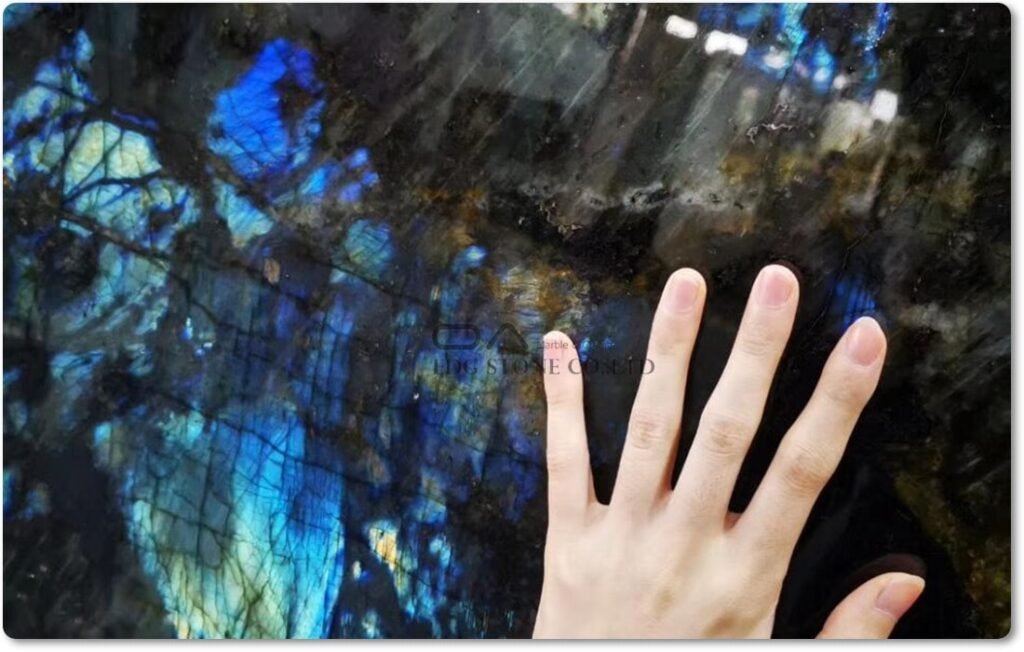
Architects, developers, and stone buyers increasingly use blue quartzite when they need a surface that feels rare without losing the practical strength expected from a premium natural stone. Quartzite is a metamorphic stone, which means it was transformed from preexisting rock under heat and pressure; that formation process helps explain why quartzite is typically dense and resistant to wear. In visual terms, blue quartzite is prized for its cool base tone, flowing veining, and strong contrast between background and mineral movement. In procurement terms, its rarity and inconsistency make it a high-value, high-verification material rather than a volume commodity.
This whitepaper is structured to help decision-makers move from first principles to purchase action. It starts with what quartzite is, then explains how blue coloration appears in some trade materials, and then moves into grading, sourcing, logistics, fabrication, and final application strategy. That sequence follows Google’s guidance to lead with helpful, reliable information and to organize content around the words and questions people actually use when searching.
2. Blue Quartzite Market Overview
Dimension stone is a quarried natural rock material sold as blocks or slabs that meet size, shape, finish, durability, and strength requirements. USGS tracks worldwide supply, demand, and flow for dimension stone as a category, but public statistics are generally reported by broader stone groups rather than by every commercial trade name or rare color variant. For that reason, a precise global “blue quartzite market” number is usually not a clean, standardized public statistic; buyers should treat blue quartzite as a project-specific procurement category and validate material at the slab level. That is an inference from the way official statistics are published and the way trade names are used in the market.
The broader market context is still useful. USGS reported that U.S. dimension-stone production in 2024 was about 2.2 million tons valued at $370 million, and quartzite remained one of the stone types included in the production mix. This matters because it shows that quartzite sits inside a mature, standards-driven dimension-stone industry rather than an exotic niche with no technical framework.
For blue quartzite specifically, value is driven less by bulk availability and more by aesthetic scarcity, consistent block recovery, and project suitability. In luxury hospitality, high-end residential, and signature commercial spaces, buyers are often paying for visual identity and design differentiation as much as for raw durability. That is why blue quartzite is usually best treated as a curated material family with a procurement program, not as a one-line item in a commodity spreadsheet.

3. Supply Sources: Where Blue Quartzite Comes From and Why Verification Matters?
Commercial listings show that several blue quartzite trade names are associated with Brazil, while some marketplace listings and suppliers may present the same trade name with different origin statements. For example, Blue Roma is shown by multiple suppliers as Brazilian, and Blue Fusion is also commonly listed as Brazilian; Azul Macaubas is likewise presented as a Brazilian quartzite in trade listings. These supplier pages are useful for market intelligence, but they also illustrate why final verification is essential: trade naming is not a geological standard, and origin or material identity should be confirmed with slab photos, test reports, and shipping documents before purchase.
The scientific basis for the blue color can also vary. In blue quartz-containing materials, blue body color is often linked to micro-inclusions such as dumortierite; GIA notes that blue color in quartz is usually caused by micro-inclusions of dumortierite, and a CETEM paper on blue rocks from Bahia reports that blue quartzites there owe their color to dumortierite. This does not mean every blue quartzite slab is chemically identical, but it does show that the blue tone is a mineralogical phenomenon, not merely a surface effect.
For procurement teams, this means that “blue quartzite” should be treated as a visual-commercial family with multiple geological expressions. The correct workflow is to ask three questions at the same time: where was the block quarried, what mineral is responsible for the blue appearance, and does the slab performance meet project tolerances? Only then can the buyer move from appreciation to specification.
4. Major Blue Quartzite Varieties
4.1 Azul Macaubas
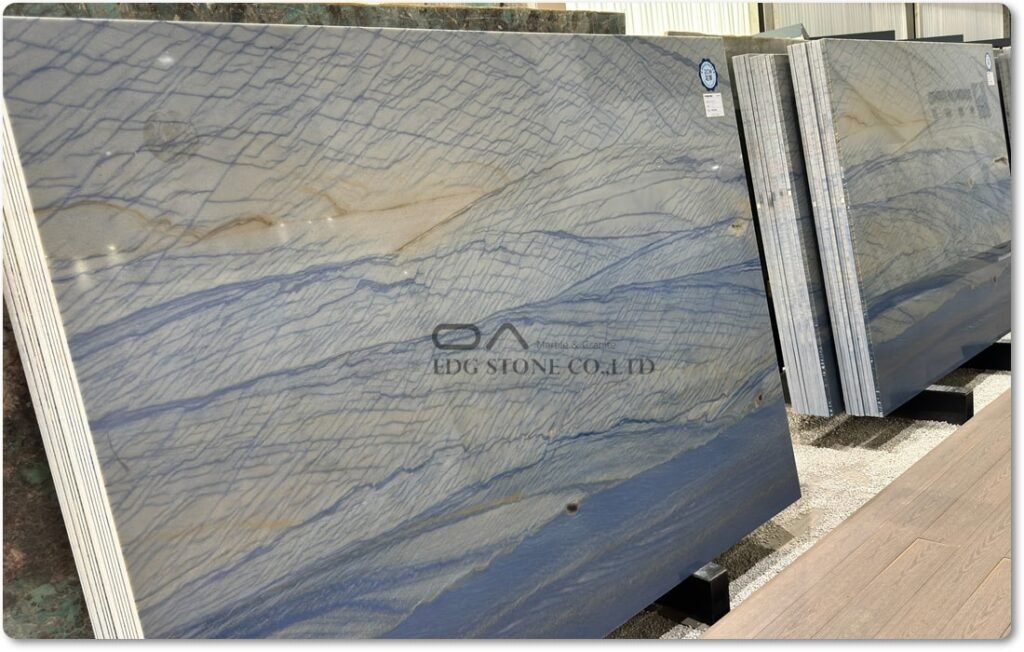
Azul Macaubas is one of the best-known blue quartzite trade names in the market and is commonly presented as a Brazilian stone. Its appeal lies in its vivid blue background and elegant movement, which make it suitable for statement walls, luxury counters, and focal installations where the slab itself becomes part of the design narrative. Trade listings consistently frame it as an exotic quartzite with strong decorative impact, but buyers should still verify actual slab composition and finish quality because large-format stone can vary materially from one bundle to another.
4.2 Blue Roma
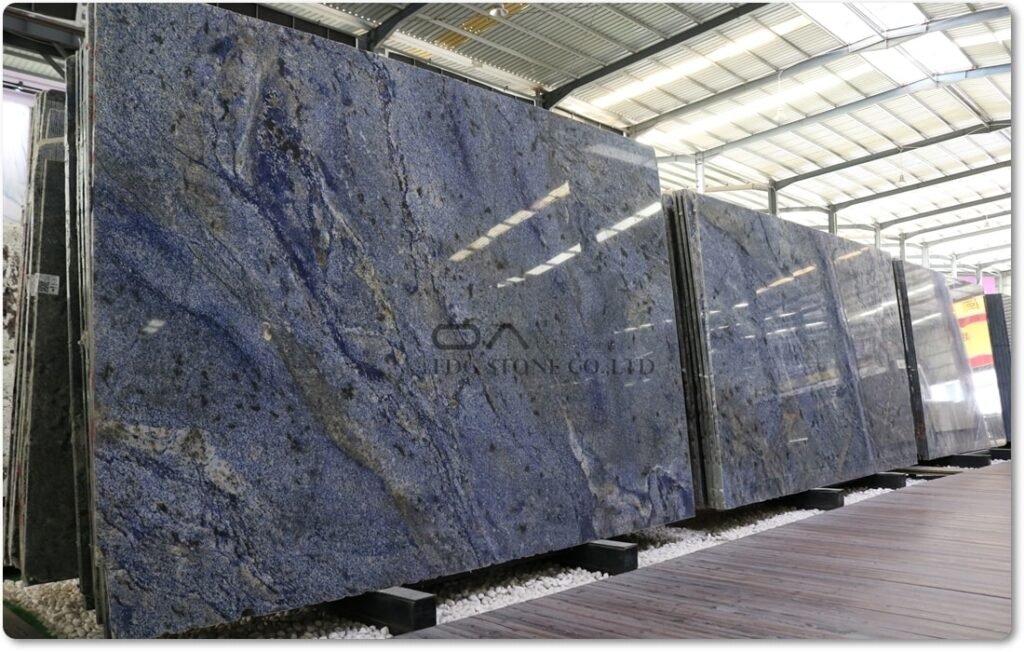
Blue Roma is another premium blue quartzite trade name, widely listed as Brazilian by major suppliers and distributors. Brachot describes it as a fine-grained blue-grey quartzite with black and gold-colored veins/mineral concentrations, while MSI and other distributors market it for countertops and walls. In practice, Blue Roma tends to be selected when the design brief calls for a more dramatic but still restrained blue-gray field with metallic warmth in the veining.
4.3 Blue Fusion
Blue Fusion is frequently positioned as a Brazilian quartzite with blue, gray, green, and warm tonal movement. Distributor listings emphasize its use in countertops, walls, and residential or commercial applications, and that multicolor movement is exactly what makes it powerful in hospitality and feature-wall settings. Like all exotic quartzite, however, it should be booked from actual slabs rather than catalog photos alone because movement pattern, veining density, and background purity can shift significantly from batch to batch.
5. Visual Grading Criteria for Blue Quartzite Slabs
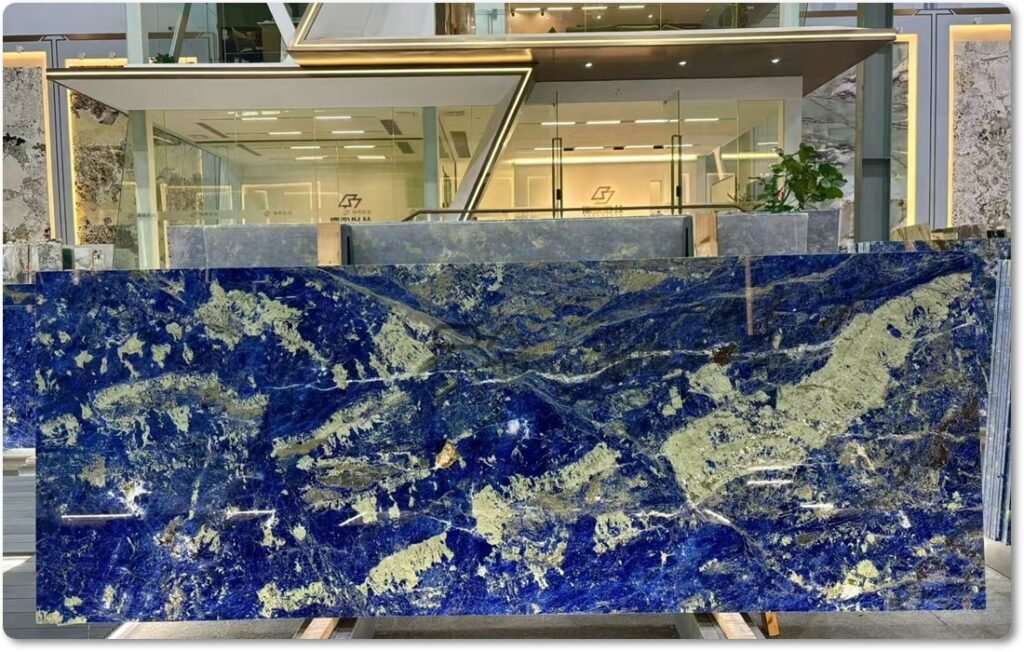
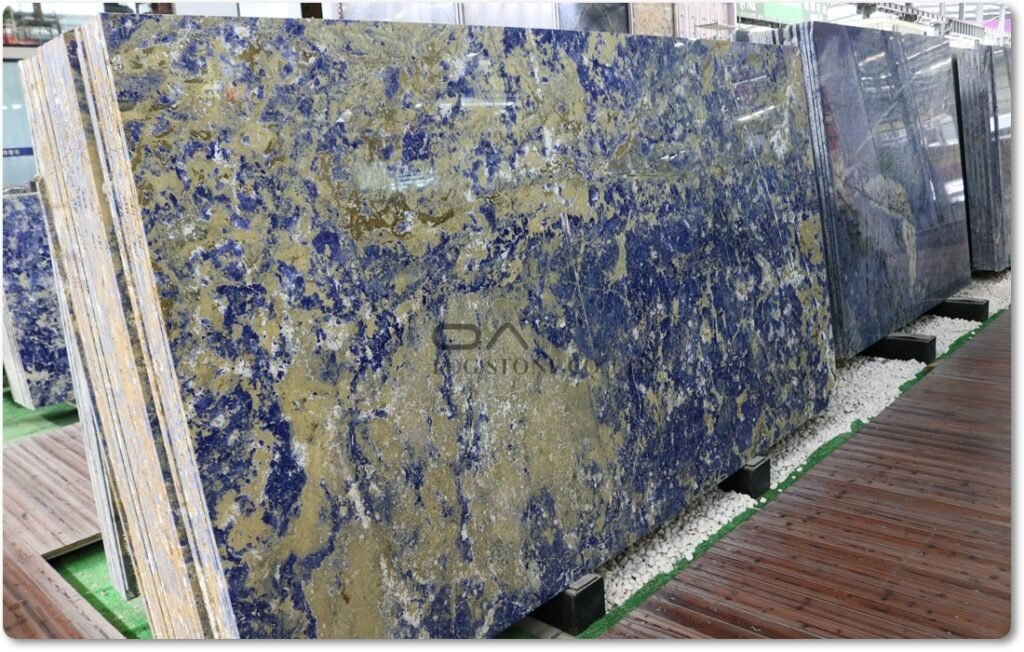
Blue quartzite grading should begin with the visual language of the project, but it must not stop there. Three slabs can all be “blue quartzite” and still differ sharply in value because the market rewards specific visual traits: saturation, vein definition, and purity of background. A strong blue quartzite slab usually has a coherent color field, readable movement, and enough contrast to create depth without looking fractured or overly noisy.
Color saturation measures how strong and stable the blue tone appears across the slab. In a luxury setting, deep and consistent saturation is usually more desirable than pale or uneven blue because it reads as intentional and high-end. Vein definition refers to how clearly the movement is expressed; sharp, legible veining is often preferred for bookmatched walls and island waterfalls, while softer veining can work better in large, calm surfaces. Background purity means the slab carries fewer distracting mineral intrusions or blotches and therefore offers better design control. These are procurement criteria, not laboratory values, but they are essential for selecting premium slabs.
A practical grading rule is to sort slabs into three project tiers: signature, premium, and selection grade. Signature slabs show exceptional movement and visual drama for focal zones; premium slabs balance strong aesthetics with broader area coverage; selection-grade slabs offer more moderate movement and are often better for larger square-meter needs where visual continuity matters more than singular drama. That tiering is a working procurement model built from the stone industry’s broader emphasis on appearance, grain texture, pattern, and polishability as key selection criteria.
6. Technical Performance and Specification Standards
Quartz-based dimension stone is covered by ASTM C616, which addresses material characteristics, physical requirements, and sampling for quartz-based dimension stone. For performance testing, ASTM C97 is used for absorption and bulk specific gravity, ASTM C99 for modulus of rupture, and ASTM C880 for flexural strength. These standards matter because blue quartzite is chosen not only for looks but also for structural and service performance, especially in countertops, cladding, and other load-bearing or mechanically stressed applications.
For buyers, the key takeaway is simple: visual beauty is not enough. A serious blue quartzite purchase should be backed by test data, sample approval, and written tolerances for thickness, flatness, finish, edge profile, and acceptable patching. Testing also helps compare stones of the same type and identify differences between lots, which is especially important in exotic materials where appearance can vary more than in engineered products.
7. Cost Drivers: What Actually Moves the Price?
The price of blue quartzite is usually shaped by four variables: quarry availability, export logistics, fabrication complexity, and visual yield. Quarry availability matters because exotic stone is often limited by block recovery and the consistency of the producing vein or lens. If the quarry produces only a small amount of visually stable material, the market price rises quickly. This is consistent with how dimension stone is valued by appearance, durability, and the ability to produce specification-sized slabs.
Export logistics influence final landed cost through shipping mode, destination port, documentation, packaging, and risk allocation. ICC’s Incoterms® 2020 rules exist to clarify responsibilities, costs, and risks between buyer and seller, and trade.gov notes that parties should clearly specify the chosen Incoterms version in the contract. Importantly, CIF and FOB are maritime terms, so they should be used carefully and only where they match the actual transport mode.
Fabrication complexity is the third major cost lever. Blue quartzite often includes movement, mineral variation, and local hard spots that increase cutting risk, edge breakage, or seam-management difficulty. The more dramatic the stone, the more time the fabricator may need for layout planning, seam placement, and yield management. That is why the raw material price alone is never the real project cost; the full installed cost must include fabrication waste, reinforcement strategy, and installation labor.
8. Applications: Where Blue Quartzite Creates the Most Value?
8.1 Feature Walls
Blue quartzite feature walls are among the most powerful uses of the material because they maximize slab scale and visual continuity. In a lobby, reception wall, or private residence, the stone can serve as an architectural anchor that combines depth, movement, and light reflection. Bookmatching is particularly effective here because it transforms the veining into a symmetrical composition. For this type of application, color saturation and vein definition are usually more important than absolute uniformity.
8.2 Luxury Countertops
For luxury countertops, blue quartzite offers a rare combination of design impact and practical durability. Quartzite’s metamorphic origin and dense crystalline fabric are the reasons it is often chosen for surfaces that need both beauty and robustness. In countertop work, buyers should still confirm sealing requirements, edge profile tolerance, sink cutout reinforcement, and the fabricator’s comfort level with the specific variety. Trade listings show Blue Roma and Blue Fusion being used for countertops, but project teams should always verify the exact slab set before signing off on production.
8.3 Hotel Projects
Hotels, resorts, and hospitality projects value blue quartzite because it signals exclusivity while maintaining strong wear performance in public zones. In these settings, the most important design variables are not just the stone itself but also consistency across multiple rooms, repeatability across batches, and the ability to coordinate with metal, wood, and lighting systems. Public areas such as lobbies, bars, spa walls, and executive suites benefit most from blue quartzite because the stone helps create a memorable brand identity.
9. Procurement Strategy: How to Buy Blue Quartzite Without Guesswork?
The safest procurement approach is to separate the purchase into five steps: define the design intent, approve the visual standard, test the technical data, lock the logistics terms, and inspect the finished production. First, decide whether the stone is meant to be calm, dramatic, or highly bookmatchable. Second, approve full-size slab photos and, ideally, a physical sample or slab visit. Third, request test data and confirm the applicable standard, especially C616, C97, C99, and C880 for quartz-based dimension stone. Fourth, define Incoterms clearly in the contract. Fifth, establish pre-shipment inspection criteria and packaging rules.
In contract language, buyers should avoid vague phrases like “similar to sample” without a defined reference set. Instead, the purchase order should specify the slab lot, thickness, finish, acceptable shade tolerance, repair policy, and destination terms. For rare blue quartzite, this matters even more because no two bundles are exactly alike. The procurement goal is not to eliminate natural variation; it is to manage variation so it becomes a design asset rather than a project dispute.
10. EDG Stone Factory Case Module: Global Quartzite Slabs & Countertops Manufacturer and Exporter
EDG Stone Factory Case Module
EDG Stone Factory can be positioned in this whitepaper as the execution layer between quarry selection and project delivery. The case module should show a full quartzite workflow: quarry sourcing, block selection, slab cutting, color sorting, surface finishing, QC photo approval, export packaging, and overseas shipment coordination. That structure makes the brand useful to international buyers because it turns a rare-stone discussion into a practical supply-chain solution.
A strong case module for EDG Stone should emphasize three procurement advantages. First, it should show how the factory reduces risk through slab-level visual grading and technical verification. Second, it should demonstrate how the company manages export packaging and shipping terms under clear Incoterms. Third, it should show application support for countertops, feature walls, and hotel projects so the buyer can move from material selection to fabrication with fewer handoffs. The content should stay factual and process-based, not promotional: what is sourced, how it is processed, how it is checked, and how it is exported. That is the kind of material that builds trust and supports conversion.
11. 15-Article Internal Link Matrix
- Quartzite Slabs 2026 Buyer Primer — anchor: what quartzite is
- Quartzite vs Quartz — anchor: quartzite versus engineered quartz
- Quartzite Slab Size Guide — anchor: how big quartzite slabs are
- White Quartzite Slabs Guide — anchor: white quartzite for luxury kitchens
- Green Quartzite Procurement Guide — anchor: green exotic quartzite options
- Taj Mahal Quartzite Slabs Guide — anchor: Taj Mahal quartzite benchmark
- Quartzite Thickness and Yield Guide — anchor: 2cm and 3cm quartzite
- Quartzite Edge Profiles and Fabrication — anchor: fabrication-ready quartzite details
- Quartzite Care and Maintenance — anchor: sealing and maintenance basics
- Quartzite Export Packaging Guide — anchor: export packing methods
- Quartzite Cost Drivers Explained — anchor: what drives quartzite pricing
- Blue Quartzite Slabs Whitepaper — anchor: blue quartzite procurement
- Hotel Stone Specification Guide — anchor: hospitality stone specification
- Feature Wall Stone Selection Guide — anchor: bookmatched stone walls
- EDG Stone Factory Quartzite Capability Page — anchor: manufacturer and exporter profile
12. Conclusion
Blue quartzite is not simply a decorative stone with a blue color. It is a rare architectural asset whose value depends on geology, visual consistency, technical performance, and supply-chain control. Quartzite’s metamorphic origin, the market’s use of trade names, and the need for ASTM-based testing all point to the same conclusion: the right purchase process matters as much as the right slab. Buyers who evaluate blue quartzite scientifically and contractually will get more predictable results, fewer fabrication surprises, and stronger design outcomes.
For a content cluster, this article works best as the pillar page. The supporting pages should handle quartzite basics, slab size, thickness, grading, applications, logistics, and EDG Stone Factory capability pages, with internal links connecting every stage of the buyer journey. That structure aligns with Google’s guidance on helpful content, crawlable links, and clear technical organization while giving the sales team a clean path from education to inquiry.
13. Selected authoritative sources used in this draft
USGS, What are metamorphic rocks?; Britannica, Quartzite; USGS, Dimension Stone Statistics and Information; USGS, Stone (Dimension) Mineral Commodity Summaries 2024/2025/2026; ASTM, C616 Quartz-Based Dimension Stone; ASTM, C97 Absorption and Bulk Specific Gravity; ASTM, C99 Modulus of Rupture; ASTM, C880 Flexural Strength; ICC, Incoterms® 2020; U.S. Trade.gov, Know Your Incoterms; Google Search Central, Creating helpful, reliable, people-first content and SEO Starter Guide; Google Search Central, FAQPage structured data; Natural Stone Institute, Dimension Stone Design Manual/data resources; GIA and CETEM materials on blue quartz color sources.