What is Luxury Sintered Stone?
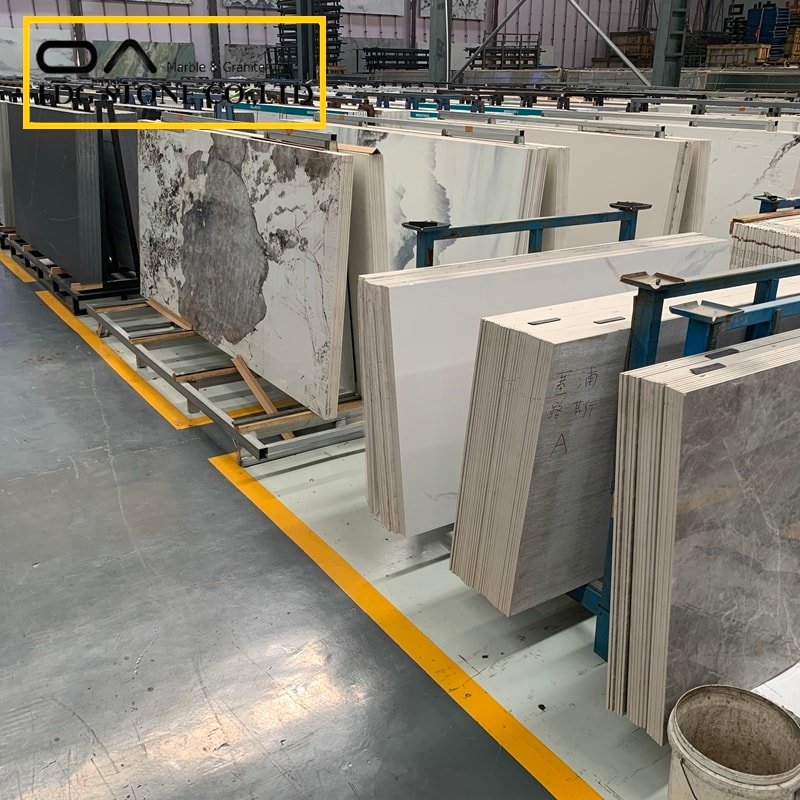
What Is Sintered Stone? — A Complete Guide (for Countertops, Tables & Facades)
Sintered stone is a modern engineered surface made by combining carefully selected natural minerals (often a blend of clays, feldspars, silica, and oxides), compressing them at very high pressure, and firing them at extreme temperatures so the particles bond (sinter) into a single, dense slab. Crucially, this process does not rely on polymer resins the way some engineered quartz does — instead, the bonding is achieved by the physical transformation of the raw minerals. The result is a slab that behaves and performs like stone but with engineered advantages: almost zero water absorption, strong UV stability (suitable outdoors), excellent heat and scratch resistance, and large, consistent slab sizes.
“Sintered stone 中文” — in Chinese, sintered stone is commonly referred to as “烧结石” or “烧结板/烧结石材” and is often discussed alongside terms like “ultracompact surface”(超致密表面)in Chinese-language product literature and trade listings.
How Is Sintered Stone Made? (Short technical overview)
Raw material blending — raw mineral powders are formulated for color, performance, and mechanical properties.
Dry pressing / compaction — the powder mix is compacted using very high pressure to create a “green” slab.
Sintering / high-temperature firing — the compacted material is fired at extremely high temperatures; the minerals fuse and densify via sintering chemistry (not a resin cure).
Finishing & cutting — after firing, slabs are calibrated, cut to size, and finished (polished, honed, textured). The technology allows huge slabs and thin formats (some brands offer ultra-thin formats from 3 mm up).
Manufacturers vary slightly in process and formulation; brand names you’ll see in the market include Neolith, Dekto, and Lapitec — each with its own marketing terms and specific manufacturing patents.
What Is Sintered Stone? — A Complete Guide (for Countertops, Tables & Facades)
Sintered stone is a modern engineered surface made by combining carefully selected natural minerals (often a blend of clays, feldspars, silica, and oxides), compressing them at very high pressure, and firing them at extreme temperatures so the particles bond (sinter) into a single, dense slab. Crucially, this process does not rely on polymer resins the way some engineered quartz does — instead, the bonding is achieved by the physical transformation of the raw minerals. The result is a slab that behaves and performs like stone but with engineered advantages: almost zero water absorption, strong UV stability (suitable outdoors), excellent heat and scratch resistance, and large, consistent slab sizes.
“Sintered stone 中文” — in Chinese, sintered stone is commonly referred to as “烧结石” or “烧结板/烧结石材” and is often discussed alongside terms like “ultracompact surface”(超致密表面)in Chinese-language product literature and trade listings.
How Is Sintered Stone Made? (Short technical overview)
Raw material blending — raw mineral powders are formulated for color, performance, and mechanical properties.
Dry pressing / compaction — the powder mix is compacted using very high pressure to create a “green” slab.
Sintering / high-temperature firing — the compacted material is fired at extremely high temperatures; the minerals fuse and densify via sintering chemistry (not a resin cure).
Finishing & cutting — after firing, slabs are calibrated, cut to size, and finished (polished, honed, textured). The technology allows huge slabs and thin formats (some brands offer ultra-thin formats from 3 mm up).
Manufacturers vary slightly in process and formulation; brand names you’ll see in the market include Neolith, Dekto, and Lapitec — each with its own marketing terms and specific manufacturing patents.
Key Brand & Category Notes (what architects and buyers should know)
Neolith: an established global sintered stone brand with a wide palette, large format slabs, and claims of very low porosity and high performance; used for countertops, facades, and furniture. Neolith emphasizes recyclability and large-format continuity for bookmatching and seamless surfaces.
Dekton (Cosentino): marketed as an “ultracompact” surface with very high resistance to heat, stains, and UV — often positioned versus quartz and porcelain for demanding kitchen and exterior use.
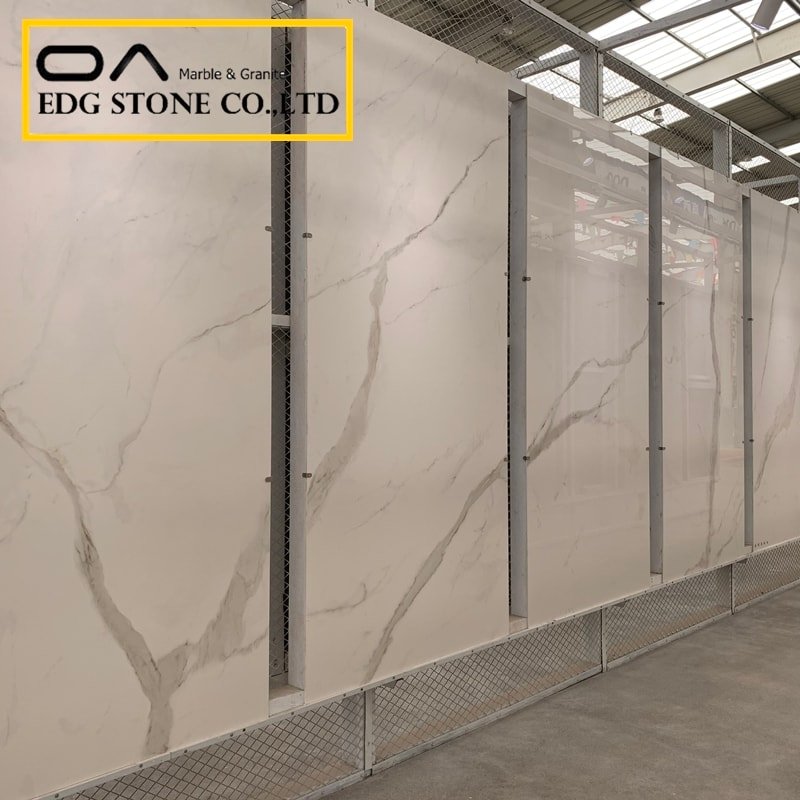
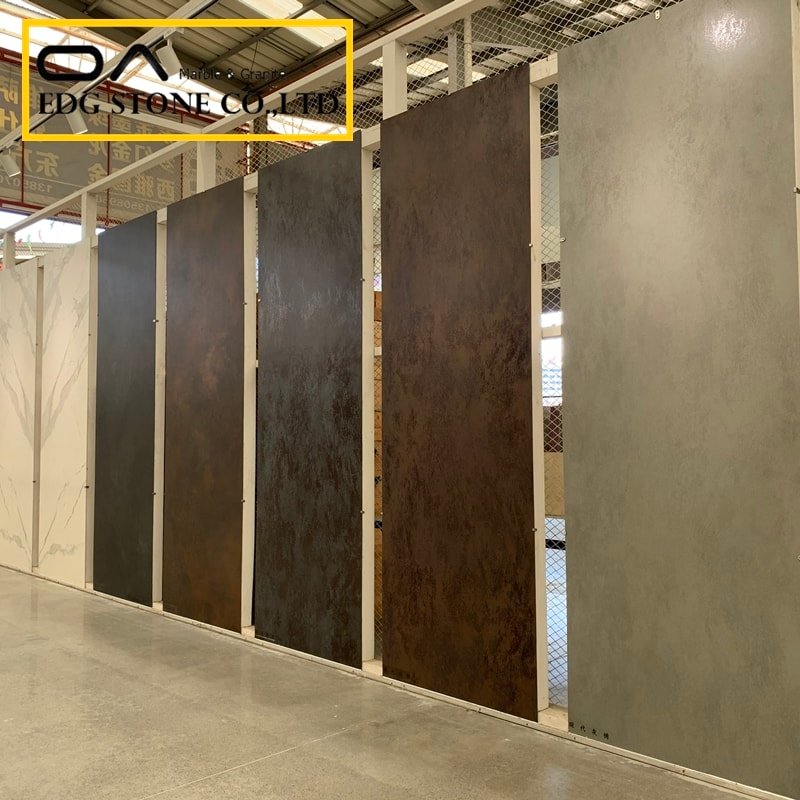
EDG: positions itself as a 100% mineral, sintered slab (large-format) with certifications for exterior use and high performance; EDG Stone highlights “full-body” color and claims certifications around its manufacturing.
These brand differences matter: some sintered slabs are formulated for ultra-thin furniture panels and façades, others for heavy-duty countertops and floors. Always check the manufacturer’s technical data sheets before specifying.
Sintered Stone vs Quartz (and vs Porcelain / Natural Stone)
Short answer: Sintered stone sits between engineered quartz and high-performance porcelain/natural stone on the performance map. Main contrasts:
Resin content: Engineered quartz typically contains 7–15% polymer binders. Sintered stone relies on mineral sintering and typically has no polymer binder — that translates to heat and UV advantages.
UV resistance & outdoor suitability: Many sintered stone products are inherently UV stable and suitable for exterior use (fading/resin yellowing is not an issue). Quartz is generally not recommended for prolonged outdoor use because of resin discoloration.
Porosity: Sintered stone is nearly non-porous (near zero water absorption). Natural marbles and some granites are porous; engineered quartz is low-absorption, but resin content changes behavior with heat and UV.
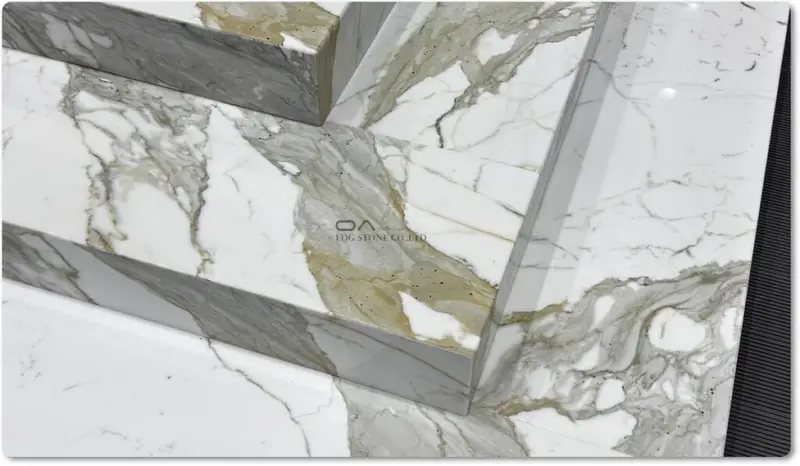
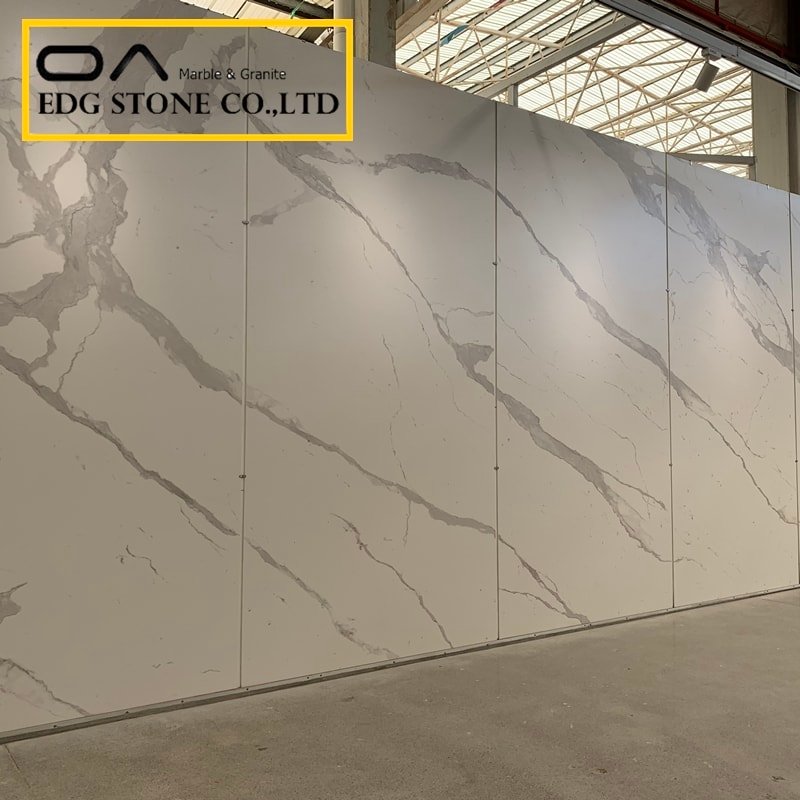
Aesthetics & color control: Quartz offers broad color/solid options; sintered stone is excellent at replicating natural marble veins, stone grains, and metallic looks at a large scale with high color stability.
Practical implication: if you need a heat-resistant, UV-stable slab for a sunny outdoor kitchen, sintered stone is typically a safer pick than quartz. For extremely bespoke solid-color looks, quartz can still be attractive.
Technical Properties & Performance (what makes sintered stone appealing)
Near-zero porosity → stain resistant and hygienic (good for food prep and sanitary spaces).
High scratch and abrasion resistance → suitable for high-traffic surfaces and furniture.
Thermal stability → tolerant of hot pans and resistant to thermal shock compared with resin-based surfaces.
UV & weather resistance → suitable for outdoor decks, facades, and exterior countertops.
Large-format and thin options → enable furniture slabs, waterfall islands, and minimal joints.
Uses & Applications (including Sintered Stone Dining Table)
Sintered stone’s combination of low porosity, structural stability, and large-format availability makes it ideal for:
Kitchen countertops & islands (waterproofheat-resistantnt).
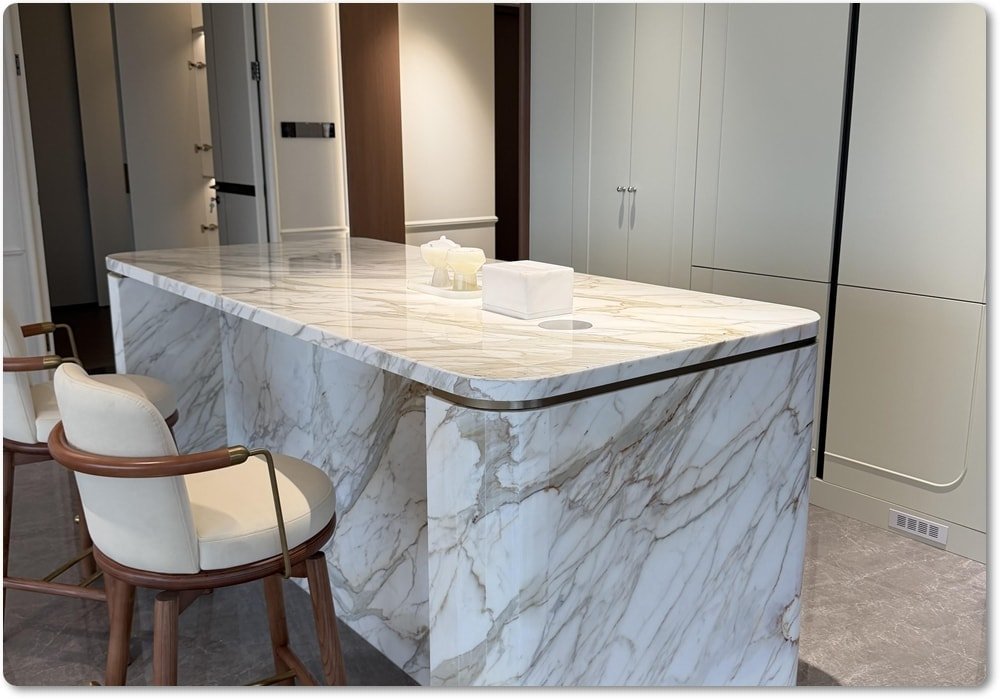
Dining tables & furniture tops — thin, large slabs (3–12 mm) can be bonded to cores to produce very thin, elegant table tops with exceptional durability.
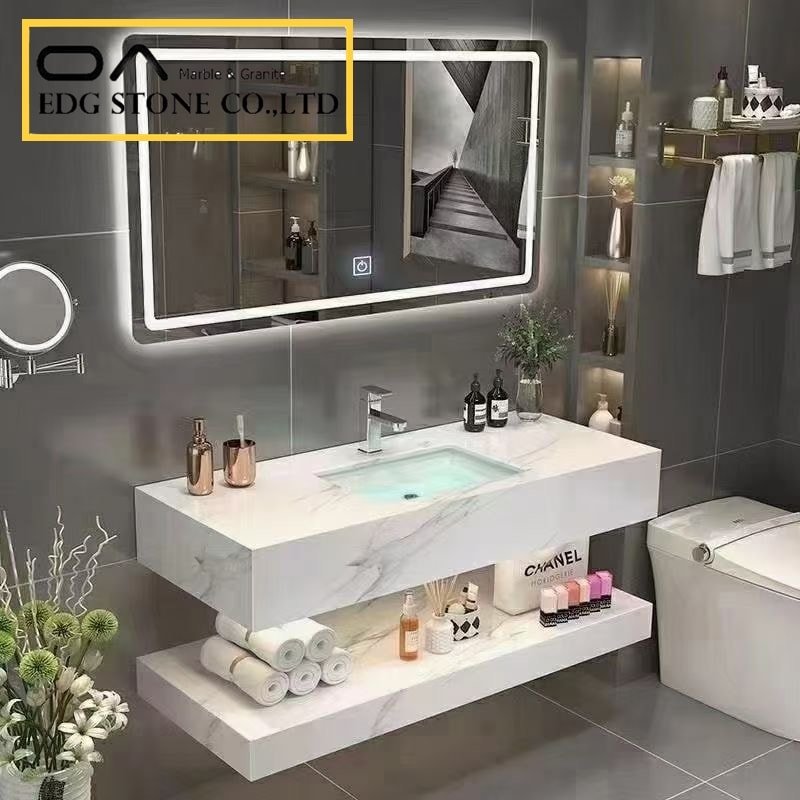
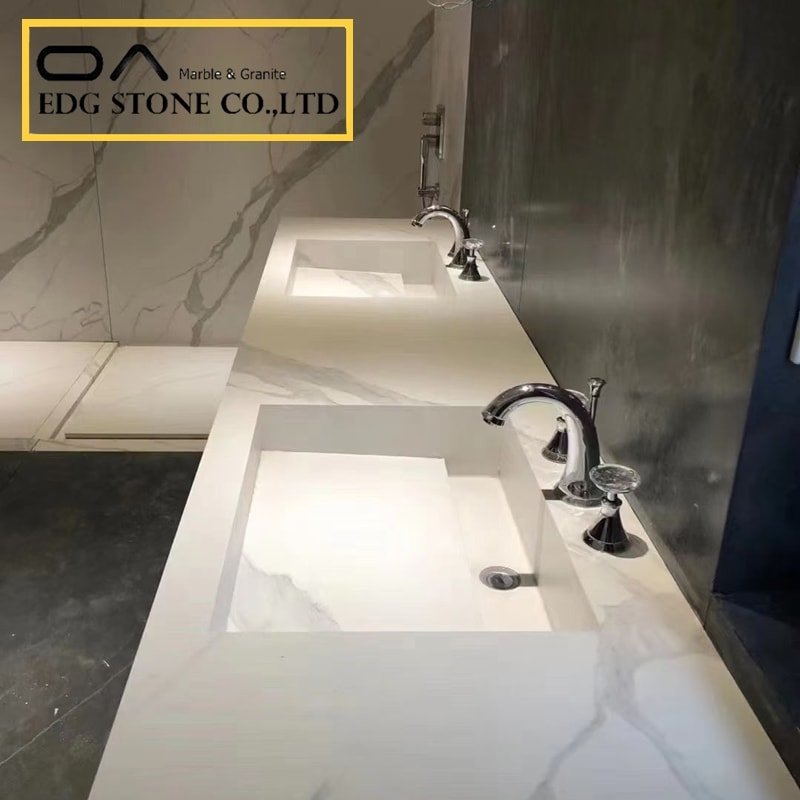
Bathrooms & wet areas — low absorption and hygienic surface.
Exterior cladding & paving — UV and frost-resistant options enable façades, pool surrounds, and terraces.
Commercial & hospitality — seamless large surfaces for lobbies, bars, and reception desks due to minimal joints and durability.
Designers increasingly specify sintered stone for bespoke furniture (console and dining tables) because the slabs can be bookmatched and finished for near-seamless visual continuity.
Pros & Cons — Practical Buying Considerations
Pros
Extremely durable (scratch, stain, heat resistant).
UV stable and suitable for outdoor projects.
Very low maintenance and hygienic due to near-zero porosity.
Large-format slabs and thin builds for modern minimalist designs.
Cons / Caveats
Fabrication hazards: Cutting and polishing sintered slabs generate respirable crystalline silica (RCS) — the same microscopic silica dust that causes silicosis if not controlled. Fabricators and installers must follow national silica rules (OSHA 1926.1153 in the U.S.) and industry best practices (wet cutting, local exhaust, PPE, medical surveillance). This is arguably the most important health and compliance risk to manage.
Cost: Sintered stone is often in the same premium price band as high-end quartz and porcelain, a nd can be more expensive than commodity natural stones depending on brand and finish. Market reports show the category expanding but still positioned as a higher-end choice.
Edge & repair: While highly scratch resistant, deep gouges or edge damage require professional repair. Not all fabricators are experienced with sintered slabs — work with certified fabricators.
Weight & support: Large slabs require engineering checks for table tops and cantilevers to ensure adequate support.
Regulatory & Safety Notes (2025 landscape)
Respirable Crystalline Silica (RCS) — cutting, grinding, and polishing sintered stone generates silica dust that can be hazardous. In the U.S., OSHA’s construction silica standard (29 CFR 1926.1153) requires exposure control plans, engineering controls, and medical surveillance where applicable. Fabricators and installers must implement wet-cutting, HEPA-filtered extraction, and PPE programs.
California Proposition 65 — respirable crystalline silica is listed under Prop 65 as a carcinogen; businesses selling or delivering stone products into California should assess warning obligations and product messaging. Proposition 65 focuses on exposure to listed chemicals (including silica in airborne respirable form). Buyers and fabricators shipping to or working in California should consult OEHHA guidance and legal counsel for labeling and worker safety compliance.
Sustainability Reporting & Supply-chain Scrutiny (CSRD & EU) — large firms that buy materials for EU projects are subject to the Corporate Sustainability Reporting Directive (CSRD), which drove buyers in 2024–2025 to demand more embodied-carbon and supply-chain data from suppliers. Sintered stone manufacturers with buyer-facing EPDs, traceability statements, and low-carbon manufacturing stories are advantaged with European specifiers. Keep an eye on EU policy developments (and the “simplification omnibus” proposals that may shift timelines).
Buying Guide — How to Procure Sintered Stone (Manufacturer/Factory/Wholesale)
Request technical datasheets (TDS) — absorption, flexural strength, thickness options, and recommended finish procedures.
Ask for block/slab-level photos & batch IDs — large-format visuals & batch IDs reduce color mismatch surprises.
Confirm fabrication support — ensure the fabricator has experience cutting, edge profiling, and joining sintered slabs; request references and sample installations.
Inspect fabrication safety plan — for larger projects, require the fabricator to provide an RCS control plan (wet cutting, LEV/HEPA, training).
Check warranty & installation instructions — some brands publish specific warranty terms for countertops and façades (e.g., Neolith residential warranties).
Buy direct (factory/wholesale) for large projects — negotiating directly with a manufacturer or factory often secures slab allocation, better pricing, and QA documentation (useful for hotels and multi-unit residential projects). Long-tail purchase-intent keywords to use when searching suppliers: “sintered stone manufacturer factory direct,” “buy sintered stone slabs wholesale,” “sintered stone slab manufacturer for dining tables.”
Market & Trends Snapshot (2024–2025)
Market estimates show sintered stone as a growing category — ResearchAndMarkets and other market analysts reported the global sintered stone market expanding from ~USD 877–929M (2024–2025 data points) with mid–mid-single-digit CAGR projections to 2030 as adoption in architecture, hospitality, and residential projects rises. Expect broader distribution channels, more color/finish choices, and increased hybridization with thin furniture markets (tables, wall panels) through 2025.
Practical Maintenance & Care (Short)
Wipe spills promptly with mild detergent; near-zero porosity means most stains won’t penetrate.
Use cutting boards to avoid potential edge micro-chipping.
For repairs, always use manufacturer-approved kits or certified fabricators.
Conclusion — Is Sintered Stone Right for Your Project?
If your brief includes: large-format continuity, outdoor exposure, heat/UV resistance, hygiene (near-zero porosity), and a high-end, low-maintenance finish (kitchens, dining tables, façades, hospitality), sintered stone is often an excellent choice. Match the brand and finish to the project’s structural and budget constraints, verify fabrication and silica-control measures, and insist on technical and sustainability documentation from manufacturers or wholesale suppliers.
FAQ — Google Hot Search Questions (Original text)
What is sintered stone?
Sintered stone vs Quartz — which is better for countertops?
Can sintered stone be used outdoors and for dining tables?
What are the health and safety concerns when fabricating sintered stone?
How do I buy sintered stone direct from a manufacturer or factory?
Semantic Closed-Loop Content Block — How / Why / Options / Considerations (AI/SGE Optimized)
Why: Buyers choose sintered stone for near-zero porosity (hygiene), UV/heat resistance (exterior suitability), and large-format visual continuity (design impact with fewer joints).
Options (detailed): Select Neolith or Dekton style products for broad palettes and warranties; Lapitec if you prioritize “100% mineral” messaging and certain certified performance claims; evaluate thin-slab options for furniture versus thicker slabs for islands and steps.
Consideration (detailed): Plan for fabrication safety (silica dust controls and documented exposure plans), request manufacturer TDS & warranty, confirm outdoor UV data, and request embodied-carbon or EPDs if the project is subject to CSRD/ESG procurement rules. Regulatory shifts in the EU (CSRD) and local product-safety laws (e.g., Prop 65 in California) make traceability and safety documentation increasingly essential for suppliers and buyers.
Focus Keyword, Meta Description, URL Slug & 50 SEO Tags
Focus Keyword: Sintered Stone
50 SEO Tags (including purchase-intent tags):
Sintered Stone,sintered stone 中文,What is sintered stone,Sintered stone vs quartz,Neolith sintered stone,Dekton sintered,Lapitec sintered stone,Sintered stone countertops,Sintered stone dining table,Sintered stone manufacturer,Sintered stone factory,Sintered stone wholesale,Buy sintered stone slabs,Sintered slab wholesale,Ultracompact surfaces,Sintered stone installation,Sintered stone maintenance,Sintered stone outdoor kitchen,Sintered stone façade,Thin sintered slabs 3mm,Sintered stone vs porcelain,Sintered stone heat resistance,Sintered stone UV stable,Sintered stone pros cons,Sintered stone market 2025,Sintered stone safety silica,OSHA silica sintered fabrication,Prop 65 silica stone,CSRD stone suppliers,EPD sintered stone,Sintered stone furniture,Bookmatched sintered slabs,Large-format sintered slabs,Sintered stone for hotels,Sintered stone for restaurants,Sintered stone warranties,Sintered stone technical datasheet,Sintered stone colors,Sintered stone textures,Sintered stone edge profiles,Sintered stone table top supplier,Sustainable sintered stone,Sintered stone recyclability,Buy Dekton slabs wholesale,Neolith supplier factory,Lapitec certified sintered stone,Sintered stone fabrication tips,Sintered stone cutting safety,Sintered slab transport crating,Sintered stone price guide.
Long-tail purchase-intent keywords (3–5 examples):
“sintered stone manufacturer factory direct wholesale slabs”
“buy sintered stone slabs for dining table wholesale”
“Neolith supplier factory quotes bulk”
“Dekton ultracompact countertop manufacturer price”