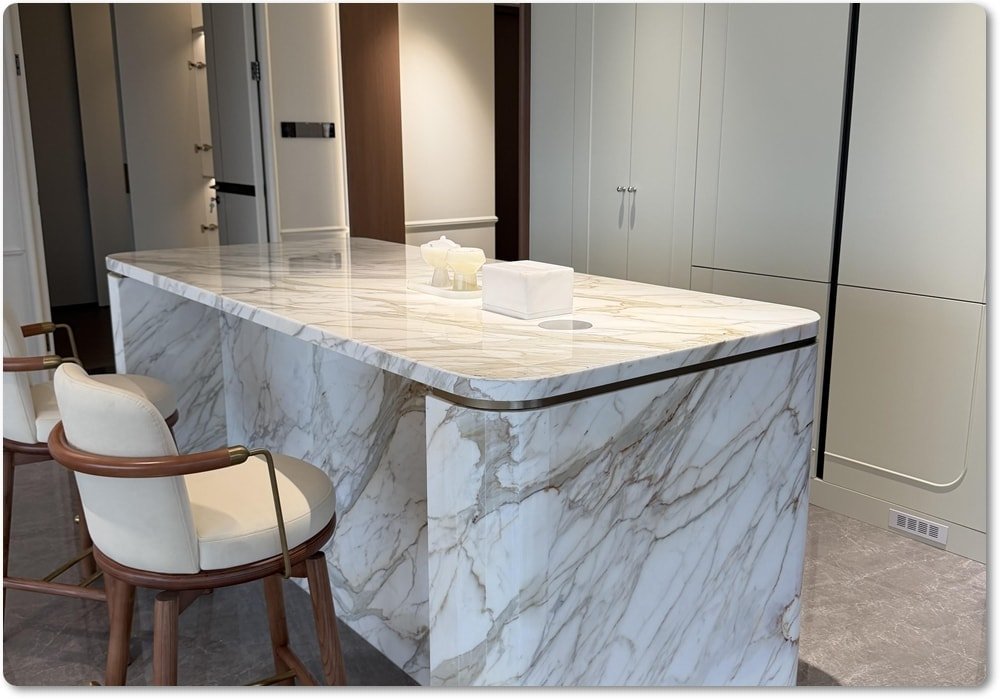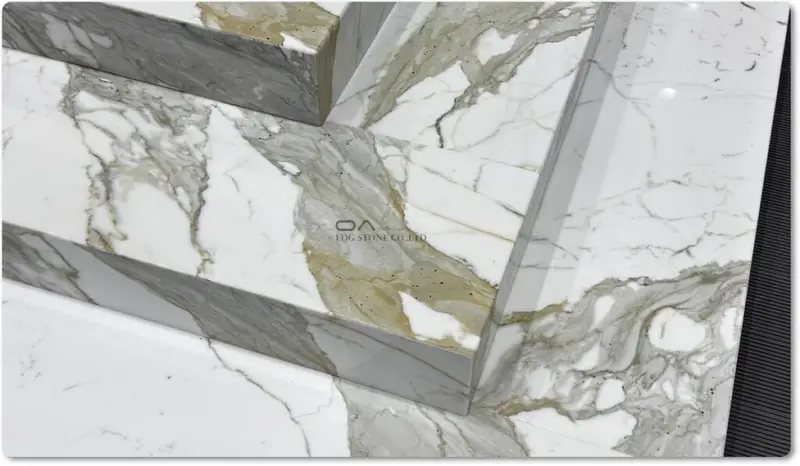
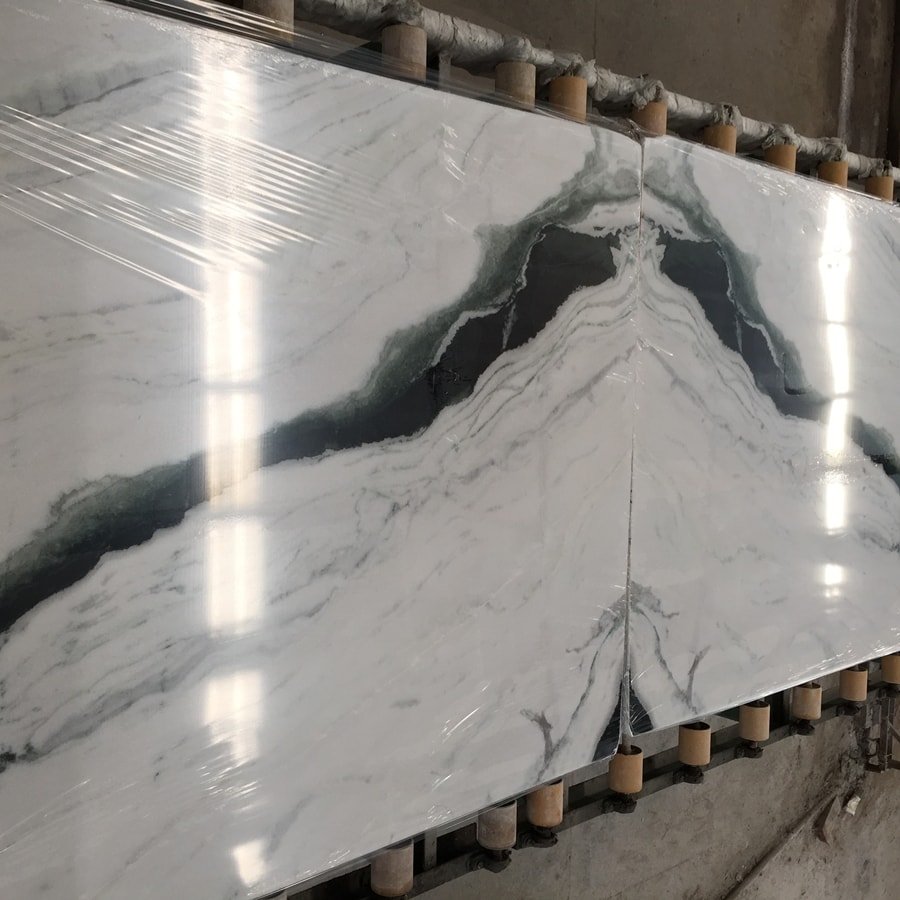
Introduction: Why Panda White + Bookmatching Matters?
Bookmatching turns two or more marble slabs into a single, mirrored composition — a bold visual strategy that elevates islands, full-height walls, and vanities into intentional artworks. Panda White marble — known for a luminous white base and strong black veining — is a top candidate for dramatic bookmatched installations where vein symmetry and contrast create a signature focal point. For owners, designers, and specifiers targeting luxury outcomes, bookmatched Panda White slabs deliver emotional impact while signaling high project value and curated craftsmanship.
What is Bookmatching? A Practical & Visual Primer
Bookmatching is the practice of slicing a single block or slab sequence and placing the pieces adjacent so that the veining matches, as in an opened book — hence the name. The technique can be implemented as a two-panel “open-book,” multi-panel sequences, radial bookmatching (for circular features), or running vein matches for longer spans. Achieving a clean bookmatch requires careful slab selection at the quarry or factory, precise cutting, consistent finishing, and rigour in labeling and packaging to preserve orientation during transport and installation.
Bookmatch Variations
Two-panel open book: most common; one split slab mirrored to its mate.
Four-panel (matched repeat): mirrors repeated for large walls or floors.
Radial / fan bookmatching: oriented to create a focal radiating pattern.
Vein-flow continuity: combining slabs to direct natural veins across surfaces without an obvious seam.
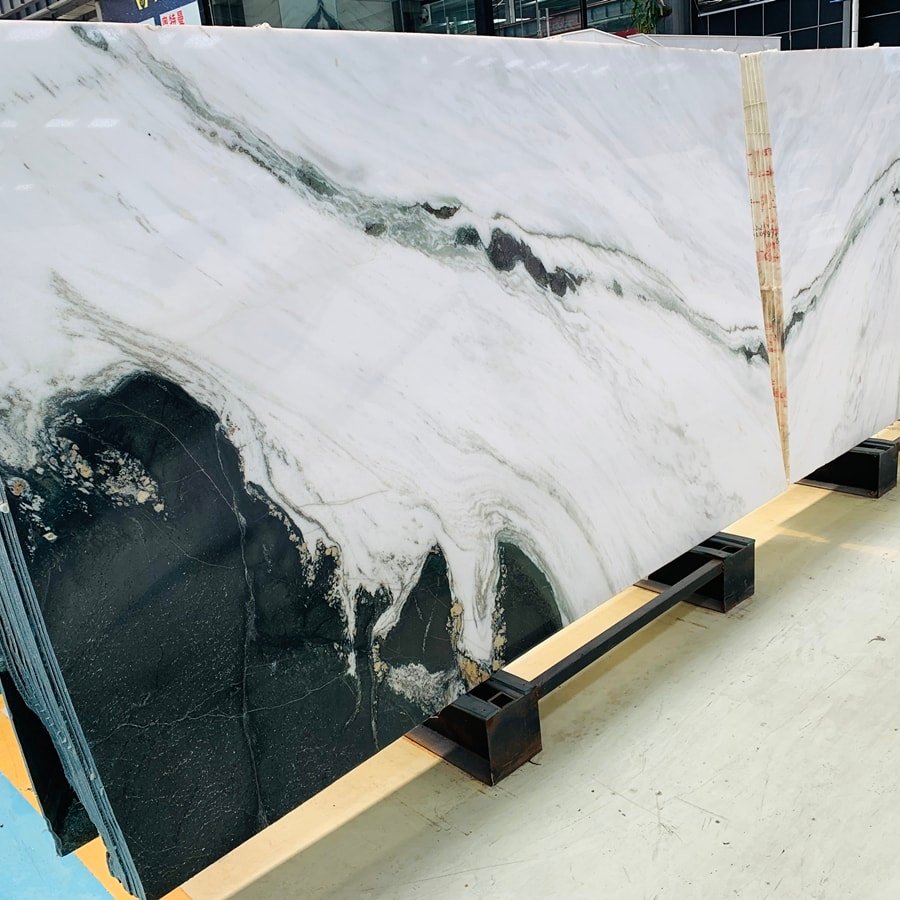
Panda White Marble: Characteristics That Make It Ideal for Bookmatching
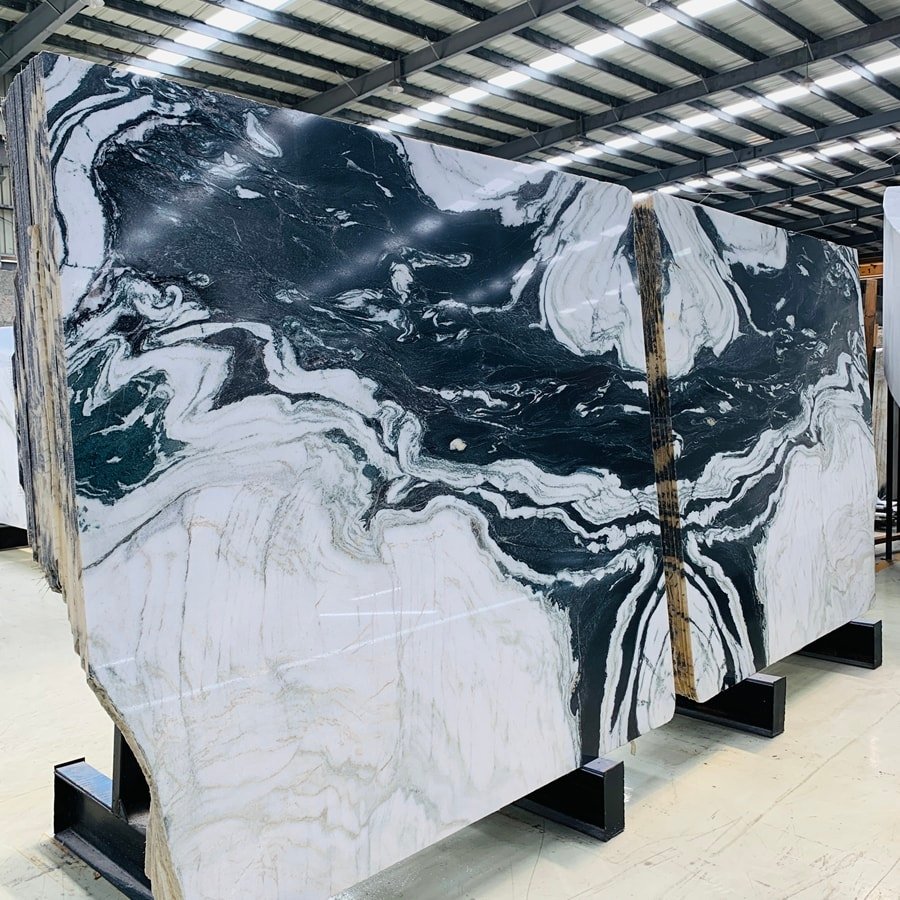
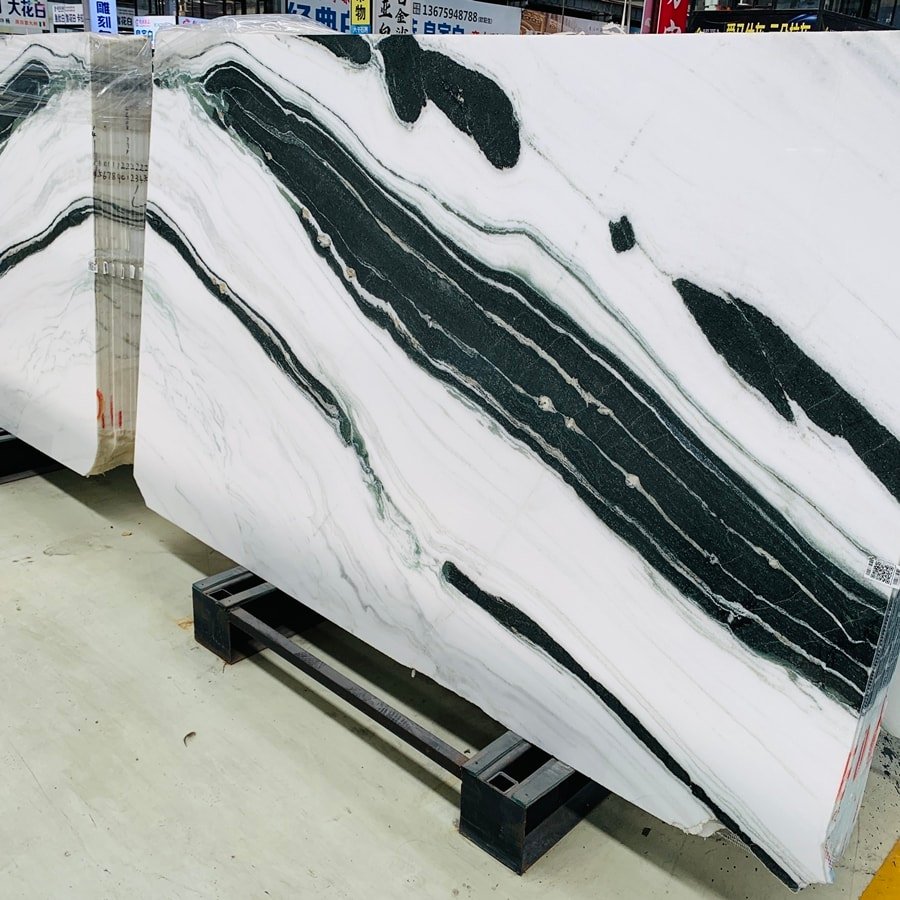
Panda White marble pairs a clear white field with strong, often ribbon-like black veins. The high tonal contrast translates exceptionally well when mirrored — veins align to form dramatic, intentional compositions rather than random patterns. Typical slab sizes and thicknesses (commonly 2 cm / 3 cm thickness, slab widths up to 160–300 cm, depending on the producer) make Panda White feasible for large-format features such as full-height walls and long kitchen islands, but yield planning is critical because bookmatching increases material waste versus straight runs. Finish selection (polished, honed, leathered) changes perceived contrast and sheen: polished emphasizes contrast and reflection, whereas leathered finishes mute glare and emphasize texture.
EDG Stone: Factory Capabilities, Quality Control & Bookmatching Workflow
As a manufacturer and supplier, EDG Stone’s competitive advantage in bookmatching centers on controlled slab selection, digital documentation, and factory-level matched cutting. A robust workflow typically includes: slab inventory and digital imaging; grading and pairing; coordinated cutting with CNC and bridge saws; finish control (edge profiling, face finish); numbering, crate layout, and photographic packaging records; and an installation packet with CAD/templating sheets. This factory-to-site continuity reduces the risk of mismatched expectations and simplifies procurement for wholesalers, hotels, and high-end residential clients. For B2B buyers, asking for slab-pair photos, production serial numbers, and crate manifests is a best practice.
Design & Layout Playbook: Planning a Bookmatched Installation
Successful bookmatching begins at schematic design. Key steps:
Define focal axis & vein flow: Decide where the mirror seam should sit (centered, offset, or wrapped).
Estimate slab yield & waste: Bookmatching consumes more material — plan an appropriate overage percentage in procurement.
Select finish & edge details: Edge profiles and finish determine how seams read visually.
Create templates & CAD plans: Provide installers with scaled drawings indicating seam placement and slab IDs.
Mock-up/sample match: Where possible, install a small mock-up area to demonstrate seam alignment and finish sheen to stakeholders before final installation.
A considered layout reduces re-cutting and on-site surprises, which is particularly relevant for hospitality or commercial projects with strict acceptance criteria.
Fabrication, Installation & On-Site Best Practices
Bookmatched slabs are sensitive to orientation; mishandling or swapping mates wholly negates the desired visual effect. Practical on-site controls include:
Storage: Keep matched pairs together, labeled, and oriented upright.
Transport: Use padded, numbered crates; include photographic documentation on crate labels.
Substrate & adhesive prep: Ensure substrate flatness and use adhesives rated for natural stone; maintain seam tolerances recommended by industry standards.
Seam management: Aim for the tightest possible seams consistent with the Natural Stone Institute’s tolerances and project aesthetic; be transparent with clients about acceptable seam widths on natural stone.
Cost Drivers, Lead Times & Purchasing Options (Manufacturer / Factory / Wholesale Signals)
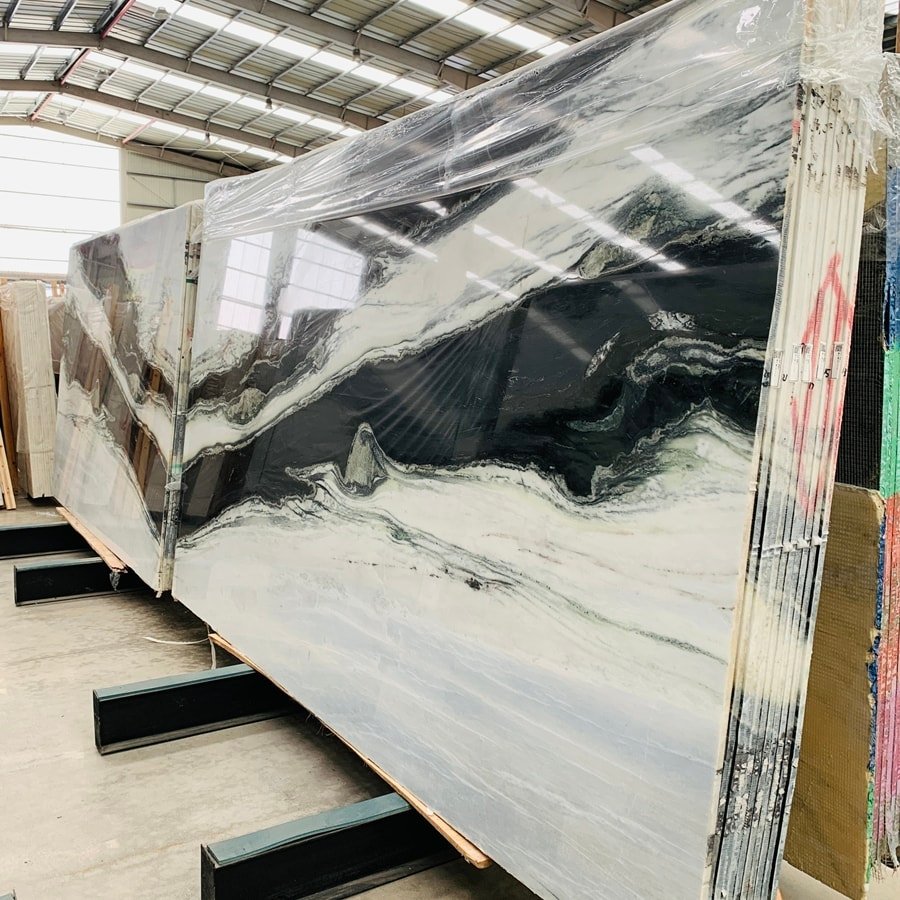
Pricing for bookmatched Panda White depends on slab grade, the percentage of yield loss due to matching, finishing, edge detailing, and logistics. Typical additional cost drivers include:
Slab-grade premium for usable matched sequence (higher grade = fewer internal fractures, better veins).
Yield loss for bookmatching (more waste vs typical straight-cut usage).
Finish & edge complexity (polished vs textured finishes change labor).
Transport & crate documentation (insured, documented crate shipping to protect matched orientation).
Custom packaging and photography are often requested by project buyers.
Manufacturers like EDG Stone often provide project-supply programs (factory direct pricing, no-MOQ offers for large projects, sample sets, and digital slab images) to support procurement and reduce buyer friction.
Regulatory, Trade & Sustainability Considerations Shaping the Stone Industry
Recent regulatory activity — particularly around worker safety and silica exposure — reshapes quarrying and fabrication practices. Agencies have tightened permissible exposure limits for respirable crystalline silica, which affects how fabricators operate cutting and polishing shops, invest in extraction controls, and document compliance. Additionally, trade policy adjustments (tariffs, HS code clarifications) and sustainability disclosure expectations (carbon footprint, chain-of-custody) influence lead times and pricing for exported stone. For specifiers and buyers, documenting supplier compliance with occupational silica controls and supply-chain sustainability KPIs is increasingly required on large commercial contracts.
Material Performance & Maintenance: Practical Data You Should Know
Panda White marble is visually dramatic, but, as a calcitic stone, it is more susceptible to etching and staining than silicate stones or engineered quartz. Practical maintenance guidance:
Sealing: Apply a high-quality penetrating sealer at installation and reapply on a cadence based on site use (typically annually for high-use areas).
Cleaning: Use pH-neutral stone cleaners; avoid acidic cleaners, which etch marble surfaces.
Repair & restoration: Minor etches can be polished out by a trained stone polisher; major damage can require local reworking or replacement of panels, which is why careful procurement and extra slab availability for matched panels is recommended.
Providing clients with a care protocol and warranty scope at handover improves long-term satisfaction and protects the appearance of bookmatched panels.
Project Case Studies
Case Study A — Hotel Lobby Feature Wall (Panda White bookmatched panels)
Scope: Full-height 6 m feature wall behind reception desk using four-panel bookmatching.
Outcome: Central seam aligned to lobby axis; slab pairing reduced perceived seam visibility with calibrated polishing and grout color matching.
Procurement tip: Reserve an extra matched slab to enable future repairs or replacements and ensure exact vein continuity.
Case Study B — Luxury Residential Bathroom
Scope: Floor-to-ceiling bookmatched panels around a freestanding tub and vanity top.
Outcome: Designer achieved a gallery-like composition; client accepted a small seam tolerance for natural stone in exchange for a large continuous visual flow.
Procurement tip: Use factory photographic documentation and crate labels to confirm orientation on-site.
Case Study C — Flagship Retail Storefront
Scope: Exterior-clad interior feature using sealed Panda White panels; polished finish for reflectivity.
Outcome: High visual brand impact; required more frequent protective maintenance due to surface traffic and contact.
Maintenance, Repair & Longevity (Post-Install Care)
Long-term preservation of a bookmatched Panda White installation requires a documented maintenance program:
Daily cleaning: Microfiber cloths and pH-neutral stone cleaners.
Periodic sealing: Annually, or sooner for heavy-use surfaces.
Damage response plan: Immediate mitigation of spills; documented contact for approved stone repairers.
Warranty & contract language: Define acceptable seam widths, finish sheen tolerances, and pre-install acceptance process in your contract to avoid disputes.
How — Bookmatching begins with source control: identify slab sequences at the quarry or factory, digitally photograph and pair slabs, cut them on precision equipment, and issue installation documentation so that matched pairs remain oriented from crate to wall. Factory-level imaging and serial-number documentation are essential to preserve the artistic continuity between slab mates.
Why — Bookmatched Panda White marble creates a single, continuous visual composition whose value lies in symmetry and contrast. When executed correctly, bookmatching is a design shortcut to instant luxury that increases perceived project value and creates distinct, brandable spaces.
What — The product is more than “marble slabs.” It’s a matched pair or sequence that includes photographic documentation, crate manifests, labeling, a template for installers, recommended finishes, and a maintenance plan. For bulk buyers and project managers, insist on factory-supplied paired-slab imagery and a documented QC workflow.
Options — Choose finish (polished, honed, leathered) based on glare, texture, and tactile goals. Select edge profiles and seam strategies (center seam, split seam, or wrapped continuity) consistent with your aesthetic intent. Consider on-site mock-ups for championship-level projects.
Considerations — Plan for yield loss (bookmatching increases material waste), document warranty terms about seam tolerance and finish variance, and require supplier compliance with silica-control and environmental reporting standards. For international procurement, add a lead-time buffer for customs and crate transport, and verify supplier chain-of-custody and worker-safety documentation.
Frequently Asked Questions (Google hot-search FAQ)
Q1: What is Panda White bookmatched marble, and how does it differ from regular Panda White slabs?
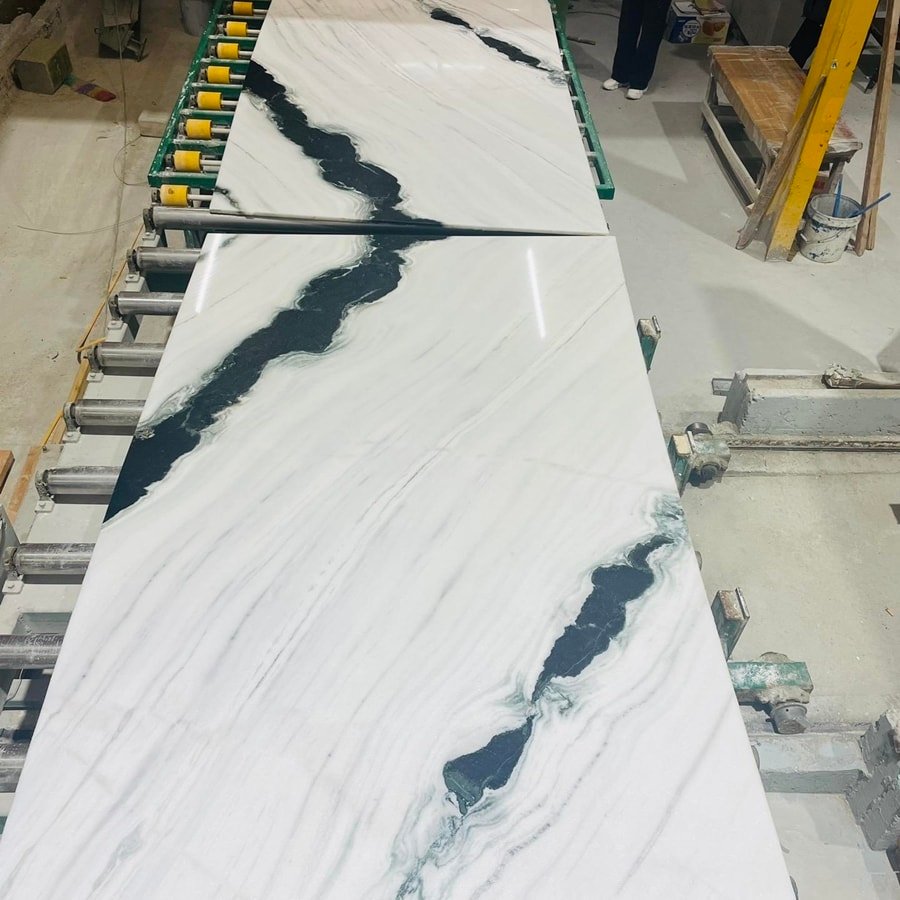
A1: Panda White bookmatched marble refers to pairs or sequences of slabs cut and arranged so veins are mirrored across a seam, creating a single, continuous composition. Regular Panda White slabs sold individually do not guarantee mirrored vein symmetry; bookmatching is a production step and a service often provided by factories or wholesalers for project continuity.
Q2: How much does a bookmatched Panda White marble installation typically cost?
A2: Costs vary widely based on slab grade, yield loss for matching, finishes, edge work, installation complexity, and shipping. Bookmatching typically adds a material premium (higher-grade slabs and overage) and labor premium (precision cutting and installation). Project buyers should request factory quotes that include slab photos, yield calculations, and shipping/crate costs for accurate budget planning.
Q3: What are typical lead times for factory bookmatching and worldwide shipping?
A3: Lead times depend on slab availability, factory schedule, finishing queue, and destination customs. For custom bookmatching projects, allow additional time for slab selection, photography, matched cutting, and crate documentation—typical factory lead times can range from a few weeks to multiple months for large or heavily finished orders. International shipping and customs add further time; always include lead-time buffers in project schedules.
Q4: How do I maintain and protect Panda White bookmatched marble to preserve the look?
A4: Use pH-neutral stone cleaners, avoid acidic products, and apply a penetrating sealer at installation with periodic resealing based on site traffic. Promptly manage spills to avoid staining and use trained stone-care professionals for repairs or repolishing to maintain seam continuity and sheen.
Q5: Can EDG Stone guarantee a perfect vein-match, and what documentation should I request?
A5: No supplier can guarantee absolute perfection on natural stone due to geological variation; however, reputable manufacturers like EDG Stone can supply slab-pair photographs, serial numbers, a documented matching process, crate manifests, and installation templates to minimize surprises. Requesting a documented QC workflow, matched-slab photos, and a reserved extra slab for future repairs is recommended.
References (author — title — publication/source — year)
U.S. Federal Register — “Lowering Miners’ Exposure to Respirable Crystalline Silica and Improving Respiratory Protection” — Federal Register — 2024.
Google Search Central — “Mark Up FAQs with Structured Data” — Google Developers — 2024.
ResultFirst / Blazeo / Frase — “How to Rank in Google SGE / AI Search” — Industry SEO analysis — 2024–2025.
Republic Elite — “Dimension Stone Design Manual (DSDM)” — Technical manual — 2022.