Introduction
In the procurement chain of Carrara White Marble, Cut-to-Size is the critical step that transforms raw material into a project-ready solution.
If slabs define where the stone comes from, then cut-to-size defines:
👉 How the stone is precisely applied in real projects.
For commercial developments, hospitality, and standardized residential projects, cut-to-size marble offers significant advantages:
- Reduced on-site cutting risks
- Faster installation timelines
- Improved dimensional consistency
- Scalable batch delivery
This guide explains Carrara White Marble cut-to-size procurement from five key dimensions: definition, applications, fabrication logic, purchasing parameters, and customization workflow.
What Is Cut-to-Size Marble?
Definition
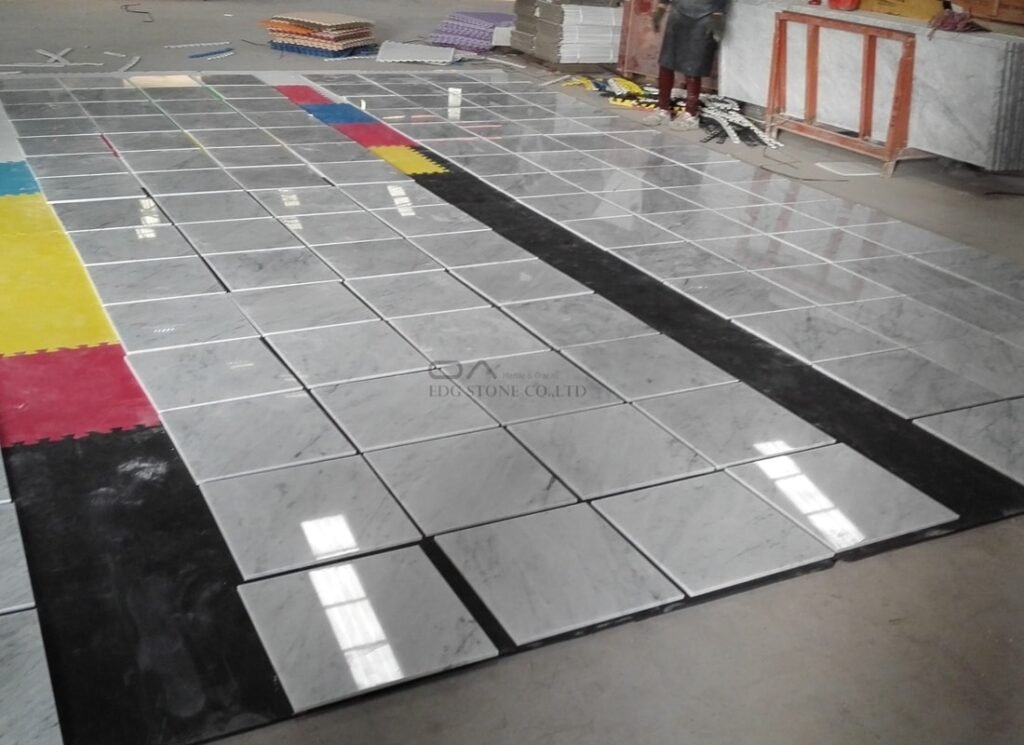
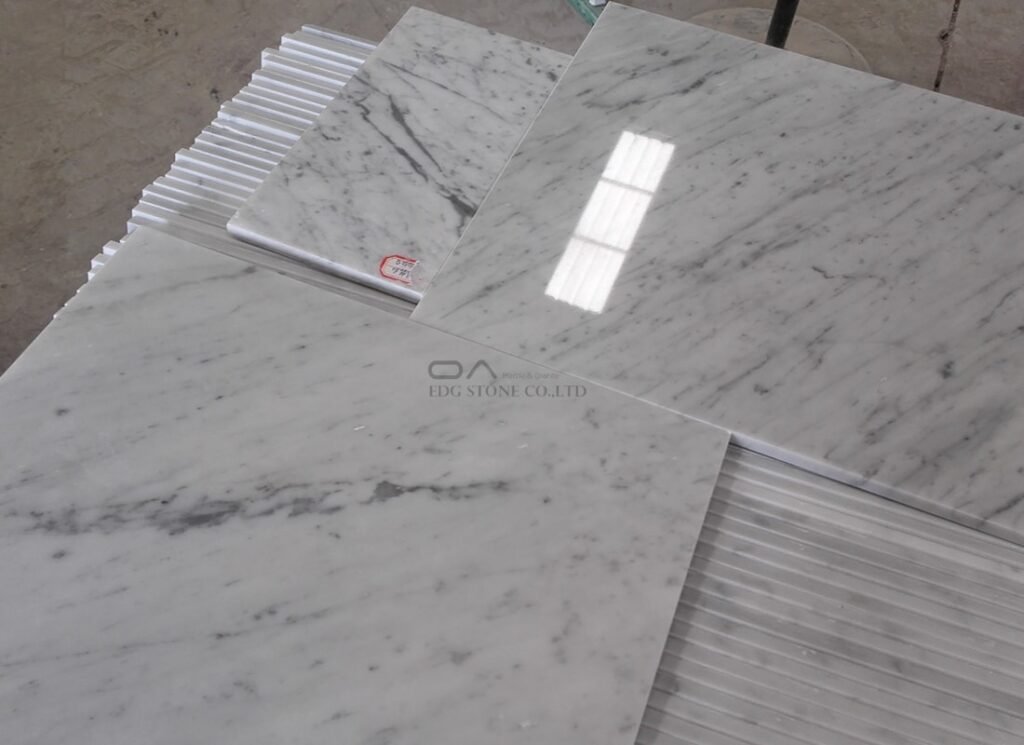
Cut-to-size marble refers to stone that has been processed from slabs or blocks into pre-defined dimensions based on project drawings.
Typical products include:
- Wall panels
- Floor tiles
- Vanity tops
- Cladding panels
- Prefabricated modular components
It is not a standard retail tile—it is engineered for specific project requirements.
Difference Between Slabs and Cut-to-Size
| Aspect | Slabs | Cut-to-Size |
|---|---|---|
| Supply Format | Full slab | Pre-cut pieces |
| Application | Custom design | Standardized projects |
| On-site Work | High | Low |
| Installation Efficiency | Medium | High |
| Waste Control | Variable | More predictable |
Why Projects Prefer Cut-to-Size Marble?
Standardization Enables Scale
In large-scale projects, the biggest risks are:
- Inconsistent dimensions
- On-site cutting delays
- Installation errors
- Batch inconsistencies
Cut-to-size shifts these risks from the job site to the factory, where precision is controlled.
Ideal for Repeatable Spaces
Cut-to-size works best in environments that require uniformity and replication, such as:
- Hotel guest rooms
- Public restrooms
- Shopping mall interiors
- Office lobbies
- Residential developments
- Villa communities
👉 The priority is not uniqueness—it’s consistency and repeatability.
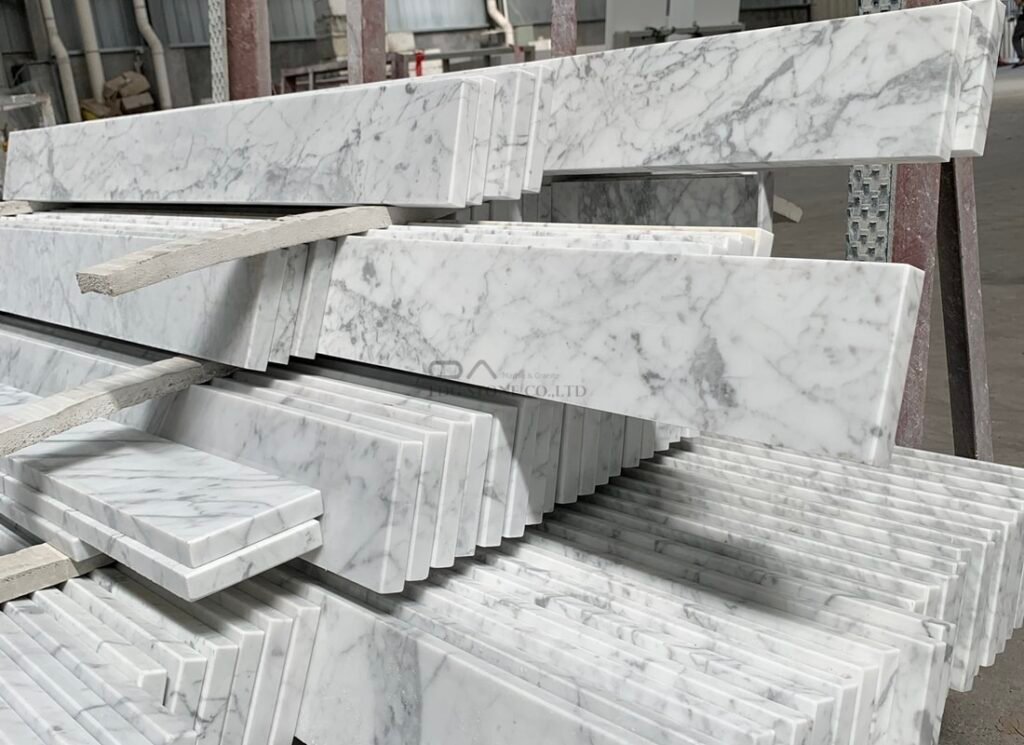
Best Applications for Carrara White Marble Cut-to-Size
1. Wall & Vertical Cladding
Perfect for:
- Feature walls
- Elevator lobbies
- Commercial interiors
- Corridor cladding
Advantages:
- Standardized dimensions
- Controlled vein matching
- Faster installation
2. Flooring Systems
Used in:
- Interior floors
- Entrance halls
- Public areas
- Medium-traffic zones
Key benefit:
👉 Pre-defined layout planning (joint lines, direction, pattern) before installation.
3. Bathroom Systems
Common applications:
- Shower wall panels
- Dry-area decorative walls
- Vanity backsplashes
Carrara’s soft white background and subtle veining create:
👉 Clean, bright, and unified bathroom aesthetics.
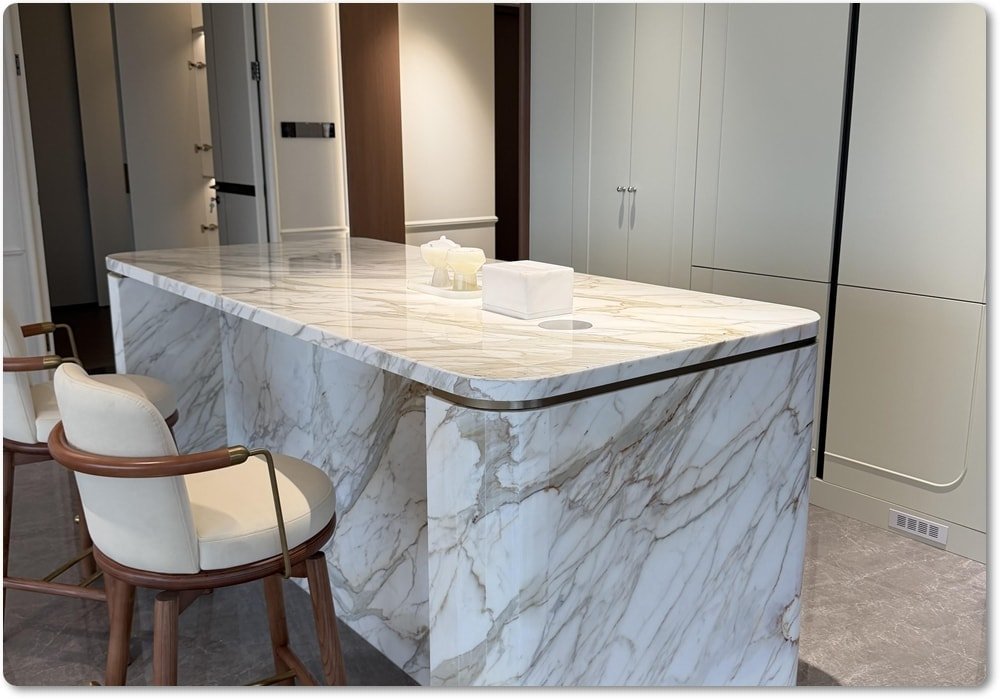
4. Prefabricated Countertops & Panels
Used in:
- Vanity tops
- Reception desks
- Cabinet cladding
- Equipment surrounds
Focus:
👉 Speed + consistency + scalability, rather than complex customization.
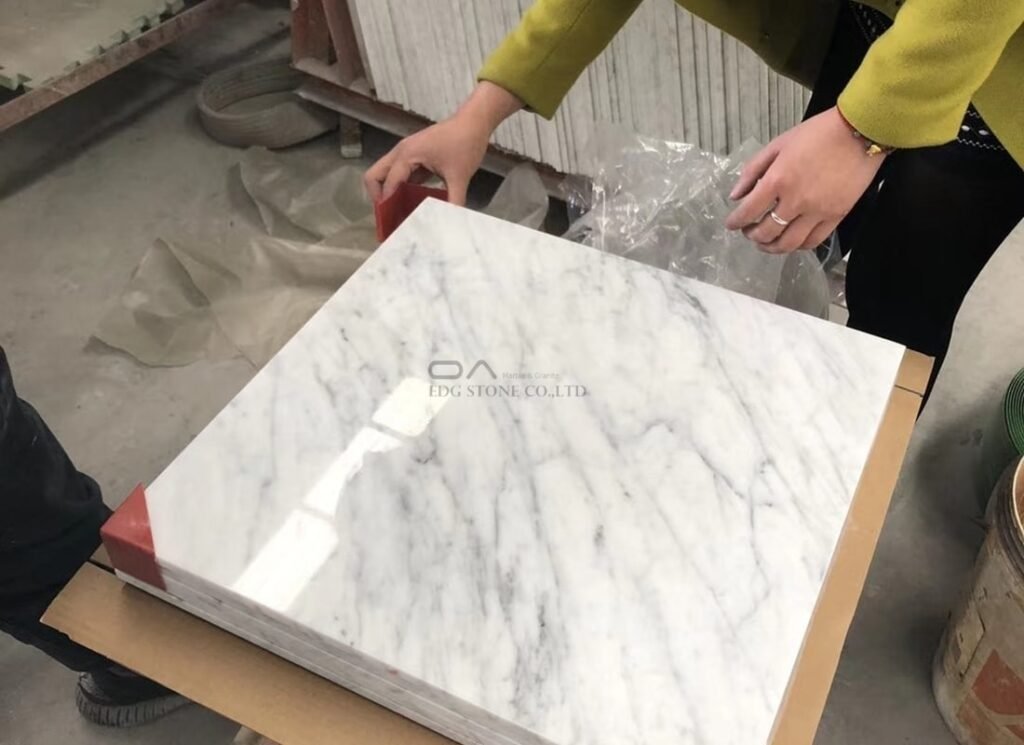
Common Fabrication Types
By Product Form
- Flat Panels – wall cladding and decorative surfaces
- Floor Tiles – standardized flooring modules
- Vanity Tops – pre-cut bathroom countertops
- Prefab Stone Units – modular systems for batch delivery
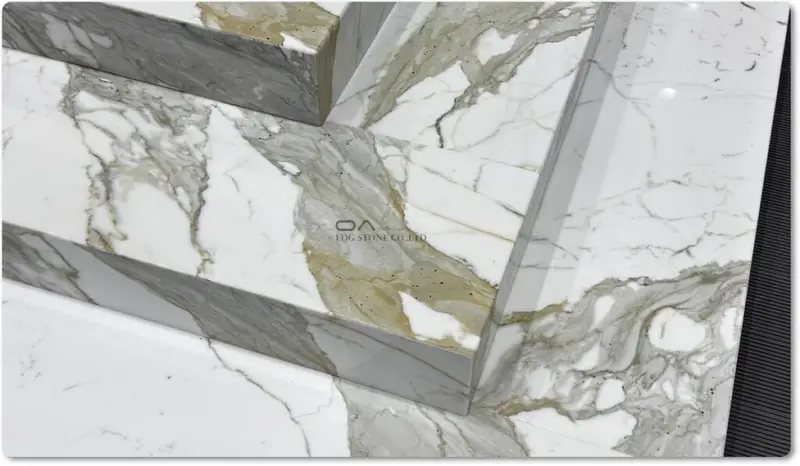
By Edge & Processing Details
- Straight edge
- Beveled edge
- Bullnose edge
- Polished edge
- Cut-outs (sink, fixtures)
- Grooving/slotting
These details directly affect:
👉 Installation efficiency and final visual quality.

What Projects Are Best for Cut-to-Size?
High Repetition Projects
Examples:
- 200 hotel bathrooms
- 300 apartment kitchens
- Repeated lobby wall modules
👉 The more repetition, the higher the efficiency gain.
Tight Construction Schedules
Cut-to-size reduces:
- On-site labor
- Cutting time
- Installation errors
Result:
👉 Faster project delivery.
High Consistency Requirements
Ideal for:
- Chain hotels
- Retail brand spaces
- Public buildings
- High-end residential developments
These projects demand:
👉 Visual uniformity across all spaces.
6 Critical Procurement Parameters
1. Dimensional Accuracy
Define clearly:
- Length
- Width
- Thickness
- Tolerance levels
Even small deviations can cause installation issues.
2. Surface Finish
Common finishes:
- Polished
- Honed
- Leathered
Each affects both:
👉 Aesthetics and maintenance performance.
3. Edge Profiles
Examples:
- Straight
- Beveled
- Bullnose
Edge details influence both design and usability.
4. Vein Direction Control
Carrara marble veining must be:
👉 Consistent across panels to achieve visual continuity.
5. Batch Consistency
Natural variation exists.
You must define:
- Acceptable variation range
- Replacement policy
- Inspection criteria
6. Packaging Standards
Essential for protection:
- Layer separation
- Corner reinforcement
- Shock resistance
- Piece labeling
👉 Most damage occurs during transport—not production.

Cut-to-Size vs Prefabricated Stone
Key Difference
- Cut-to-Size = dimensional cutting
- Prefab Stone = cutting + finishing + pre-assembly
Prefab may include:
- Sink cut-outs
- Edge finishing
- Pre-drilled installation points
- Modular assembly systems
👉 Prefab is a higher level of standardization and efficiency.
5 Practical Procurement Tips
1. Confirm Drawings First
Correct workflow:
👉 Drawings → Dimension verification → Production → Delivery
Never reverse this sequence.
2. Use Mockups
Before mass production:
- Sample approval
- Pilot area installation
- Mockup zones
👉 Prevent costly mistakes.
3. Define Variation Tolerance
Include in contract:
- Color variation range
- Veining acceptance
- Replacement conditions
4. Plan Installation Sequencing
Even standardized panels require:
- Numbering
- Area zoning
- Installation mapping
5. Consider Logistics Early
Ensure:
- Packaging standards
- Transport method
- On-site handling plan
Advantages and Limitations
Advantages
- High standardization
- Faster installation
- Better batch control
- Reduced material waste
- Ideal for large-scale projects
Limitations
- Less design flexibility
- Not suitable for complex shapes
- Requires precise early planning
- Higher coordination effort upfront
Procurement Decision Guide
Choose Cut-to-Size if your project involves:
- Large-scale delivery
- Standardized layouts
- Tight timelines
- High consistency requirements
Choose Slabs if your project requires:
- Custom design flexibility
- Unique vein expression
- Complex fabrication
Conclusion
Carrara White Marble cut-to-size is not just a processing method—it is:
👉 A system that converts natural stone into a scalable, install-ready building product.
Its real value lies in:
- Efficiency
- Precision
- Cost control
- Visual consistency
For commercial and batch projects, cut-to-size is not a compromise—it is:
👉 The most practical and optimized procurement strategy.
FAQ (Featured Snippet Ready)
What is cut-to-size marble?
Cut-to-size marble is stone pre-cut to exact project dimensions for walls, floors, countertops, and panels.
Is cut-to-size better than slabs?
It depends on the project. Cut-to-size is ideal for standardized, repetitive, and time-sensitive projects.
What projects are best for cut-to-size marble?
Hotels, apartments, bathrooms, and commercial interiors benefit most from cut-to-size marble.
Can Carrara marble be used for wall panels?
Yes, it is one of the most common materials for marble wall panel systems.
What is prefab stone?
Prefab stone is pre-cut and pre-fabricated marble designed for faster installation and reduced on-site work.
Internal Linking Suggestions
- What is Carrara marble → Guide 01
- marble vs granite vs quartz → Guide 02
- marble grading and veining → Guide 03
- Carrara marble slab buying guide → Guide 04
- marble countertop fabrication → Guide 06
- project procurement process → Guide 12