China Calacatta Verde Green Natural Marble — Complete Buyer & Specifier Guide
China Calacatta Verde Green Natural Marble

What is Calacatta Verde (Green) Marble?
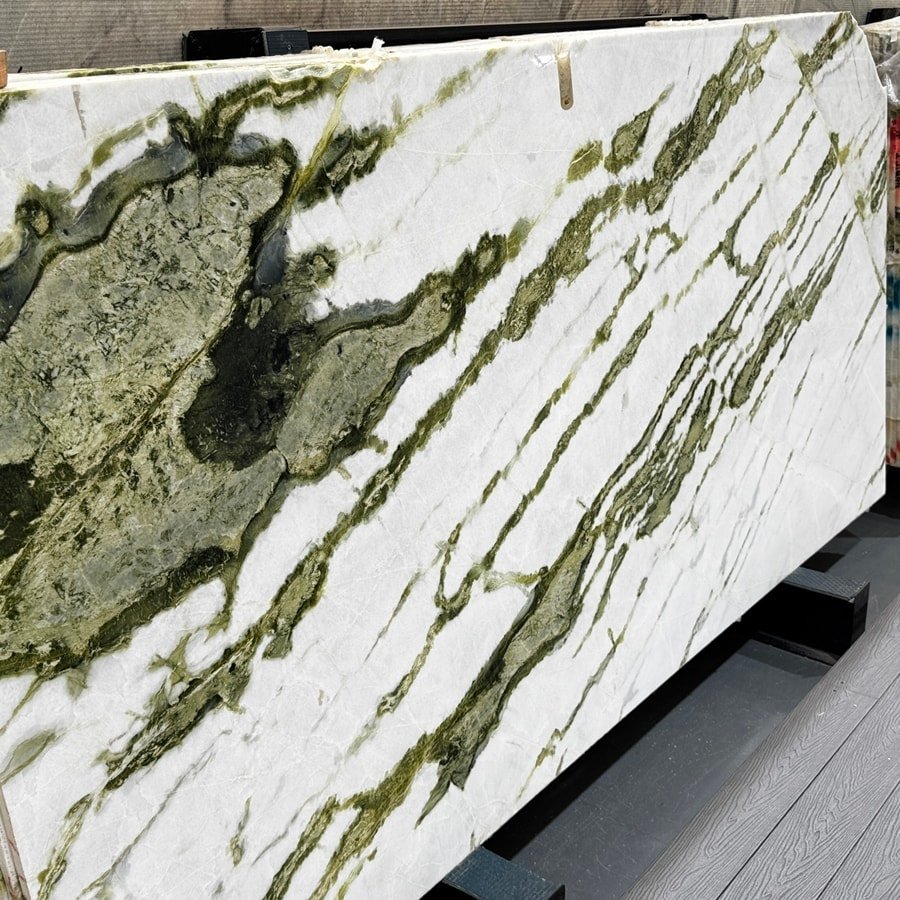
Calacatta Verde (also marketed as Calacatta Green, Calacatta Verde Jade, or similar) is a carbonate (calcite-rich) marble characterized by a predominantly light/white ground with distinctive green veining and occasional gold or grey streaks. Variants originate from multiple regions; China has become an important producer and processor, offering slab, tile, and bookmatched panels through domestic factories and exporters. Many Chinese suppliers list factory-priced Calacatta Verde slabs and tiles aimed at global B2B buyers.
Material basics (typical ranges):
Composition: Predominantly calcite with accessory minerals that create green/grey/gold veining.
Mohs hardness: ~3–4 (typical marble range).
Density: ≈2.6–2.8 g/cm³.
Porosity: Low–medium (depends on slab and finishing).
These characteristics inform where the stone performs best (vertical cladding, low-to-moderate horizontal surfaces) and where alternatives are preferable (heavy kitchen prep counters, exterior exposed flooring).
Performance & technical characteristics (practical guidance)
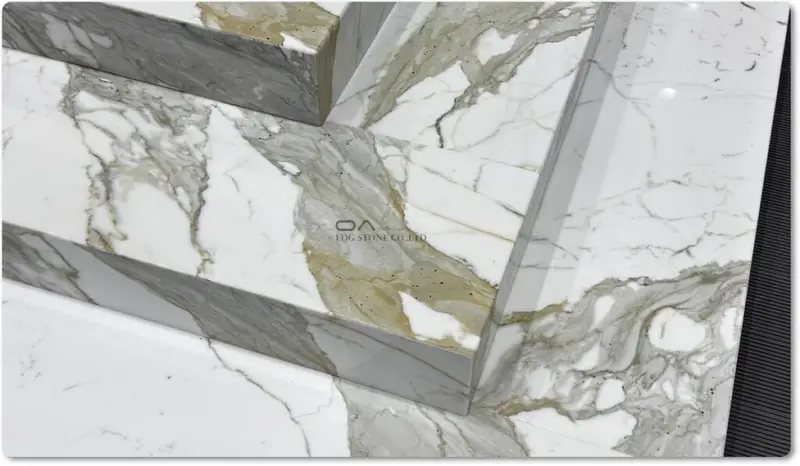
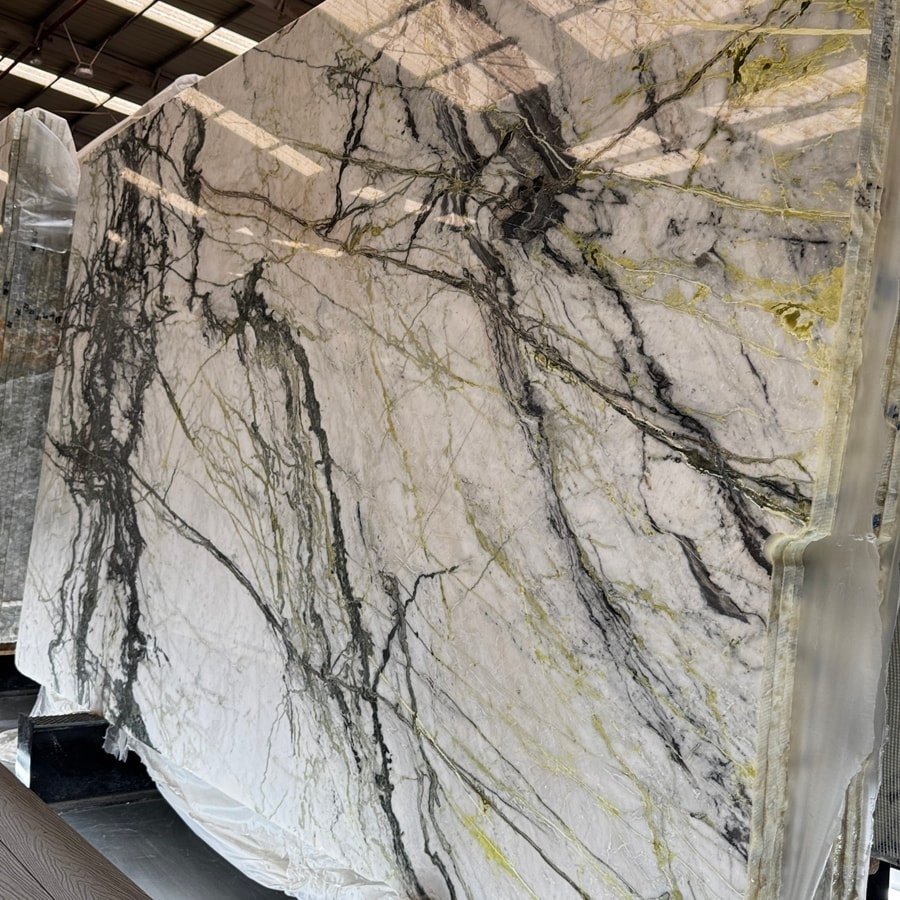
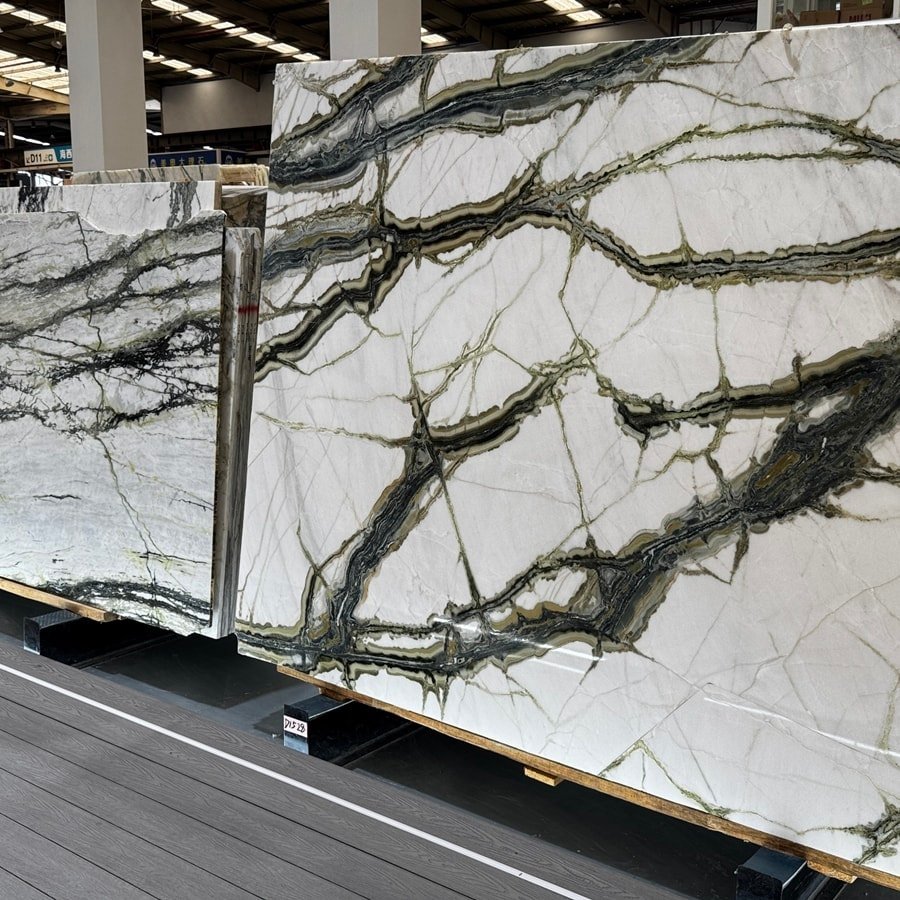
Aesthetic behavior: The green veins in Calacatta Verde vary from subtle mossy lines to strong jade-green rivers. Large slabs often display dramatic vein movement suitable for bookmatching (mirror patterning) to create continuous visual flows on walls or islands.
Mechanical behavior: Because it’s calcitic, Calacatta Verde:
Polishes to a high gloss but is susceptible to acid etching (citrus, vinegar, wine).
Can scratch more easily than quartzite or granite; use honed finishes in high-traffic floors or stair treads.
Benefits from high-quality penetrating sealers to reduce staining; sealers do not make the stone etch-proof.
Fabrication tips:
Use experienced fabricators for bookmatching and thin-slab backlit applications.
Stabilize natural fissures with resin impregnation when needed; test large slabs to detect veins that create thin or weak zones.
For large vertical panels, specify back-buttering, mechanical anchors, and movement joints to avoid stress cracks.
(Technical property ranges and fabrication notes reflect industry norms and supplier data for Calacatta Verde slabs.)
Best architectural & interior uses
Calacatta Verde’s dramatic green veins make it an ideal material for:
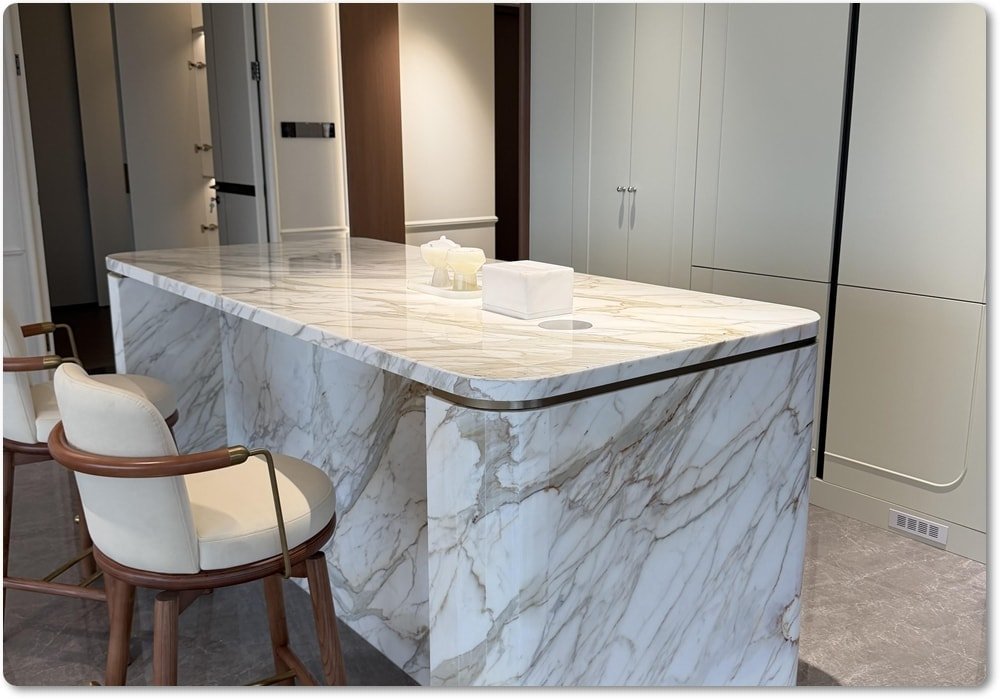
Feature waterfall islands and countertops (accent islands—avoid heavy prep unless client accepts high maintenance).
Bookmatched lobby and reception walls — high-impact, museum-like panels.
Luxury bathroom cladding & vanity tops — vertical surfaces where polish and veining show best.
Backlit onyx-like panels (thin-slab translucent selections) — if translucent characteristics are present, backlighting creates luminous effects.
Custom furniture tops and decorative millwork — when matched to warm metals (brass) or dark woods for contrast.
Avoid: externally exposed paving in freeze-thaw zones and heavy industrial floors. Use honed or leathered finishes in flooring and wet zones to reduce slip and hide micro-abrasion.
Sourcing: China factories, wholesale channels & procurement tips
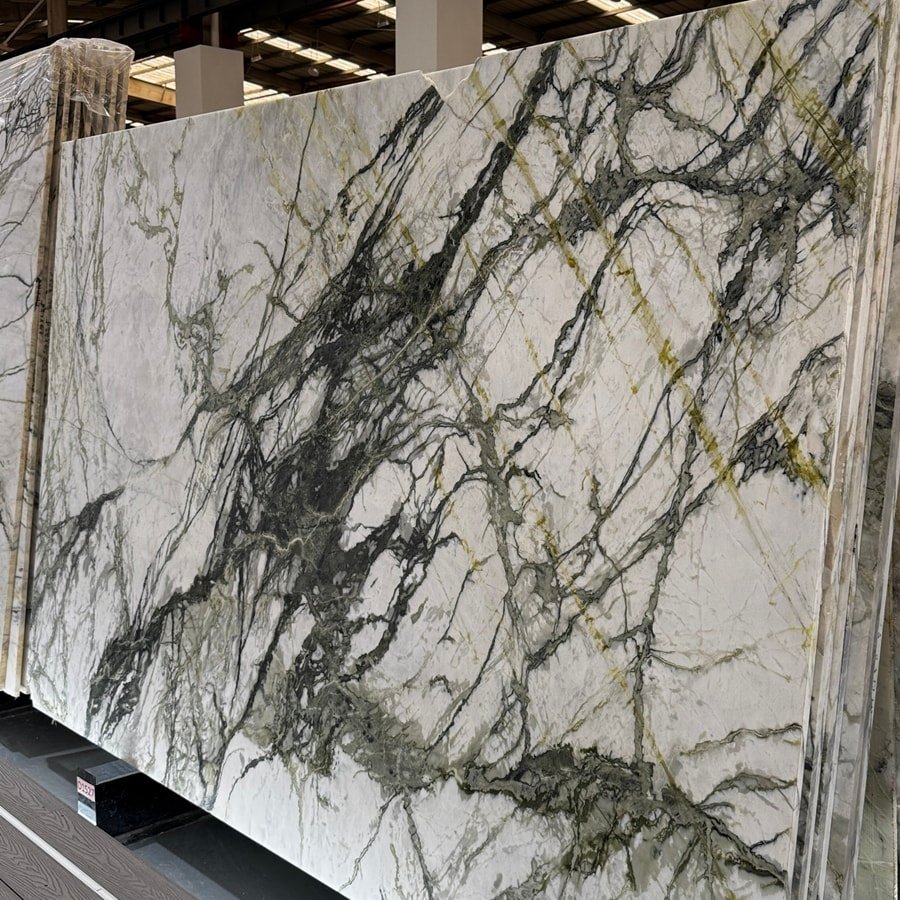
China is a significant global exporter of building stone and slabs; industry trade data shows China exports billions in building stone annually and maintains an active slab shipment market. If you’re procuring Calacatta Verde from China, consider factory audits, slab photos/scans, and sample shipments before committing to container volumes. Verified suppliers often provide scanned slab images and quality reports before shipment.
Sourcing checklist for buyers:
Request full-slab high-resolution photos and vein layout.
Confirm slab thickness (2 cm vs 3 cm); many buyers prefer 3 cm for islands and structural durability.
Ask for factory QA data (moisture content, porosity tests, resin impregnation if applied).
Verify packaging and export packing standards (wood crating, corner protection).
Request COA / country-of-origin and check for any trade restrictions or duties.
Buying intent keywords to use on marketplaces and supplier inquiries: “factory price Calacatta Verde slabs”, “wholesale Calacatta Verde manufacturer”, “Calacatta Verde 3cm slab supplier”.
Price signals & market direction (what buyers should expect)
Price depends on vein quality, slab size, and finishing. “Premium” Calacatta Verde with bold, continuous green veins and bookmatching potential commands higher prices. China supplies a range from economical commercial lots to premium factory-graded slabs. Export shipment data indicates recent growth in slab exports from China, reflecting robust international demand and active supplier networks.
Regulations, compliance & testing (what specifiers must know)
Global construction markets are increasingly requiring testing and documentation for natural stone. Key compliance drivers:
Radiological safety & construction product rules (EU): Recent EU regulations and guidance ask for radiological testing and safety standards for construction materials (including stone) under building product frameworks. If targeting EU projects, ensure test certificates and compliance statements are available.
Import/export & quarry controls (China): China’s stone industry is under increasing environmental supervision: local authorities carry out regulation and supervision of quarrying and mining operations; non-compliant operations can face fines or shutdowns. Buyers should ask suppliers for environmental compliance documentation and quarry operating permits.
Quality & standards: While ISO standards for ceramic tiles (e.g., ISO 13006) do not directly cover marble, many projects specify performance tests (water absorption, slip resistance, flexural strength) aligned to project specs or EN standards for natural stone; ask suppliers for lab test reports on relevant metrics.
Practical step: Require an independent third-party test report (radiological, water absorption, PTV slip rating, where relevant) when specifying Calacatta Verde for large commercial or public projects in regulated jurisdictions.
Sustainability & circularity trends
The stone industry is evolving: regulations, waste management and embodied emissions are key buyer concerns. Look for:
Suppliers that reduce waste by efficient nesting and remnant reuse.
Evidence of water recycle systems at polishing plants (reducing slurry contamination).
Suppliers offering reclaimed or remnant slabs for smaller elements (lowers embodied carbon).
Sourcing transparency (quarry origin, chain of custody) improves project sustainability reporting and is increasingly requested by institutional clients.
Practical maintenance & lifecycle advice for owners
Sealing: Penetrating sealer on installation and reseal annually (high-use areas more often).
Cleaning: pH-neutral cleaners only. Avoid acids.
Protection: Use cutting boards, trivets, and coasters on countertops.
Wear management: For polished floors or countertops, plan for professional repolishing cycles—especially in commercial settings.
Case study snapshot (how an architect used China Calacatta Verde)
Project: boutique hotel lobby cladding — large-format bookmatched Calacatta Verde panels were used on two main walls and the reception desk waterfall. Slab selection prioritized continuous vein flow; slabs were resin-stabilized and mechanically anchored with stainless steel support. The result: a photogenic, continuous marble mural that became the hotel’s signature image and marketing hero shot. (Typical workflow for premium bookmatched installations—coordination between quarry photos, fabrication, and on-site templating.)
3–5 Additional long-tail search/commerce keywords
“Calacatta Verde marble manufacturer China wholesale slabs”
“Calacatta Verde marble 3cm slab factory price”
“Calacatta Verde Marble Slabs Bulk Export”
“buy calacatta verde marble tile manufacturer”
“Calacatta Verde Jade Green Marble Supplier Factory”
FAQ — Google hot search style (short answers)
Q1: What is Calacatta Verde marble?
A: Calacatta Verde is a white marble with green veining, used for luxury cladding, islands, and vanities.
Q2: Is Calacatta Verde suitable for kitchen countertops?
A: Yes, but expect higher maintenance—seal regularly and avoid acidic spills; consider using it on accent islands rather than primary prep areas.
Q3: Where is China Calacatta Verde quarried?
A: China’s suppliers process many green-veined marbles and slabs domestically; slab origin can be regional—always request quarry provenance and slab documentation.
Q4: What thickness should I order (2cm vs 3cm)?
A: For islands and heavy-duty tops, 3 cm is recommended; 2 cm is acceptable for wall cladding and standard countertops with reinforced support.
Q5: How to ensure regulatory compliance when importing to the EU?
A: Request radiological testing, product declarations, and evidence of conformity with EU construction product rules; ask suppliers for lab reports and COAs.
Semantic Insights — How / Why / What / Options / Considerations
How is Calacatta Verde used best?
Use it where veining is visible and appreciated: waterfall islands, bookmatched walls, and vanity cladding. For functional horizontal zones, combine with protective strategies (honed bands, protective glass surfaces) or use it as an accent.
Why choose China-sourced Calacatta Verde?
China offers a spectrum of slabs—from commercial lots to premium, scanned, factory-graded slabs—often with competitive factory pricing and established export logistics. Choose verified suppliers with slab photos, QA reports, and export packing records.
What compliance checks should you require?
Ask for radiological test reports (where relevant for EU projects), water absorption and slip testing for floors, and documentary proof of quarry permits and environmental compliance. Third-party lab results are the gold standard.
Options & tradeoffs (detailed):
3 cm polished slab — best for islands and waterfall features (higher cost, thicker/stronger).
2 cm cut & laminated — budget-friendly for cladding; requires reliable backing/support.
Resin-stabilized thin slabs — good for backlit panels; ensure resin transparency and long-term UV stability.
Considerations for procurement & lifecycle:
Total cost = stone + fabrication + shipping + installation + lifecycle maintenance (resealing, repolishing).
Sustainability lens: prefer suppliers that recycle polishing water and offer remnant reuse.
Regulatory risk: when targeting the EU, treat radiological and construction product compliance as non-optional requirements.