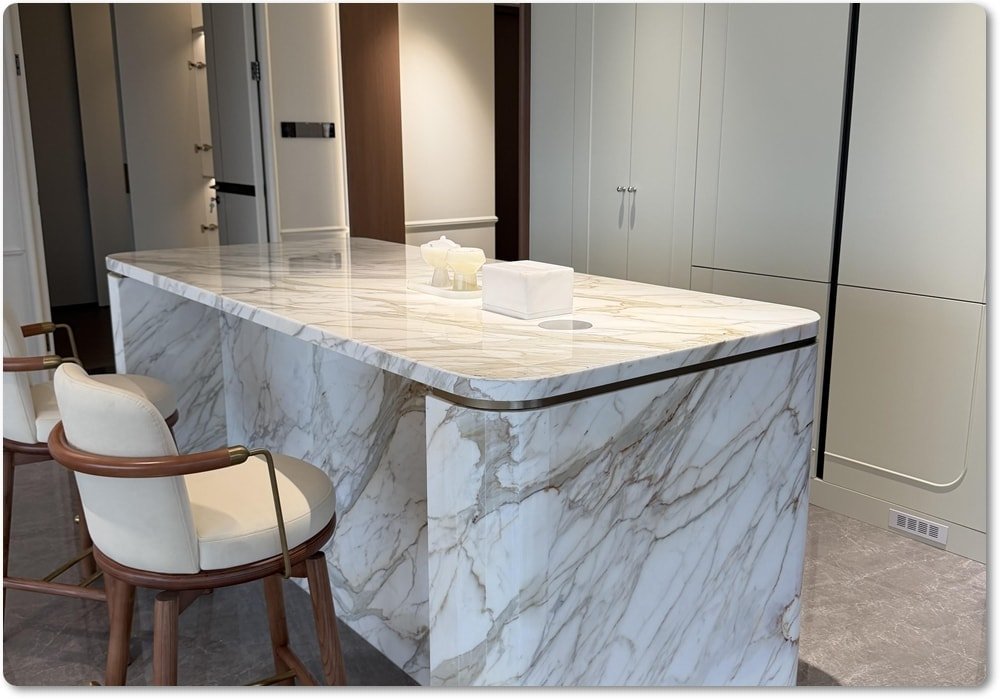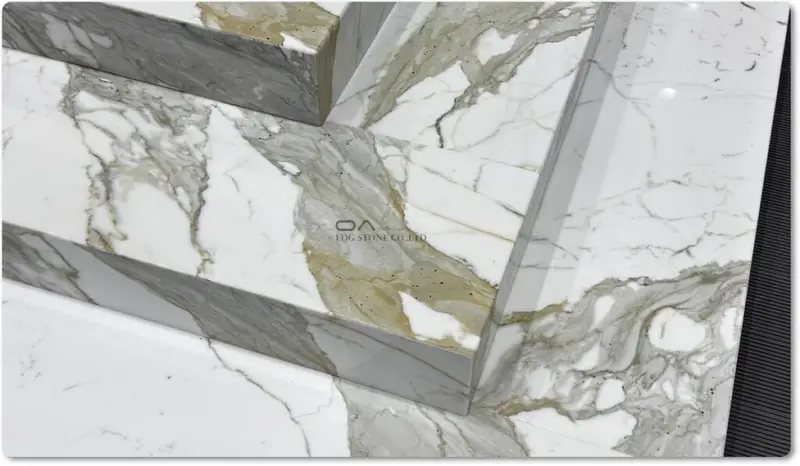
Summary
Black marble represents one of the most prestigious choices in architectural stone design. This technical white paper examines natural black marble rock from geological origin through quarry processing to commercial specification.
Architects, stone importers, contractors, and project developers can use this guide to evaluate physical performance metrics, compare natural black marble against alternative surfaces, analyze global supply chains, and mitigate risks during specification and installation.
Key Takeaways
Geological Identity: True black marble forms when limestone undergoes metamorphism while retaining fine carbonaceous matter or organic bitumen, yielding a deep jet-black base.
Calcite vs. Granite Physics: Black marble consists primarily of calcite ($\text{CaCO}_3$). It ranks 3 on the Mohs scale, making it softer and chemically sensitive to acids compared to igneous black granites.
Commercial Performance: Veining patterns from minerals like calcite, quartz, and marcasite create distinct architectural aesthetics such as those seen in Nero Marquina, Laurent Black, and Portoro.
Global Trade: Demand across commercial interiors, luxury residential designs, and hospitality projects drives trade through major processing hubs in China, Italy, and Spain.
Sourcing Security: Partnering with experienced stone manufacturers like EDG Stone Factory guarantees precise slab matching, controlled water-jet fabrication, and consistent quality control for international projects.
Technical Specifications & Definition
                       GEOLOGICAL CLASSIFICATION & CHEMICAL PROFILE

           +-----------------------------------------------------------------+
           |                      Protolith: Sedimentary                     |
           |             (Organic-rich Limestone / Calcite Mud)              |
           +-----------------------------------------------------------------+
                                           |
                                           | Regional Metamorphism
                                           | (High Pressure & Temperature)
                                           v
           +-----------------------------------------------------------------+
           |                       Natural Black Marble                      |
           |                  Recrystallized Calcite Matrix                  |
           +-----------------------------------------------------------------+
                                           |
                   +-----------------------+-----------------------+
                   |                                               |
                   v                                               v
     +---------------------------+                   +---------------------------+
     |   Base Mineral Matrix     |                   |    Pigment & Veining      |
     |   Calcite: 85% - 98%      |                   |   Bitumen / Carbon: < 2%  |
     |   Dolomite: 0% - 10%      |                   |   Calcite Veins: White    |
     |   Quartz/Pyrite: Trace     |                   |   Pyrite/Iron: Gold/Rust  |
     +---------------------------+                   +---------------------------+
Natural black marble rock is a metamorphic stone created when limestone undergoes heat and pressure inside the Earth’s crust. Heat and pressure force the calcite in the limestone to recrystallize into an interlocking mosaic of calcite crystals.
The dark color comes from trace organic matter—primarily bitumen or carbon compounds—trapped in the original sediment. When this organic material stays dispersed throughout the matrix during metamorphism, the stone takes on a black color.
Material Property Matrix
The table below outlines the physical and mechanical properties of standard commercial black marble, tested according to ASTM and EN standards.
| Physical Property | ASTM Standard | EN Standard | Typical Value Range | Engineering Impact |
| Apparent Density | ASTM C97 | EN 1936 | $2,650 – 2,720\text{ kg/m}^3$ | Structural dead-load calculations |
| Water Absorption | ASTM C97 | EN 13755 | $0.10\% – 0.35\%$ by weight | Resistance to liquid staining and freeze-thaw |
| Compressive Strength | ASTM C170 | EN 1926 | $90 – 140\text{ MPa}$ | Load-bearing limits for flooring and structural steps |
| Flexural Strength | ASTM C880 | EN 12372 | $11 – 18\text{ MPa}$ | Resistance to bending stress in cantilevered slabs |
| Mohs Hardness | Standard | Standard | $3.0 – 3.5$ | Susceptibility to surface scratching |
| Abrasion Resistance | ASTM C241 | EN 14157 | $15 – 22\text{ Index}$ | Suitable application traffic zones |
| Acid Resistance | ASTM C217 | — | Low (Etches on contact) |
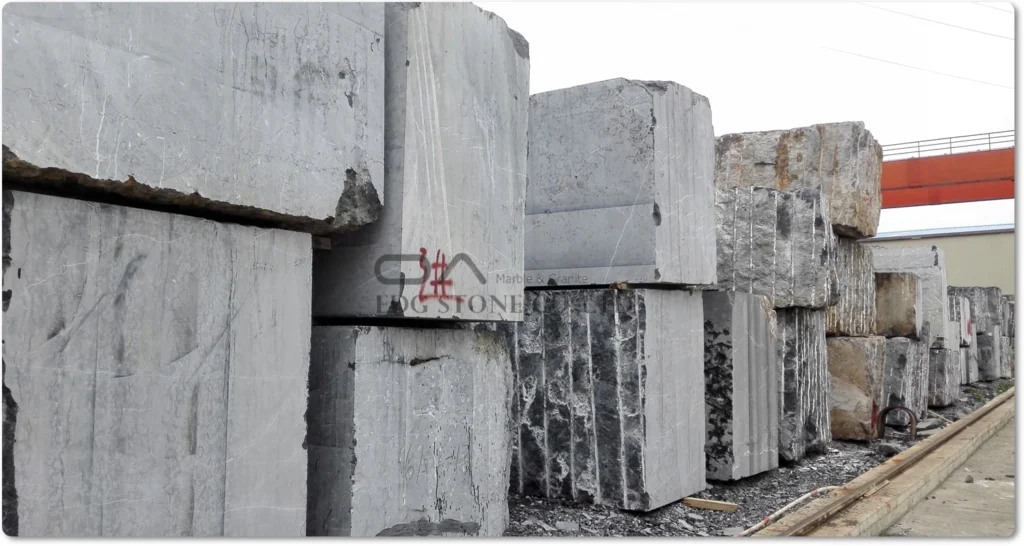
Geological Formation of Black Marble
The formation of natural black marble requires specific geological environments over millions of years.
                            GEOLOGICAL TIME ELEVATION PROFILE

  Deposition Phase (Anoxic Basin)
  -----------------------------------------------------------------------  Sea Level
  ~~~~ Calcite Mud + Organic Bitumen / Algal Remains ~~~~
  =======================================================================  Ocean Floor

  Tectonic Burial & Metamorphism
  -----------------------------------------------------------------------  Depth: 3 - 10 km
  [ Pressure: 2 - 8 kbar ]   ===> Recrystallization of Calcite Matrix
  [ Temp: 200°C - 400°C ]    ===> Carbon Micro-Dispersion (Dark Base)
                             ===> Hydrothermal Fracturing (White Veining)
Deposition Phase
Millions of years ago, calm marine environments such as quiet oceanic basins and shallow lagoons accumulated layers of fine calcite mud, marine shells, and organic algae. Because these low-oxygen (anoxic) environments slowed down organic decay, dark carbonaceous compounds mixed into the settling muds.
Metamorphic Transformation
Tectonic plate collisions pushed these sedimentary layers deep into the Earth’s crust, exposing the rock to intense heat ($200^\circ\text{C}$ to $400^\circ\text{C}$) and high pressure ($2$ to $8\text{ kbar}$).
The limestone softened and recrystallized into a tight network of pure calcite grains.
The fine carbonaceous particles dispersed across the mineral grain boundaries rather than burning away.
This trapped carbon absorbs light across the visible spectrum, giving the stone its rich black color.
Vein Formation Mechanisms
The white, yellow, or gold veins running through black marble formed later in the geological cycle:
Tectonic stress created micro-fractures in the solidifying black rock mass.
Hydrothermal fluids rich in dissolved minerals flowed through these fractures under high pressure.
As these fluids cooled, pure calcite precipitated out to form bright white veins.
Fluid containing iron oxide or pyrite deposited rich gold and yellow veins, producing dramatic varieties like Portoro marble.
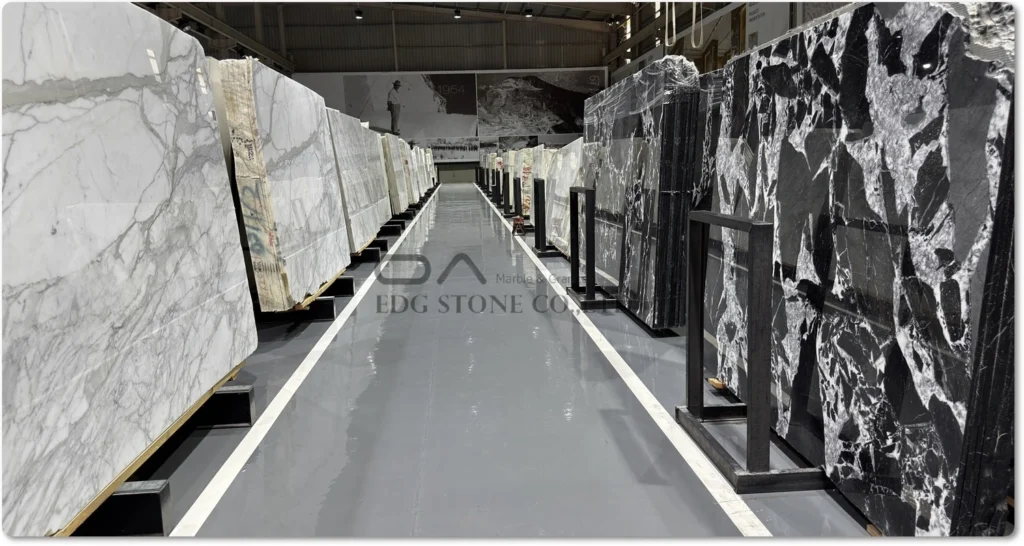
Black Marble vs. Black Granite vs. Other Dark Surfaces
Designers and engineers often treat black stone materials as interchangeable, but their mineral structures perform very differently under real-world conditions.
                          MINERAL COMPOSITION COMPARISON

   Natural Black Marble               Black Granite (Gabbro/Basalt)
  +-----------------------+              +-----------------------+
  | Calcite (CaCO3): 95%  |              | Plagioclase: 55%      |
  | Carbon Pigment: ~2%   |              | Pyroxene/Augite: 35%  |
  | Trace Minerals: ~3%   |              | Olivine/Quartz: 10%   |
  +-----------------------+              +-----------------------+
  (Acid-Sensitive, Soft)                 (Acid-Resistant, Hard)
Black Marble vs. Black Granite (Gabbro / Basalt)
“Black Granite” is usually a commercial term for dark, coarse-grained igneous rocks like gabbro, norite, or basalt. Unlike marble, these rocks form from cooled magma and contain no calcite.
Hardness: Black granite scores $6.0$ to $7.0$ on the Mohs scale, while black marble scores $3.0$ to $3.5$. Granite resists scratching from stainless steel blades, whereas steel will scratch black marble.
Chemical Reaction: Black marble reacts with acids like lemon juice, vinegar, or harsh cleaners, which etch the calcite surface and leave dull white marks. Black granite resists acid etching, making it a lower-maintenance option for kitchen counters.
Aesthetic Characteristics: Black granite presents a uniform, fine-grained appearance. Black marble offers bold, fluid veining patterns and dynamic visual contrast.
Natural Black Marble vs. Engineered Black Surfaces
Engineered stone surfaces use ground quartz or porcelain clays bound with resins or fired at high temperatures to match the look of natural black stone.
+-------------------+-----------------------+-----------------------+-----------------------+
| Feature           | Natural Black Marble  | Black Quartzite       | Engineered Quartz    |
+-------------------+-----------------------+-----------------------+-----------------------+
| Composition       | >85% Calcite          | >90% Quartz           | 90% Quartz + Resin    |
| Heat Resistance   | High (500°C+)         | Very High (800°C+)    | Low (Resin Scorches)  |
| UV Stability      | High (Indoor/Outdoor) | High (Indoor/Outdoor) | Low (Resin Yellows)   |
| Vein Uniqueness   | 100% Unique / Random  | 100% Unique / Random  | Printed / Repeated    |
| Scratch Repair    | Easy (Re-polishable)  | Difficult             | Surface Specific      |
+-------------------+-----------------------+-----------------------+-----------------------+
Material Comparison Matrix
| Property | Natural Black Marble | Black Granite (Gabbro) | Black Quartzite | Black Engineered Quartz | Black Porcelain Slabs |
| Mohs Hardness | 3.0 – 3.5 | 6.0 – 7.0 | 7.0 | 6.0 – 7.0 | 7.0 – 8.0 |
| Acid Sensitivity | High (Etches) | Very Low | None | Low | None |
| UV Resistance | High | High | High | Poor (Resin degrades) | High |
| Flexural Strength | $11 – 18\text{ MPa}$ | $15 – 25\text{ MPa}$ | $25 – 40\text{ MPa}$ | $40 – 60\text{ MPa}$ | $45 – 65\text{ MPa}$ |
| Maintenance Need | High (Sealer required) | Low | Low-Medium | Low | Low |
| Primary Visual | Fine, linear veining | Uniform speckle | Crystalline depth |
Major Commercial Black Marble Varieties
Distinct global quarry regions produce commercial black marble varieties with unique vein patterns, physical properties, and design applications.
                             GLOBAL VARIETY LANDSCAPE

         SPAIN                         ITALY                        CHINA
  +------------------+          +------------------+         +------------------+
  |  Nero Marquina   |          |  Portoro Gold    |         |  Silver Dragon   |
  |  Deep Black Base |          |  Intense Black   |         |  Black & White   |
  |  Calcite Veins   |          |  Gold/Yellow     |         |  Bold Flowing    |
  +------------------+          +------------------+         +------------------+
           |                             |                            |
           +-----------------------------+----------------------------+
                                         |
                                         v
                         +--------------------------------+
                         | Global Specification Selection |
                         +--------------------------------+
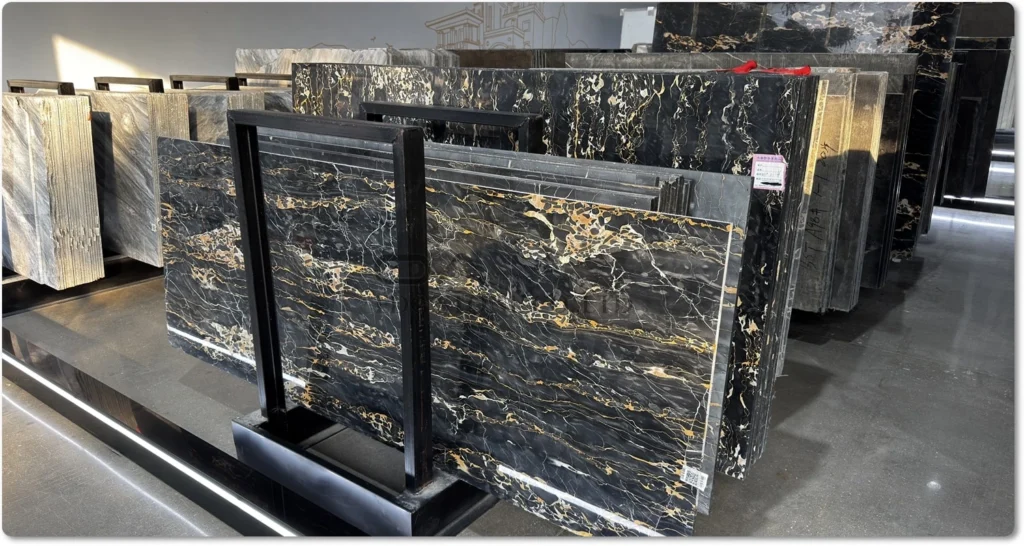
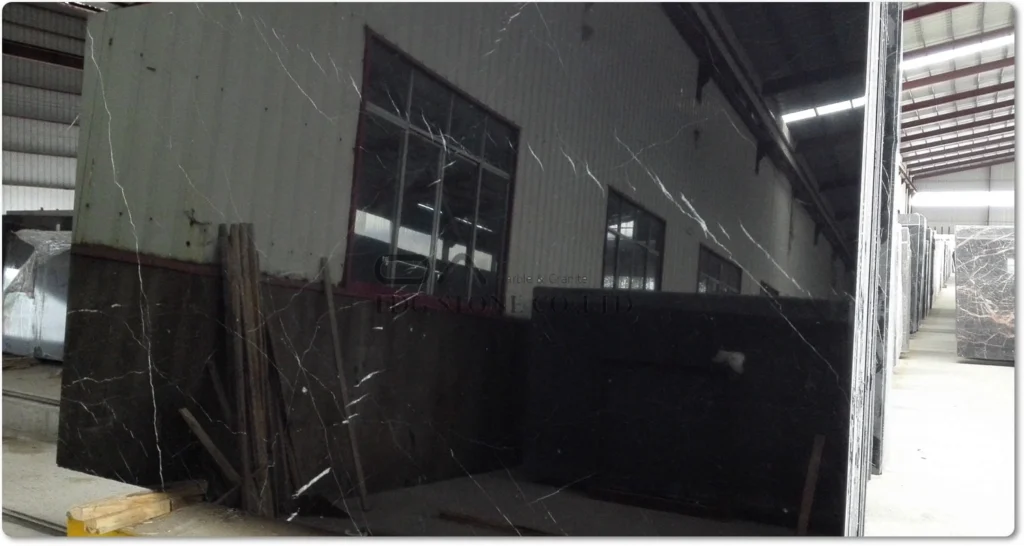
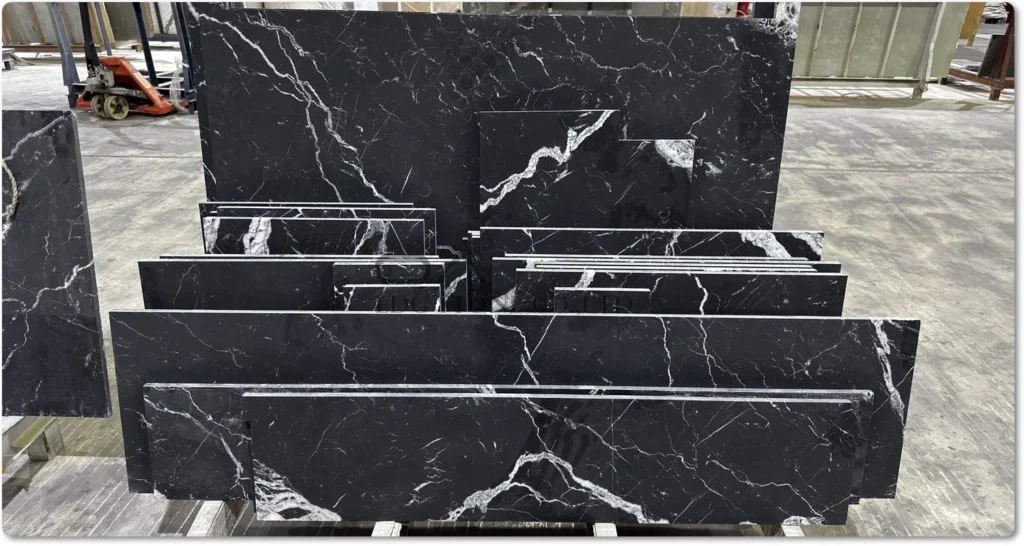
1. Nero Marquina (Marquina Black)
Origin: China, Markina, Basque Country, Northern Spain.
Description: A deep black calcite marble featuring bold, irregular white veins.
Application: Interior flooring, feature walls, bathroom vanity tops.
Technical Note: A high frequency of micro-fractures requires mesh backing and resin treatment during slab processing.
2. Portoro (Nero Portoro / Black & Gold)
Origin: La Spezia region, Liguria, Italy.
Description: A rare luxury marble featuring a deep black background with gold, yellow, and silvery veins.
Application: Exclusive interior decorative work, carved accents, furniture, and luxury wall panels.
Technical Note: Very delicate structure requires expert handling during diamond-saw cutting and resin stabilization.
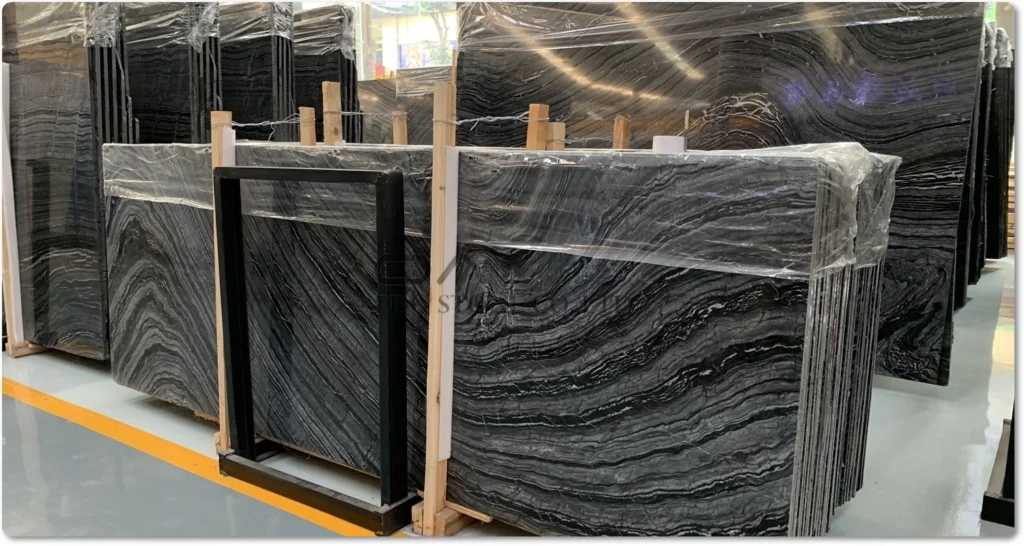
3. Silver Dragon (China Nero Marquina / Black Dragon)
Origin: Guangxi / Hubei Province, China.
Description: A deep black background accented by sharp silver-white linear veins that form dynamic wave-like patterns.
Application: High-traffic floor tiles, wall cladding, integrated vanity basins.
Technical Note: Higher density and compressive strength than standard European black marbles, making it well-suited for high-traffic installations.
4. Laurent Black (Noir Saint Laurent)
Origin: France / Morocco.
Description: Dark brown to deep black background with a distinctive pattern of white, copper, and bronze veins.
Application: High-end interior accents, decorative tables, custom furniture surfaces.
Market Value & Pricing Drivers
Understanding stone pricing models helps architects and buyers evaluate bids and control costs. Raw block quality, slab yielding efficiency, and surface finish complexity directly shape the final market cost of black marble.
                           COST CONVERSION PIPELINE

 +--------------------+       +--------------------+       +--------------------+
 |   Block Sourcing   |       |  Slab Fabrication  |       |   Surface Finish   |
 |  Quality Grade:    | ====> | Yield & Resining:  | ====> | Polished / Honed / |
 |  A / B / C Rating  |       | Vacuum Netting     |       | Leathered Processing|
 +--------------------+       +--------------------+       +--------------------+
                                                                     |
                                                                     v
                                                   +----------------------------------+
                                                   | Final FOB/CIF Cost per Sq. Meter |
                                                   +----------------------------------+
Key Pricing Factors
Block Selection & Grade: Quarry blocks receive grades ($A$, $B$, or $C$) based on color consistency, vein distribution, and structural integrity. Grade $A$ blocks feature deep background color without red iron stains, grey patches, or structural cracks.
Resin & Mesh Technology: High-grade black marble requires dual epoxy treatment under vacuum conditions. Slabs receive a fine fiberglass mesh backing to ensure structural stability during international transit.
Vein Continuity & Bookmatching: Matched slab sets (Bookmatched, Diamond-matched) command price premiums of $20\%$ to $45\%$ due to higher block consumption and precision cutting requirements.
Indicative FOB Market Pricing (2026 Reference Data)
The following reference table outlines typical FOB export pricing for polished $20\text{ mm}$ thick slabs from primary manufacturing centers.
| Variety Grade | Origin | Price Range (USD / m2) | Primary Cost Drivers |
| Silver Dragon (Standard) | China | $\$25 – \$45$ | High quarry output, optimized local processing |
| Silver Dragon (Select) | China | $\$45 – \$70$ | Crisp white veins, deep black background |
| Nero Marquina (Commercial) | Spain | $\$40 – \$65$ | Higher white cloud density, structural micro-fissures |
| Nero Marquina (First Choice) | Spain | $\$70 – \$130$ | Jet-black ground, clean linear white veining |
| Laurent Black (Premium) | Morocco/France | $\$110 – \$220$ | Limited quarry output, complex color patterns |
| Italian Portoro (Authentic) | Italy | $\$350 – \$900+$ | Rare block supply, high processing care |
Engineering Applications & Design Guidelines
Using black marble effectively requires balancing its dramatic visual appeal with its physical limitations.
                         INTERIOR SPECIFICATION PATHWAY

                     +------------------------------------+
                     |    Proposed Interior Application   |
                     +------------------------------------+
                                       |
                   +-------------------+-------------------+
                   |                                       |
                   v                                       v
         [ Horizontal Surfaces ]                 [ Vertical Surfaces ]
         Floors / Countertops                    Walls / Feature Cladding
                   |                                       |
         +-------------------+                   +-------------------+
         | Low/Med Traffic?  |                   | Dry or Wet Zone?  |
         +-------------------+                   +-------------------+
           |               |                       |               |
         (Yes)            (No)                   (Dry)           (Wet)
           |               |                       |               |
           v               v                       v               v
    +-------------+ +-------------+         +-------------+ +-------------+
    | Honed Finish| | Avoid Marble|         | Polished    | | Sealed      |
    | + Penetrat. | | Use Granite |         | Honed or    | | Honed Panel |
    |   Sealer    | | / Quartzite |         | Leathered   | | Anti-slip   |
    +-------------+ +-------------+         +-------------+ +-------------+
High-Impact Applications
Lobby Flooring: Black marble establishes strong visual grounding in corporate lobbies and residential towers. Designers often alternate black marble with white stones like Calacatta or Ariston to create dramatic floor patterns.
Vertical Accent Walls: Large bookmatched black marble slabs create striking feature walls behind reception desks, living room displays, and executive suites.
Bathroom Vanities & Spa Surfaces: Honed black marble brings a rich, refined feel to low-traffic bath areas.
Custom Furniture: Table surfaces, desk tops, and fireplace surrounds highlight the organic line movements of black marble veins.
Key Installation Guidelines
Adhesive Selection: Use polymer-modified, quick-setting white cement mortars or two-component epoxy adhesives. Standard dark mortars can bleed through micro-cracks, discolored background tones, or affect moisture cure times.
Subfloor Preparation: Keep deflection limits below $L/360$ under total live and dead loads to prevent flexural cracking across vulnerable calcite veins.
Moisture Control: Seal all four sides and the back of each slab with an alkali-resistant sealer before installation to prevent efflorescence and moisture-related staining.
Pros & Cons Analysis
Understanding the advantages and challenges of black marble helps ensure appropriate application selections.
Advantages
Unmatched Visual Depth: The high contrast between white or gold veins and a dark black matrix creates a rich, timeless look that synthetic materials struggle to replicate authentically.
High Polish Capability: Natural calcite takes a high-gloss finish, reflecting light sharply to brighten interior spaces.
Design Versatility: Black stone pairs easily with warm wood tones, polished metals (brass, gold, brushed steel), and modern structural glass.
Thermal Mass: Offers high density and efficient thermal storage, making it well-suited for underfloor heating systems.
Challenges
Acid Sensitivity: Exposure to acidic liquids like citrus juice, wine, vinegar, or acidic cleaners etches the surface, creating permanent dull spots on polished finishes.
Scratch Visibility: Fine dust, tracked-in sand, or metallic items can leave light scratches that show up clearly on high-gloss black surfaces.
Maintenance Requirements: High-traffic installations require regular cleaning routines, pH-neutral soaps, and periodic re-sealing with penetrating impregnators.
EDG Stone Factory Case Study: Global Project Delivery
Selecting high-grade natural stone requires working with an experienced manufacturer that can manage structural quality, slab matching, and global delivery schedules.
                      EDG STONE FACTORY FABRICATION WORKFLOW

  +--------------------+      +--------------------+      +--------------------+
  | 1. Block Selection | ===> | 2. Precision Sawing| ===> | 3. Resin & Netting |
  | Quarry Direct Pick |      | Gang-saw / Diamond |      | Vacuum Epoxy Bond  |
  +--------------------+      +--------------------+      +--------------------+
                                                                    |
  +--------------------+      +--------------------+      +--------------------+
  | 6. Export Packing  | <=== | 5. Dry-Lay Matching| <=== | 4. CNC Fabrication |
  | Fumigated Crates   |      | Pattern & Vein Run |      | Water-Jet / Edge   |
  +--------------------+      +--------------------+      +--------------------+
Custom Processing Excellence
As an established manufacturer and exporter of natural marble, granite, and quartzite slabs, EDG Stone Factory delivers tailored stone solutions for major architectural projects worldwide.
+---------------------------------------------------------------------------------+
|                         EDG STONE QUALITY CONTROLS                              |
+--------------------------+--------------------------+---------------------------+
| Ultra-Fine Calibration   | CNC Water-Jet Cutting    | Complete Dry-Lay System   |
| Thickness control within | Complex radius profile   | Full slab layout matching |
| +/- 0.5mm tolerances.    | zero-stress edges.       | before container packing. |
+--------------------------+--------------------------+---------------------------+
Direct Quarry Access: EDG Stone sources raw blocks directly from top-tier quarry operators across China, Spain, and Italy, ensuring primary access to Grade $A$ natural materials.
Advanced Processing Facility: Utilizing modern multi-blade gang saws, automated slab polishing lines, and vacuum-assisted resin processing systems, EDG Stone produces flat, structurally sound slabs with vibrant surface finishes.
Custom Project Manufacturing: From precision CNC water-jet floor medallions to thin-veneer wall panels, cut-to-size floor tiles, and edge-profile vanity tops, EDG Stone meets strict project specifications.
Comprehensive Quality Assurance: Every production batch undergoes dry-lay inspections, vein-matching verification, water absorption testing, and secure export packaging in reinforced, fumigated wooden crates.
Expert Recommendations & Maintenance Best Practices
Leading stone conservators and architectural stone consultants recommend the following protocols to maintain the long-term finish of installed black marble.
Surface Finish Selection
                        SURFACE FINISH SELECTION GUIDE

  +--------------------+--------------------+--------------------+
  |  Polished Finish   |    Honed Finish    |  Leathered Finish  |
  +--------------------+--------------------+--------------------+
  | High gloss, highly | Smooth matte, dull | Textured, tactile, |
  | reflective. Best   | surface. Hides     | hides fingerprint  |
  | for vertical walls | fine scratches.    | oils & micro-scuffs|
  | & luxury panels.   | Ideal for floors.  | great for vanities.|
  +--------------------+--------------------+--------------------+
Polished Finish: Recommended for vertical accent walls, low-impact decorative surfaces, and vanity backsplashes where high gloss enhances architectural light.
Honed Finish: Recommended for interior floor installations and commercial foot-traffic zones. The smooth matte surface reduces light glare and masks micro-scuffing better than high-gloss polish.
Leathered Finish: Ideal for bath vanities and bar accents. This textured finish offers a tactile surface that resists finger oils, masks micro-scratches, and highlights the stone’s organic depth.
Protective Sealing Protocol
Apply a high-performance fluoro-chemical penetrating sealer immediately after installation and clean-up.
Allow the penetrating sealer to cure inside the calcite pore structure for $24$ hours before exposing the surface to moisture.
Re-apply penetrating sealer every $12$ to $18$ months in commercial settings, or every $24$ to $36$ months in residential applications.
Daily Maintenance Standard
Dry Dust Mopping: Sweep floors daily with a clean, dry microfiber dust mop to remove loose grit, sand, and soil particles that could scratch the surface underfoot.
pH-Neutral Wash: Clean surfaces using warm water mixed with a dedicated pH-neutral stone cleaner ($pH = 7.0$). Avoid using vinegar, bleach, ammonia, or general glass cleaners containing harsh solvents.
Immediate Spill Remediation: Blot up liquid spills immediately with soft towels. Avoid wiping across the surface, as this spreads liquid into adjacent micro-veins.
Entity Cluster & Topic Knowledge Graph
                            TOPIC KNOWLEDGE CLUSTER

                            +-----------------------+
                            |  Natural Black Marble |
                            +-----------------------+
                                        |
        +-------------------------------+-------------------------------+
        |                               |                               |
        v                               v                               v
+------------------+           +------------------+           +------------------+
| Geological Origin|           | Performance & QA |           | Market & Logistics|
+------------------+           +------------------+           +------------------+
| - Metamorphism   |           | - ASTM C97 / C170|           | - Block Sourcing |
| - Calcite Matrix |           | - Mohs Hardness  |           | - Slab Processing|
| - Bitumen Pigment|           | - Sealer Tech    |           | - FOB / CIF Data |
| - Hydrothermal   |           | - Honed/Polished |           | - EDG Stone MFG  |
+------------------+ +------------------+ +------------------+Frequently Asked Questions (FAQ)
Is black marble more expensive than white marble?
Price depends on grade, quarry yield, and material origin rather than color alone. Standard commercial black marbles like Silver Dragon or Nero Marquina are often competitively priced against standard white marbles like Carrara. However, rare black varieties with fine gold veining, such as Italian Portoro, rank among the most expensive natural stones in the world.
How do I remove etch marks from a black marble surface?
For shallow etch marks on polished black marble, use a gentle marble polishing powder and a soft pad to buff out the surface. Deep etches or broad matte spots require professional re-honing and re-polishing with fine diamond abrasives.
Does black marble fade in outdoor sunny environments?
Natural black marble retains its color pigments under UV sunlight because its dark carbon matrix is thermally stable. However, high-gloss polished finishes exposed to direct outdoor weathering, rain, and atmospheric acid will dull over time. Honed or textured finishes perform best in exterior installations.
Can I install black marble over underfloor heating systems?
Yes. Natural black marble conducts heat efficiently and offers high density, making it an excellent match for radiant underfloor heating. Installers should use flexible polymer-modified mortars and maintain expansion joints along room perimeters to accommodate thermal movement.
Complete Technical References & Data Sources
USGS Mineral Commodity Summaries: Dimension Stone Industry Annual Reports, United States Geological Survey.
Natural Stone Institute (NSI): Dimension Stone Design Manual, Version VIII, Technical Performance Standards for Marble and Granite.
ASTM International:
ASTM C503/C503M: Standard Specification for Marble Dimension Stone.
ASTM C97/C97M: Standard Test Methods for Absorption and Bulk Specific Gravity of Dimension Stone.
ASTM C170/C170M: Standard Test Method for Compressive Strength of Dimension Stone.
ASTM C880/C880M: Standard Test Method for Flexural Strength of Dimension Stone.
European Committee for Standardization (CEN): EN 12440: Natural Stone – Denomination Criteria; EN 1936: Natural Stone Test Methods.
International Trade Centre (ITC) / UN Comtrade: HS Code 6802: Worked Monumental or Building Stone and Articles Thereof, International Trade Flow Data.