
Introduction — short answer
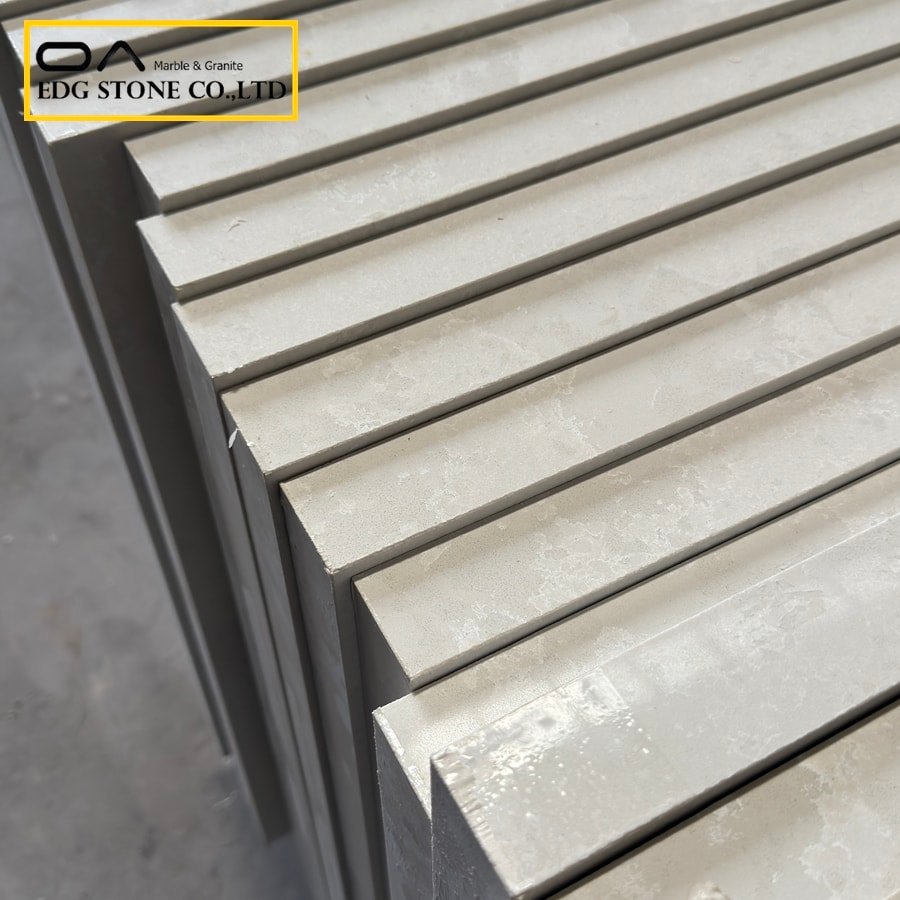
A “3 cm thickness guarantee” is not a marketing slogan — it’s a measurable systems problem. Meeting North American cabinet installation standards (base cabinet + countertop → typical finished counter height ≈ 36 inches) requires specifying a nominal thickness and defensible tolerances, measuring and controlling slab thickness throughout fabrication, and agreeing on who is responsible for field adjustments (shimming, leveling). Real guarantees combine manufacturer specs, AWI/NAAWS or industry tolerances, calibrated machinery, quality fixtures, and installation protocols so the delivered countertop consistently meets the intended finished height and functional fit.
Why thickness accuracy matters for North American installs?
Cabinet/Counter height interface: Standard base cabinet body height is typically 34.5″; adding a nominal countertop thickness (commonly 1.5″, ≈ 38 mm for 3 cm nominal) produces the industry target of 36″ finished work surface. A thickness error translates directly to finished height variance, affecting appliance alignment, ergonomics, faucet/backsplash fit, and ADA/ergonomic expectations.
Seams & lippage: Thickness mismatch between adjacent slabs produces visible lippage at seams; industry practice expects very small joint lippage (often ≤0.8–1.5 mm depending on spec).
Support & overhang design: Overhang limit and support spacing are a function of thickness — for example, recommended cantilevers and support spans differ for 20 mm vs 30 mm stone. Accurate thickness informs structural supports.

What does the industry commonly tolerate?
You must define a tolerance numerically in the contract. Common reference points from suppliers and trade guidance include:
±3 mm (≈1/8″) between the thickest and thinnest slabs on a project is widely quoted as an acceptable slab-to-slab variation for natural and engineered stone.
Manufacturer/fabricator tolerance examples: Some quartz fabricators publish tighter finished thickness tolerances (for instance, a fabrication spec of -1/16″ / +1/64″ for final thickness checks). These tighter asymmetric tolerances appear on product fabrication guides and should be adopted where precision is critical.
Flatness and lippage: AWI/NAAWS and other workmanship standards provide flatness and lippage guidance (flatness per span and allowable joint widths) that should be combined with thickness tolerance requirements at the contract stage.
Practical guidance: For a 30 mm nominal slab, specify something like 30 mm ± 3 mm as minimum; for a premium project, demand ±1 mm–±1.5 mm and confirm via factory QA measurements.
Where thickness variation come from?
Understanding root causes lets you eliminate them:
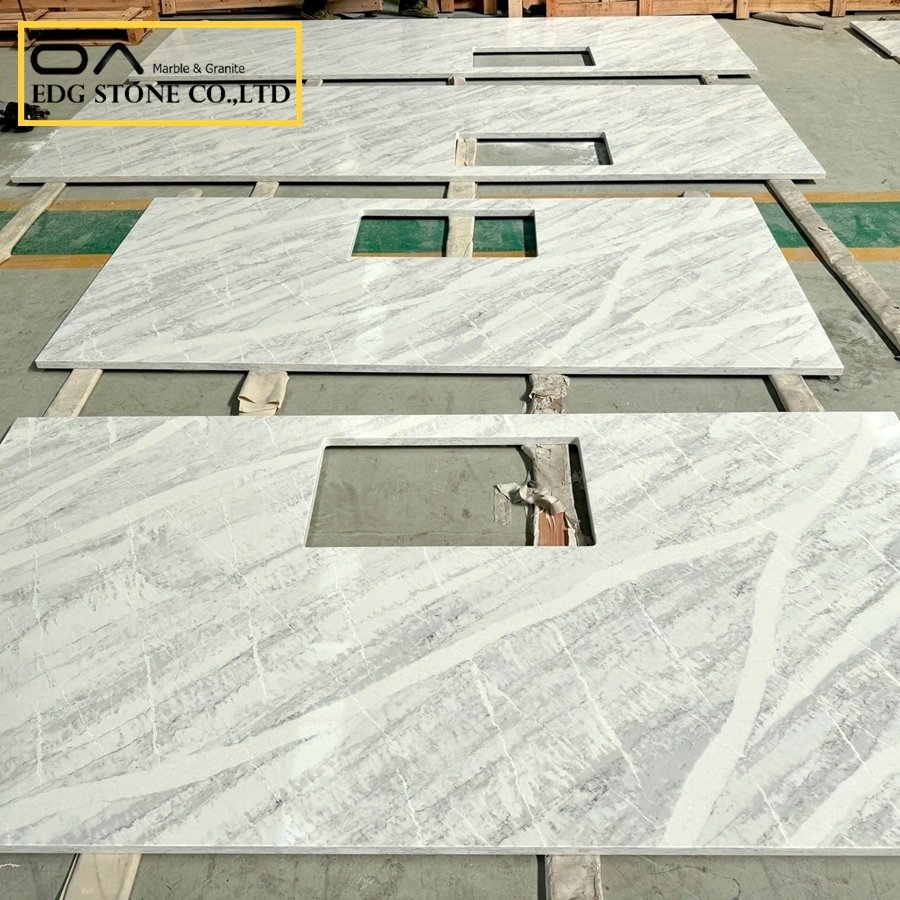
Slab production variation — gangsaw/cutter processes and finishing tolerances create intrinsic variability in as-cut thickness. Many factories sort slabs by nominal thickness bands.
Polish and finish losses — polishing steps remove microns; if CNC and polishing parameters are not compensated for, final thickness shifts.
Edge profiling and chamfering — edge shaping removes material and, if not controlled, can make exposed edges appear thinner than the measured center.
Multi-slab matching/vein matching decisions — matching adjacent slabs may require one slab to be planed or ground to match another, affecting thickness.
Handling/transport damage — chips, broken corners, or micro-fractures can force rework or replacement.
Field shimming & cabinet irregularities — even a perfect slab will sit unevenly on out-of-level or deformed cabinets; field shimming and pre-installation cabinet remediation are common fixes.

A factory-level QA workflow to guarantee 3cm ± X mm
Below is a practical, reproducible QA workflow manufacturers and fabricators can adopt. Each step should be documented and signed off on.
1) Spec & contract stage
Declare nominal thickness and tolerance (e.g., 30.0 mm ± 3.0 mm or premium 30.0 mm ± 1.0 mm).
Reference installation standard (NKBA for cabinetry clearances; AWI or NAAWS for fabrication/install tolerances) in contract.
2) Incoming slab inspection
Measure each incoming slab at multiple grid points (corners + center + midpoints) with calibrated digital calipers or thickness gauges; log results in an incoming QA sheet.
Reject or reassign slabs outside project tolerance bands; tag slab cut lists accordingly. Record slab IDs and thickness maps.
3) CNC / nesting compensation planning
Program the CNC to compensate for expected polish loss and edge profiling (use the measured slab thickness map rather than the nominal value).
Nest patterns to minimize seams and to keep matched pairs from slabs with similar thickness.
4) In-process measurement & control
Use step gauges or fixed thickness fixtures to confirm post-CNC / pre-polish thickness at defined checkpoints.
Retain “as-cut” thickness records attached to each job sheet.
5) Final finish measurement
After polishing/profiling, measure and record the final thickness at the same grid points. Use a calibrated micrometer or digital thickness gauge (resolution ≤0.1 mm if seeking tight tolerances).
6) Factory sign-off & transport protection
Only release slabs with signed QA that meet project tolerances.
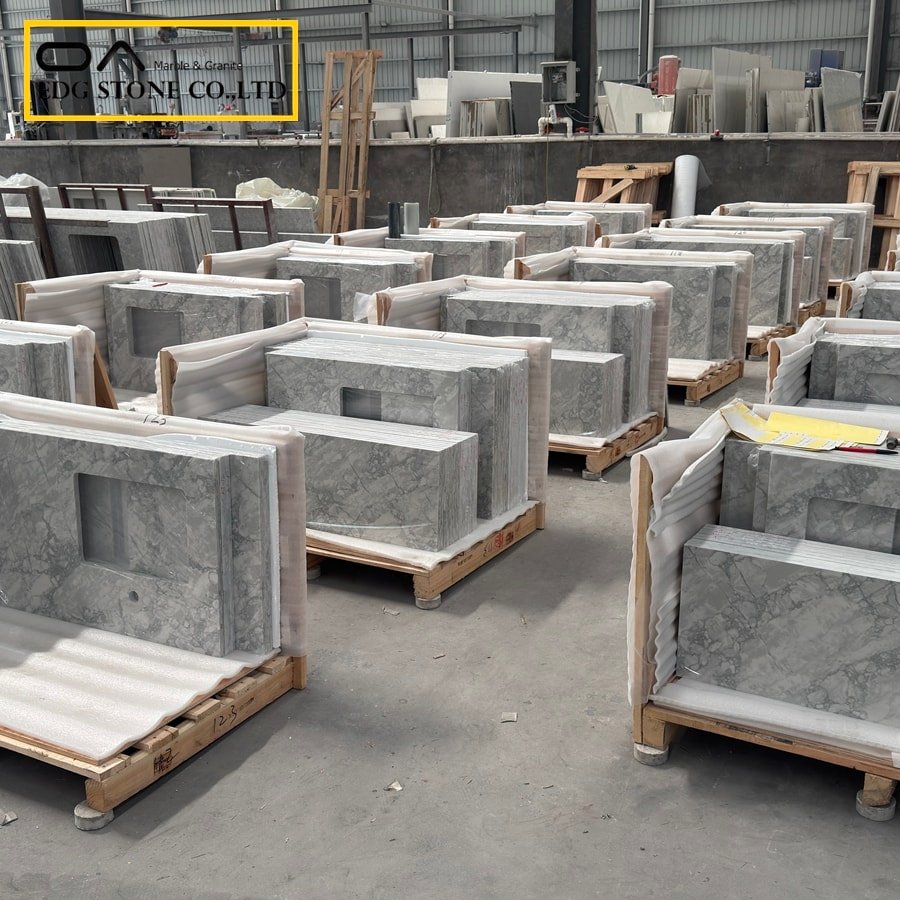
Use protective packaging and transport brackets to avoid damage.
7) Installer verification & adjustment
On-site, verify cabinet levelness and shim policy before setting countertops. Limit installer shimming to the agreed amount (e.g., ≤6 mm total shim without cabinet remediation; larger corrections require cabinet work). Document pre-install measurements.

Measurement tools, fixtures & calibration best practices
Digital calipers/micrometers — handheld calipers with 0.01 mm or 0.1 mm resolution for spot checks.
Fixed thickness gauge plates / go-no-go blocks — custom fixtures that a final panel must pass through to validate thickness. Use for rapid pass/fail in the shop.
CMM or laser scanning — for premium projects, a laser scanner or CMM can create a thickness map to sub-millimeter precision.
Periodic calibration — instruments should be calibrated against standards, and calibration logs kept with the QA records.
Contract language & buyer protections
To make a “3 cm guarantee” enforceable, include:
Exact nominal value and numeric tolerance (e.g., 30.0 mm ± 3.0 mm).
Acceptance test method: list tools and locations of measurement (e.g., 9-point grid, digital micrometer).
Remedy clause: define acceptable remedies for out-of-tolerance (strip replacement, cost credit, or rework).
Pre-installation cabinet inspection: require contractor-level cabinet flatness check and define maximum allowable cabinet deviation before countertop setting; if exceeded, require cabinet remediation first.
Practical tolerances to specify
Standard residential: 30 mm ± 3 mm (industry common).
High-precision/premium: 30 mm ± 1.0–1.5 mm with documented factory measurement records and stamped QA.
Seam & lippage: specify maximum seam lippage ≤0.8 mm for high-end kitchens (or follow project spec).
Installation realities and acceptable field practices
Shimming limits: Many installers will shim up to 1/4″ (≈6 mm) for cabinet irregularities, but larger corrections should be performed by cabinet trades. Agree in writing.
Final height verification: measure the final finished height at multiple points (work surface edge + center) and record; this protects the owner, fabricator, and installer.
When to replace vs rework: if thickness deviation affects appliance fit, backsplash alignment, or causes visible seam lippage beyond spec, replacement (not rework) may be required.
Data & regulation context that drives better QA
Workmanship standards (AWI/NAAWS/AWI1236) provide accepted tolerances and performance metrics for countertops and casework—use them as contractual references.
Industry design docs and stone trade guides document common tolerances (±3 mm is widely referenced). Adopting these published tolerances avoids disputes.
Five Google-hot FAQs
Q1: What is the standard tolerance for a 3 cm (30 mm) countertop?
A1: Industry practice commonly accepts ±3 mm for slab thickness variation across a project; premium fabrication shops may produce final countertops to ±1–1.5 mm when specified and documented.
Q2: Will a 3 cm countertop always give a finished 36″ counter height with standard North American cabinets?
A2: Not automatically. Standard base cabinet height is normally 34.5″; with a nominal 1.5″ countertop, this yields 36″. Variations in slab thickness, cabinet build tolerances, and installer shimming can alter the final height; control requires defined thickness tolerances and a pre-install cabinet level check.
Q3: How do fabricators measure and guarantee thickness?
A3: Fabricators use multi-point measurement (digital calipers, micrometers), CNC compensation for polish loss, final thickness fixtures, and signed QA logs. Contract language should require these steps for any thickness guarantee.
Q4: What tolerance should I demand if I’m a manufacturer supplying countertops to installers?
A4: At minimum specify ±3 mm for general supply; for high-end residential projects, require ±1–1.5 mm with factory measurement records and sample checks.
Q5: Who fixes height problems on install day if the countertop thickness is off?
A5: The contract should define responsibility. Typical practice: installer performs agreed shim allowance (e.g., up to 6 mm); beyond that, either the cabinet contractor corrects cabinets or the fabricator replaces/reworks slabs per the remedy clause. Pre-install verification reduces surprises.
Semantic closure: How to think about a 3cm thickness guarantee?
How: Guaranteeing 3 cm means you define the number (30.0 mm) and the allowed swing (e.g., ±3 mm or ±1 mm). Then instrument your supply chain: incoming slab mapping → CNC compensation → polish loss accounting → final fixture validation → signed release → protected transport → on-site pre-set verification.
Why: It aligns the factory deliverable to North American cabinet targets (34.5″ cabinet + countertop → 36″ work height), reduces field dispute costs, improves appliance fit & aesthetics, and protects brand reputation for premium builds.
What: Define numeric tolerance, acceptance measurement method, and remedy. Use AWI/NAAWS/NKBA as referenced standards for cabinetry and countertops.
Options (detailed):
• Standard supply contract: 30 mm ± 3 mm, factory QA sheet provided.
• Premium contract: 30 mm ± 1–1.5 mm, measured at 9 points, laser scan available, signed calibration certificates.
• Manufacturer warranty add-on: Replacement guarantee if the final installed height differs by more than X mm due to out-of-tolerance slab thickness (exclusions apply for cabinet errors).
Considerations (detailed): Cabinet levelness, allowable shim policy, seam lippage tolerance, support/overhang rules (based on thickness), CNC & polishing calibration, and transport protection. Each step must be codified into the purchase order and installation scope to make a guarantee practical and enforceable.